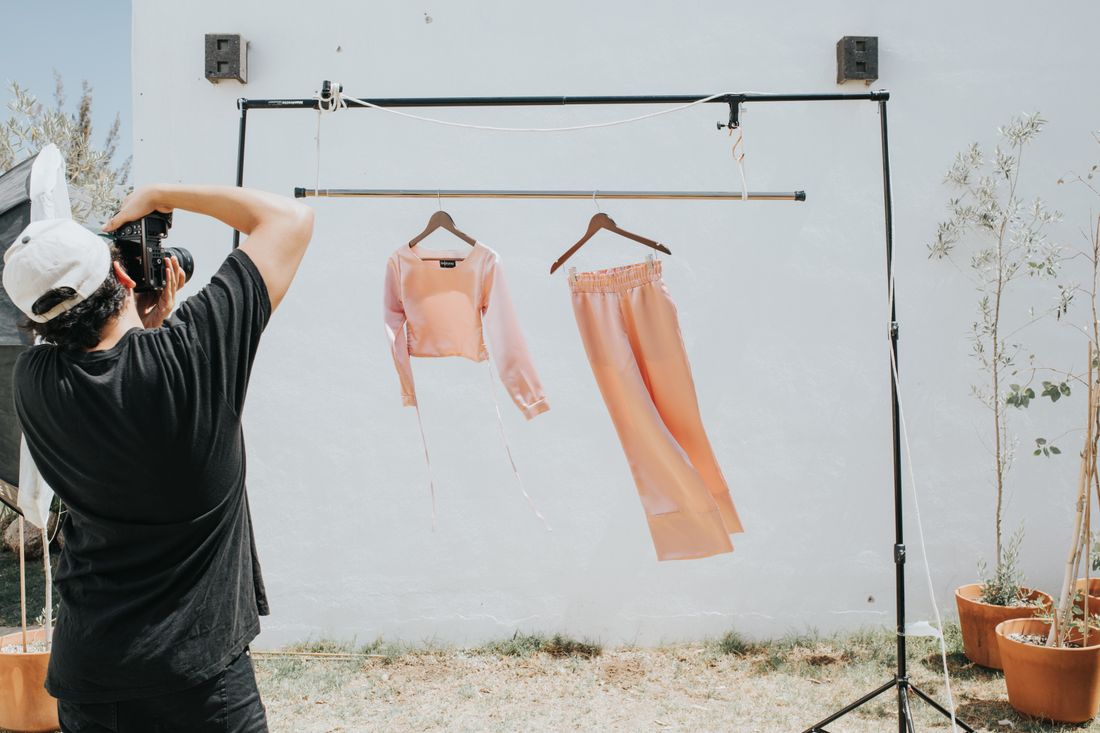
An indoor styling kit is built around a room that does most of the work: a mirror, an outlet, a rod to hang things on, four walls holding the temperature steady. None of that exists once a shoot moves outside. Wind knocks over an unweighted rack, the temperature can swing across a single morning, and the ground itself decides what footwear actually works. What changes for an outdoor art shoot isn't the stylist's job. It's almost everything they have to carry to do it, and how the day gets scheduled around a sky that won't hold still.
Outdoor art shoots add what a controlled room used to provide for free: weights to keep a rack upright in wind, layers for temperature swings across the day, terrain-appropriate footwear, a portable changing plan, and contingencies for sun and sweat. The schedule also shifts to protect the best available light instead of starting at a fixed, convenient time.
What Actually Changes When a Shoot Moves Outdoors?
An indoor kit assumes a room with a mirror, a power outlet, a garment rod, and a floor flat enough to lay out a rack. Outdoors, none of that exists on its own. A stylist has to bring or improvise every one of those things, which is why an outdoor kit is built around self-sufficiency instead of convenience.
Indoors, the room does half the job. A doorframe holds a hanging rod, an outlet runs the steamer, and a full-length mirror lets a subject check a look before stepping in front of the camera. None of that infrastructure travels with a location scout to a park, a rooftop, or a stretch of coastline. The stylist becomes the room: a folding rack stands in for the rod, a battery steamer stands in for the outlet, and a handheld mirror stands in for the wall.
The bigger shift is philosophical. An indoor kit optimizes for convenience inside a controlled space, the same rack and steamer that work because the room isn't fighting back. An outdoor kit survives variables the room used to absorb: wind that knocks over an unweighted rack, ground that won't hold a tripod-style stand, and light that keeps moving instead of staying fixed.
In practice, this means packing less delicate equipment and more contingency gear. A steamer needing a wall outlet gets replaced by a battery model, and a wheeled rack gets replaced by something that folds flat and survives being carried across grass or sand. None of it is exotic. It's the same job, adapted to a room that doesn't exist.
What Do Stylists Add to Manage Wind Outdoors?
Wind is the variable an indoor kit never has to plan for, so an outdoor bag adds sandbags or water-fillable weights for the rack, binder clips and safety pins for fabric that won't sit still, and a plan for hair and loose layers that a gust can undo mid-shot.
A garment rack that stands fine on a studio floor becomes a hazard the moment a real gust hits it outdoors. A loaded rack can tip, damaging both the rack and whatever is hanging on it. Weighted bases, sandbags looped over the rack's feet, or simply parking it against a solid surface like a car or a low wall all solve the same problem: keeping it upright without a second person babysitting it.
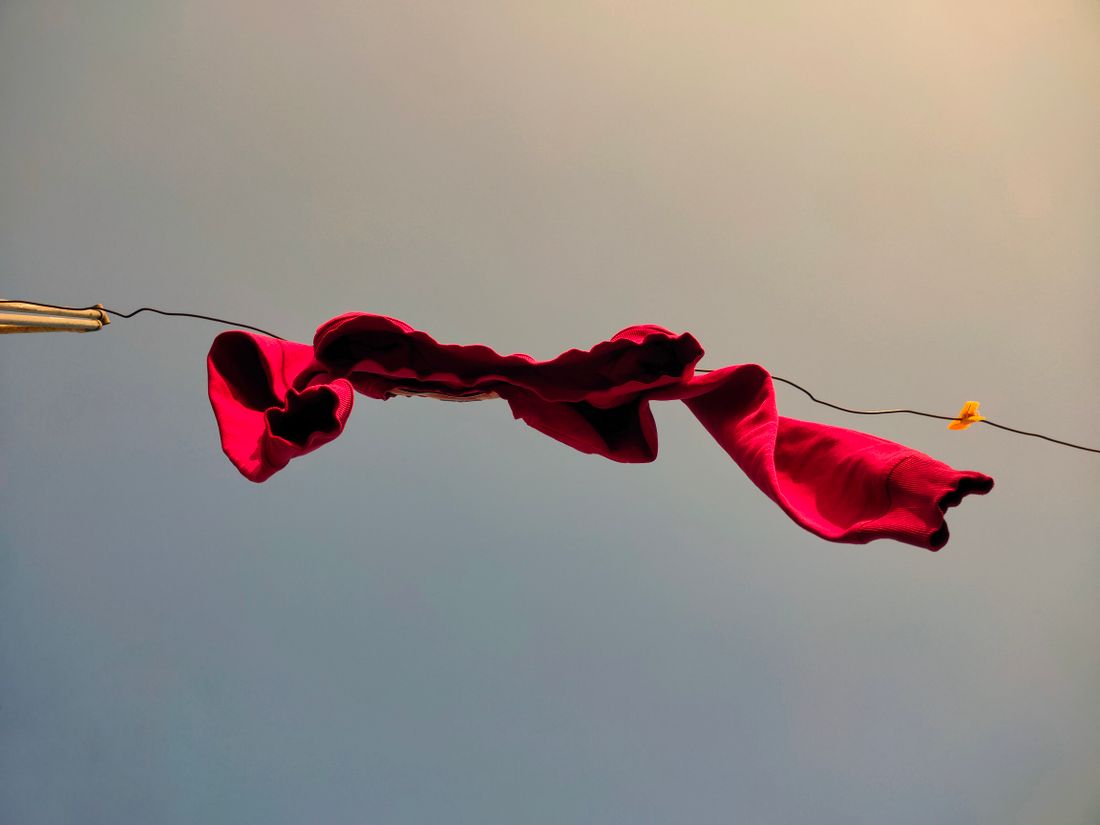
Wind also acts directly on the garments themselves. A loose blouse or an open jacket that reads fine in still air starts to billow the moment there's a breeze, which is why an outdoor kit carries more binder clips, safety pins, and small clamps than an indoor kit usually needs. These pin a hem in place between takes, secure a scarf so it doesn't fly into frame, or clip a jacket closed from behind, out of camera view.
The other wind problem is hair and accessories, which fall more on continuity than wardrobe but still land in the stylist's lap outdoors. A small bottle of anti-frizz or hold product, hairpins, and a plan for which direction the subject faces relative to the wind all become part of the kit, not because the styling changed, but because the environment now has an opinion.
How Do You Dress for Temperature Swings During an Outdoor Shoot?
Outdoor shoots run longer than the weather stays consistent, so the kit needs layers the subject can add or remove between setups without changing the look on camera: a base layer for warmth, an outer layer that comes off easily, and backup garments for a shoot that runs past the temperature it started in.
An indoor shoot happens in a room set to one temperature for the whole session. An outdoor shoot can start in cool morning air and finish in full sun, or start warm and lose ten degrees the moment the sun drops behind a building. The subject can't visibly shiver or sweat through a look, so the stylist plans hidden layers: a thin thermal base under the visible outfit, a coat or blanket worn between takes and shed right before the camera rolls.
This is also where duplicate garments earn their place in the bag. A second version of a key piece, the same shirt in a slightly heavier or lighter fabric, lets the stylist swap in a warmer or cooler option without changing how the shot reads, if the schedule runs long enough that the original temperature assumption stops holding.
The practical habit is checking the actual hour-by-hour forecast the night before, not just the day's general high and low, and packing for the coldest and warmest points the schedule will touch, not the average. A shoot booked from early morning through late morning outdoors in early fall can move through a real temperature swing before it wraps, and the kit needs to cover both ends of it.
What Footwear Works on Real Outdoor Terrain?
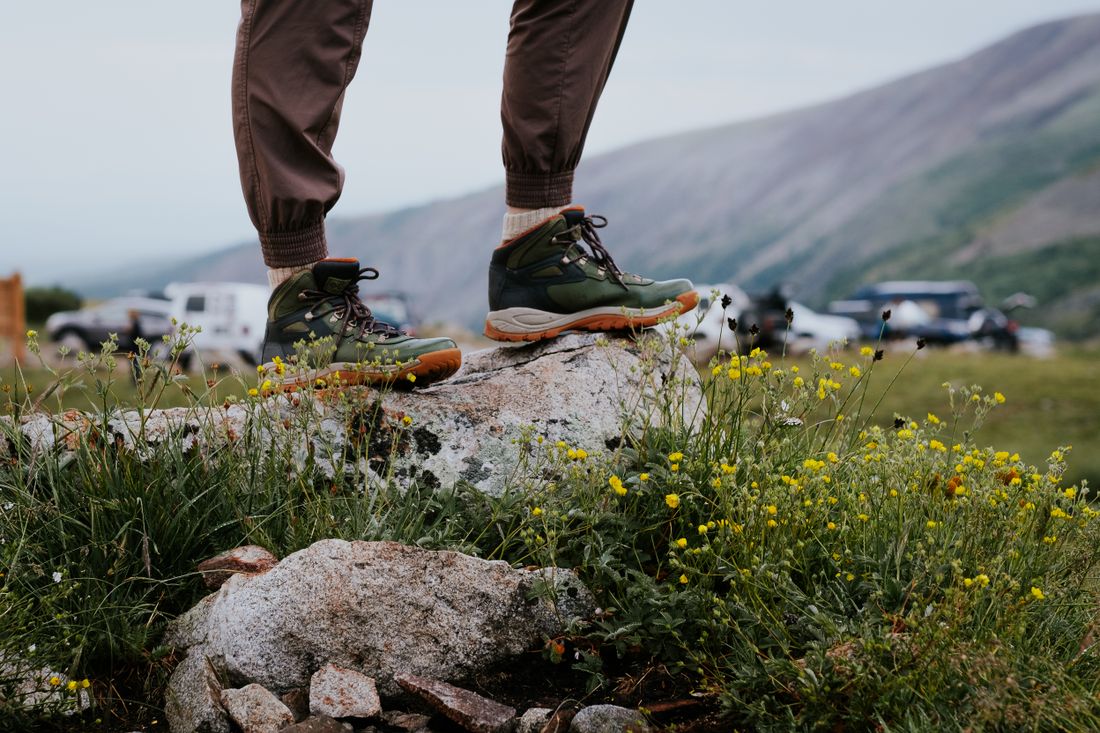
Indoor footwear only has to look right. Outdoor footwear also has to survive grass, gravel, sand, or uneven pavement without twisting an ankle or slowing the shoot down, so the kit carries a walking pair for moving between setups and the camera-ready pair for the actual frame.
A heel that's perfectly stable on a studio floor becomes a liability on grass, cobblestone, or a dirt path. It sinks, catches, or simply can't be walked in safely between locations. The practical fix isn't avoiding heels entirely; it's carrying a separate pair of flat, sturdy shoes for the subject to walk in between setups, then swapping into the camera-ready pair only once they're standing in the exact spot for the shot.
Terrain also changes how much footwear actually shows in frame, which changes what the stylist needs to plan for. A full-body shot on a beach or in a park puts shoes on camera the whole time, while a tighter shot on uneven ground might only need the shoes to survive being walked in, not photographed. Knowing the shot list in advance tells the stylist whether to prioritize how the shoes look or how they hold up.
The other terrain problem is protecting the shoes themselves. A pair that needs to look clean on camera picks up mud, dust, or wet grass fast outdoors, so wipes, a small brush, or simply carrying the camera-ready pair separately until the last possible moment keeps them presentable through a session that involves real ground instead of a swept studio floor.
How Do You Plan Changes Without a Room to Change In?
Without a dressing room, a stylist needs a portable option worked out before call time: a pop-up changing tent, a parked car with the windows up, a nearby restroom, or a large wrap held up by trusted crew as a temporary screen, decided in advance rather than improvised on the day.
Indoors, a bathroom or a spare office solves the changing problem without anyone thinking about it. Outdoors, that privacy has to be built or found. A compact pop-up changing tent is the most reliable option because it travels light and sets up in under a minute, but it isn't always practical for every location. A crowded park or a public beach might make a parked car the more realistic choice, especially for quick changes between setups.
When neither a tent nor a car is available, the fallback is a large wrap or blanket held up by one or two crew members to create a temporary screen, used only with the subject's clear comfort and the group positioned away from foot traffic. This is a last resort, not a default plan, because it depends on cooperation and timing that a tent or car doesn't need.
The decision that matters most happens before the shoot: scouting the location ahead of time for an actual restroom, a covered spot, or a place to park, and confirming which option the day will use rather than discovering there isn't one once the crew is already on site and the light is starting to move.
What Sun and Sweat Problems Come Up Outdoors?
Direct sun brings sweat, sunscreen transfer, and glare that a studio never has to manage, so the outdoor kit adds blotting sheets, a travel-size stain remover for sunscreen marks on fabric, and shade, a reflector, umbrella, or simply a tree, to give the subject relief between takes.
Sweat shows up fastest at the collar, underarms, and hairline, and it reads differently on camera than it does in person. A slight sheen that looks like a normal warm day in the moment can look damp or uneven once it's lit and shot. Blotting papers and a small powder brush handle the skin side of this; breathable fabric choices and avoiding heavy synthetic layers in direct sun handle the garment side.
Sunscreen is its own separate problem, because it transfers onto light-colored fabric on contact and doesn't always show until the garment is already stained. Letting sunscreen fully absorb before dressing, using a barrier layer for direct-contact areas like the neckline, and packing a travel stain remover as a backup are all standard outdoor precautions that simply never come up in a studio.
Shade matters for the subject's comfort as much as the wardrobe's condition, since standing in direct sun between takes accelerates both sweating and fatigue. A reflector angled to block instead of bounce light, a compact umbrella, or positioning the base camp under a tree between setups all buy the subject recovery time that a studio's climate control provides automatically and an outdoor location does not.
Which Fabrics Behave Differently in Daylight and Motion?
Daylight is harsher and more directional than studio lighting, and outdoor shoots involve more walking and movement, so fabrics that read as rich or structured indoors can look washed out, see-through, or shapeless outside, which changes which garments actually earn a spot in the outdoor kit.
Direct sunlight is far more intense than a softbox and shows texture and translucency that studio lighting can hide. A fabric that looks opaque and solid under controlled indoor light can turn slightly see-through in strong sun, especially lighter colors and thinner weaves, something worth checking against actual daylight before a shoot rather than assuming from how the garment reads indoors.
Motion changes the equation again. An outdoor shoot usually involves the subject walking, turning, or reacting to wind, not holding one static pose the way an indoor portrait setup often does. Structured fabrics that hold their shape hold up better through movement, while very loose or slippery fabrics can twist, ride up, or lose their line the moment the subject takes a few steps, problems that barely surface in a controlled studio setup.
The practical response is testing key pieces in actual daylight and in motion before the shoot, not just under indoor lighting on a hanger. A quick walk-and-turn test in natural light reveals whether a fabric holds its shape and opacity the way it needs to, and it's a short check that prevents discovering a problem for the first time once everyone is already on location.
How Does the Schedule Change to Protect Outdoor Light?
Indoors, light waits for the crew because it's built and controlled on set. Outdoors, light is the one variable nobody can adjust, so the schedule bends around it: call times shift toward golden hour or overcast windows, and wardrobe changes get sequenced around when the light is actually usable.
A studio shoot can start whenever the crew is ready, because the lighting setup gets built to match the schedule, not the other way around. Outdoors, the light has its own timeline: early morning and late afternoon give softer, more flattering angles, while midday sun creates harsh shadows that are much harder to work around. Call times for outdoor shoots often get built backward from the best light window instead of a convenient morning start.
This changes how the stylist sequences the day, not just when it begins. The most important or most complex look usually gets scheduled for the best light window, with simpler or more forgiving looks filling the harsher midday stretch. Wardrobe changes that take longer get planned for stretches when the light is flat anyway, so time spent changing doesn't cost the shoot its best light.
Weather adds another layer on top of the daily light cycle. A shoot planned around a clear-sky golden hour can lose that window entirely to cloud cover, which usually means a backup plan rather than reshuffling on the fly. In practice, this means the stylist's schedule is built around the photographer's light plan, not handed a fixed slot and asked to work around whatever the sky is doing.
Frequently asked questions
Does an outdoor kit replace the indoor kit or add to it?
It adds to it rather than replacing it. Steamers, pins, and basic tools still travel to an outdoor shoot, but they get joined by weights for the rack, layers for temperature swings, a changing plan, and terrain-appropriate footwear. Think of the indoor kit as the baseline and the outdoor additions as a second layer built specifically for wind, ground, and light that a studio never has to account for.
What's the item stylists forget most often when packing for an outdoor shoot?
Weights for the garment rack. It's easy to pack every wardrobe and grooming item and still forget that a loaded rack needs something to keep it upright once there's real wind, not the mild draft of a studio. A rack tipping mid-shoot costs more time than almost any other outdoor mistake, and sandbags or a water-fillable weight are small enough to pack without a second thought.
How much extra time should be planned for changing outdoors versus indoors?
Plan for roughly double the indoor change time, since there's no dedicated room and the subject often has to walk to a tent, car, or covered spot before changing even starts. A change that takes five minutes in a studio dressing room can realistically take ten to fifteen outdoors once travel, wind, and re-checking hair and makeup after the walk back are factored into the schedule.
Do lighter or darker fabrics generally hold up better outdoors?
Neither is automatically better. It depends on the specific fabric and the light, not just the color. Lighter fabrics show sunscreen transfer and sweat more visibly and can read as see-through in strong sun, while darker fabrics show dust, grass stains, and heat retention more. The safer approach is testing the actual garment in daylight beforehand rather than assuming a color rule will hold across every fabric.
What happens if the weather changes mid-shoot?
A good outdoor plan includes a backup for lost light or sudden weather, since the schedule was already built around the sky rather than a fixed studio setup. That usually means a covered fallback location, a reordered shot list that prioritizes the most important look first, or simply rescheduling remaining setups rather than forcing a shot under conditions that won't match the rest of the set.
Wardrobe should point back to the work, not away from it.
We plan styling for artist portraits the same way we plan the rest of the shoot, around who you are and what you make, not around looking photographed.
Explore styling services →