Ask an insurer or an appraiser what "insurance-grade" means and you'll usually get a version of the same answer: it depends what you're trying to prove. A claim needs different evidence than a routine appraisal update. A total loss claim needs different evidence than a partial damage claim. But underneath those differences is a consistent expectation, and it has almost nothing to do with megapixels.
This guide walks through what actually makes artwork documentation useful for insurance purposes, why the phrase gets treated like a spec when it isn't one, and where collections most often fall short without anyone noticing until a claim is already in motion.
What "insurance-grade" actually means
When an insurer, adjuster, or appraiser calls documentation "insurance-grade," they mean it's complete enough to stand in for the artwork itself in a conversation about condition and value. Nobody in that conversation has the piece in front of them. They have your photos, your dimensions, and whatever notes came with the file. If those materials answer the obvious questions on their own, the documentation is doing its job.
That's a functional definition, not a technical one. It's the same reason two photographers can produce very different files, both technically well-shot, and only one of them holds up when a claim actually gets filed. The gap isn't skill with a camera. It's whether the shoot was planned around the questions a claim eventually asks.
Why there's no official certification
Collectors sometimes go looking for a governing standard the way they'd look for an ISO certification or a building code, and it's a reasonable thing to expect. It just doesn't exist for this. Insurers, museums, and appraisal organizations each have their own internal expectations, and those expectations overlap heavily but aren't unified into one published spec anyone can point to.
What fills that gap in practice is professional convention. Appraisers who've handled claims tend to want the same things: full views, accurate color, condition detail, real dimensions, and a date. Photographers who work with galleries and collections regularly enough pick up those expectations from experience, not from a manual. That's also why the phrase gets thrown around loosely. It sounds like a spec, so people assume someone can just check a box for it. There's no box. There's a standard of usefulness, and it's worth aiming for even without a certificate to show for it.
What makes documentation hold up as evidence
Strip away the vocabulary and the actual test is simple: could someone unfamiliar with the piece look at your documentation and know exactly what it looked like on this date, in this condition? Everything insurers and appraisers ask for traces back to that one question.
Full, uncropped views of the entire piece come first, because a partial view can't confirm the whole object is intact. Consistent, color-accurate lighting matters because a claim often involves comparing a "before" photo to an "after" photo, and if the lighting shifted between shoots, that comparison becomes a guess dressed up as evidence. Accurate physical dimensions matter because size is part of value and part of identity. Two similar canvases from the same series can only be told apart with certainty if the numbers are right. And consistent file naming tied to the artwork's inventory or appraisal record matters because documentation that can't be matched to the right piece isn't documentation, it's a folder of nice photos.
Resolution still matters, just less than people assume. A file only needs enough pixels to show what it needs to show (the whole piece cleanly, the damaged corner clearly). Past that point, more resolution doesn't make the case stronger.
Why a color reference card matters
A color or gray reference card in at least one capture is one of the smallest additions to a shoot and one of the most useful later. It gives anyone reviewing the file a fixed point to check color and exposure against, instead of trusting that the monitor they're viewing it on is calibrated the same way yours was.
This becomes concrete the first time a piece needs a before-and-after comparison (after a restoration, after transit, after a claim). Without a shared reference, two photos taken months apart under different lighting are almost impossible to compare with confidence. A slight color shift could be genuine fading. It could also just be a different bulb in the room. The card removes that ambiguity, and it costs about ten seconds per shoot.
Why you photograph the damage, not just the good angle
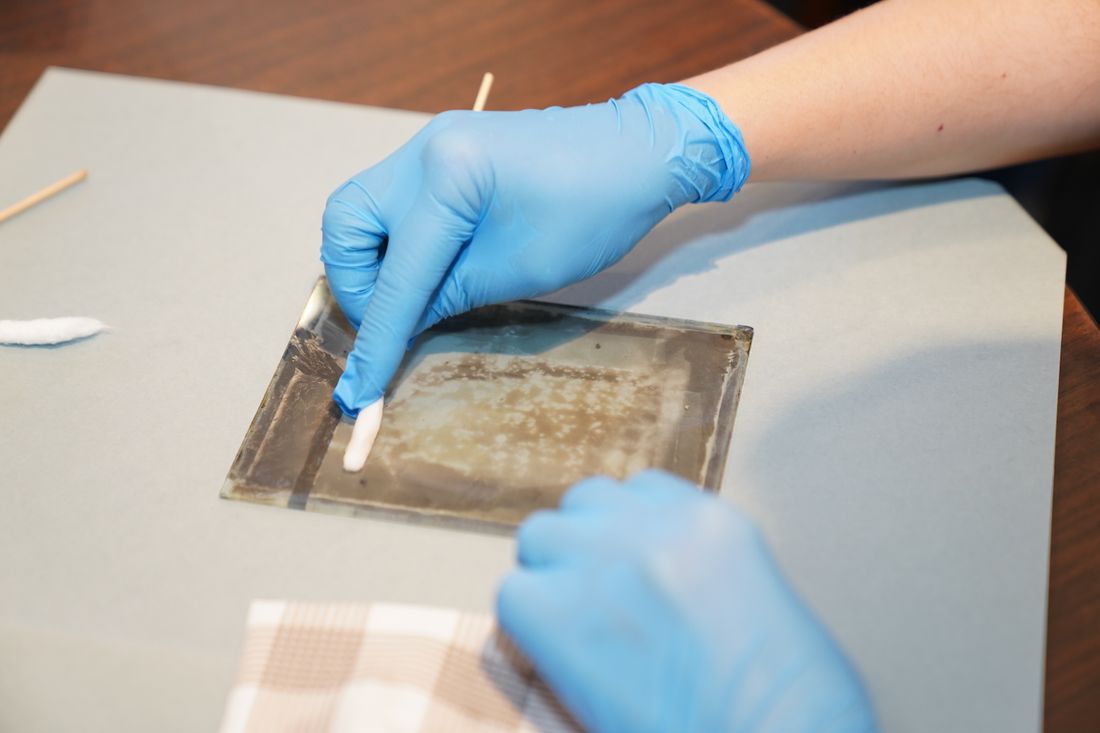
This is the section collectors are most likely to skip, and it's the one that matters most for a claim. Insurers and appraisers care about condition-focused detail shots of any existing damage, repairs, or wear, because those photos become the baseline that future damage gets measured against. If a corner is already dinged before a piece ships to a fair, a photo proving that predates the trip is what keeps a new claim honest and a false one from getting filed by accident.
Skipping this doesn't make the piece look better on file. It just removes the evidence that would otherwise separate old wear from new damage. Frame condition, edge wear, and the verso (the back of the piece) deserve their own shots for the same reason. A crack that starts at the stretcher bar or a repair on the back of a canvas won't show up in a front-facing hero shot, and it's exactly the kind of detail an adjuster asks about.
A scale reference in at least one detail shot helps too. A close-up of a small chip in the paint tells a very different story depending on whether that chip is the size of a grain of rice or a coin, and a ruler or coin in frame settles the question instantly instead of leaving it to a caption.
Recording dimensions and file names that match the record
Photographs answer what a piece looks like. They don't answer how big it is, and pixel dimensions in a file are not the same as the physical size of the artwork. That's a separate number that has to be measured and recorded alongside the images, not guessed from the crop. Height, width, and depth for anything three-dimensional or framed all belong in the record, ideally noted the same day as the shoot while the piece is still in front of you.
File naming sounds like the least interesting part of this whole process, and it's also where good documentation quietly falls apart. A brilliant set of photos is only as useful as the system that connects each one to the right appraisal record. A consistent naming convention tied to the artwork's title, inventory number, or accession number means nobody has to reconstruct which photo belongs to which piece months later, under worse circumstances than a routine filing session.
For what that standard costs against what it protects, there’s a calculator here — including the point below roughly $5,000 a piece where the insurance argument stops applying and we say so. If insurance is only one of the reasons you're documenting a collection, our guide to what art documentation services cost breaks pricing down across other use cases too.
Why the capture needs a date
A dated capture is what turns a good photo into evidence. Condition isn't a fixed fact about a piece. It's a fact about a piece at a point in time, and insurance conversations are almost always about what changed between two points in time. A photo with no reliable date attached can still be useful, but it can't do the one thing insurance documentation is built to do, which is prove a "before."
Most cameras embed capture dates automatically in file metadata, which is a reasonable starting point, but metadata can be stripped or altered when files get exported, converted, or run through certain platforms. Keeping the original files with intact metadata, alongside a simple written log of when each documentation session happened, is worth the small bit of extra organization.
The mistakes that undercut a claim
A few patterns show up again and again in collections that later struggle to support a claim. Only photographing the flattering angle is the most common one (understandable, since nobody enjoys photographing a piece's flaws), but it leaves the record incomplete right where completeness matters most. Skipping frame, edge, and verso shots is a close second, usually because those views feel like formalities rather than documentation.
No scale reference in detail shots is a smaller miss with outsized consequences, since it turns a precise photo into a guessing game about actual size. Inconsistent lighting across a collection is a bigger structural problem. It might look fine shoot to shoot, but it makes reliable before-and-after comparison across the whole set nearly impossible. And losing track of which photo goes with which appraisal record undermines everything else, because even a perfect photo is useless evidence if nobody can say with certainty which piece it documents.
None of these are failures of effort. They're usually just gaps that never got asked about, because "high resolution" was the only spec anyone requested going in.
When a collection needs to be re-shot
Documentation isn't a once-and-done task from acquisition. Collections should be re-shot after any move, loan, restoration, or significant time gap, because each of those events is a real opportunity for condition to change, and the value of a "before" photo depends entirely on it predating whatever happens next.
A piece that travels to a fair and back has been handled, crated, and transported, worth a condition check against the last documentation, even if nothing looks obviously different. A piece that comes back from restoration needs new photos almost by definition, since the whole point of the restoration was to change its condition. And a collection that hasn't been touched in years just needs a refresh on general principle, the same way any record gets less useful the further it drifts from the present.
One production detail worth knowing: reshoots go faster once a naming and lighting system already exists from the first session. The second and third documentation passes on the same collection take a fraction of the planning time the first one did, because the reference points (camera position, light setup, file structure) are already worked out. That's a good argument for getting the system right the first time, even if the first shoot only covers part of the collection.
Frequently asked questions
Is "insurance-grade" an official certification?
No. There's no licensing body or technical standard that certifies a photograph as insurance-grade. It's informal shorthand insurers, appraisers, and collectors use for documentation thorough enough to support a claim or appraisal on its own, without someone having to explain what the photos don't show.
What do insurers actually want to see in artwork documentation?
Full uncropped views of the entire piece, consistent color-accurate lighting with a reference card in at least one frame, condition detail shots of any existing damage or wear, accurate physical dimensions, consistent file naming tied to the inventory or appraisal record, and a dated capture. Resolution matters far less than whether the documentation would hold up as evidence.
Do I need a professional to take insurance documentation photos?
You can shoot a reasonable baseline yourself with consistent lighting and a reference card, and that's better than nothing. But consistency across a whole collection, accurate color, and condition shots that hold up under scrutiny are easier to get right with someone who documents artwork regularly and knows what an adjuster or appraiser is going to look for.
How often should insurance documentation be updated?
Re-shoot after any move, loan, restoration, or significant time gap, not just once at acquisition. A piece's condition isn't fixed. Every move or loan is a chance for something to change, and the value of a dated capture is that it proves what the piece looked like before that happened.
What if my collection was only ever photographed once, years ago?
That single set of photos is still useful as a starting baseline, but it's aging out of usefulness the longer it sits without an update. Prioritize re-documenting anything that's moved, been loaned, or been restored since that shoot, then work through the rest of the collection as time allows.
Give your collection a record that holds up.
We document artwork the way an adjuster or appraiser would actually want to see it: full views, accurate color, condition detail, and a system that keeps every file tied to the right record.
Explore artwork documentation →