
Most galleries and artists booking fair coverage default to the same brief they'd use for an opening: get some crowd shots, get some work shots, done. A fair booth needs a slightly different list, because the booth only exists for a handful of days and it's doing double duty. It has to work as a sales environment in the room, and it has to work as proof of participation everywhere else, on the gallery's site, in a recap post, in next year's application to the same fair.
The other difference is competition for attention. A gallery opening has one show and one crowd. A fair has dozens of booths in a single hall, all photographed under roughly the same light, competing for the same handful of scrolls on Instagram in the days after. A booth's coverage needs to look like itself, not like every other booth's coverage from the same show. This guide covers what to shoot first, what a fair booth needs beyond crowd and artwork shots, why convention-hall lighting is its own problem, and how to time coverage around a fair's actual schedule instead of a generic event timeline.
Clean booth shots, shot before the crowd arrives
A booth looks its best for a short window: the hour or two right after installation, before a single visitor has walked through. Wall labels are still straight, the floor hasn't been scuffed by two days of foot traffic, and there's room to step back and photograph the booth as a whole without a stranger standing in the frame. That window is usually the morning of the VIP preview or the last hour before public doors open, and it closes fast once people start arriving.
What to get in that window, roughly in order:
- A few wide shots of the full booth, showing the wall layout and how the work was hung for this specific fair.
- Clean individual shots of each piece, straight-on and evenly lit, the way the work would get documented in the studio.
- The small stuff that gets forgotten once the day fills up: the price list or checklist, business cards or gallery materials at the desk, the booth's entry signage.
None of this can be recaptured once the fair is running. A gallery opening happens once, but the gallery itself keeps existing, so a missed shot there can sometimes get picked up later on a quiet afternoon. A booth doesn't get that grace period. Once the fair closes, the wall comes down and the space stops existing.
Individual works, framed the way the booth actually hung them
A lot of fair coverage defaults to shooting the art the way it would get shot in a gallery: straight-on, evenly lit, cropped tight to the piece. That's useful, but it misses what makes a fair booth different from a documentation shoot. The booth itself, the wall configuration, how the pieces sit next to each other in that one temporary layout, is information a standalone artwork photo can't carry on its own.
A handful of wider shots that show the booth's actual design, how the gallery chose to hang and pair the work for this fair, do something the individual shots can't. They prove the gallery made curatorial choices for this booth, not just that they showed up with inventory. That distinction matters more than it sounds like it should, especially for a gallery applying to the same fair again next year.
The coverage should also match how the gallery presents itself everywhere else. If a gallery's usual photography leans tight and quiet, the fair coverage should carry that same restraint instead of suddenly going wide and busy just because the booth allows for it. Consistency across a gallery's visual material matters more over time than any single fair's photos do on their own.
Collectors, conversations, and the artist near the work
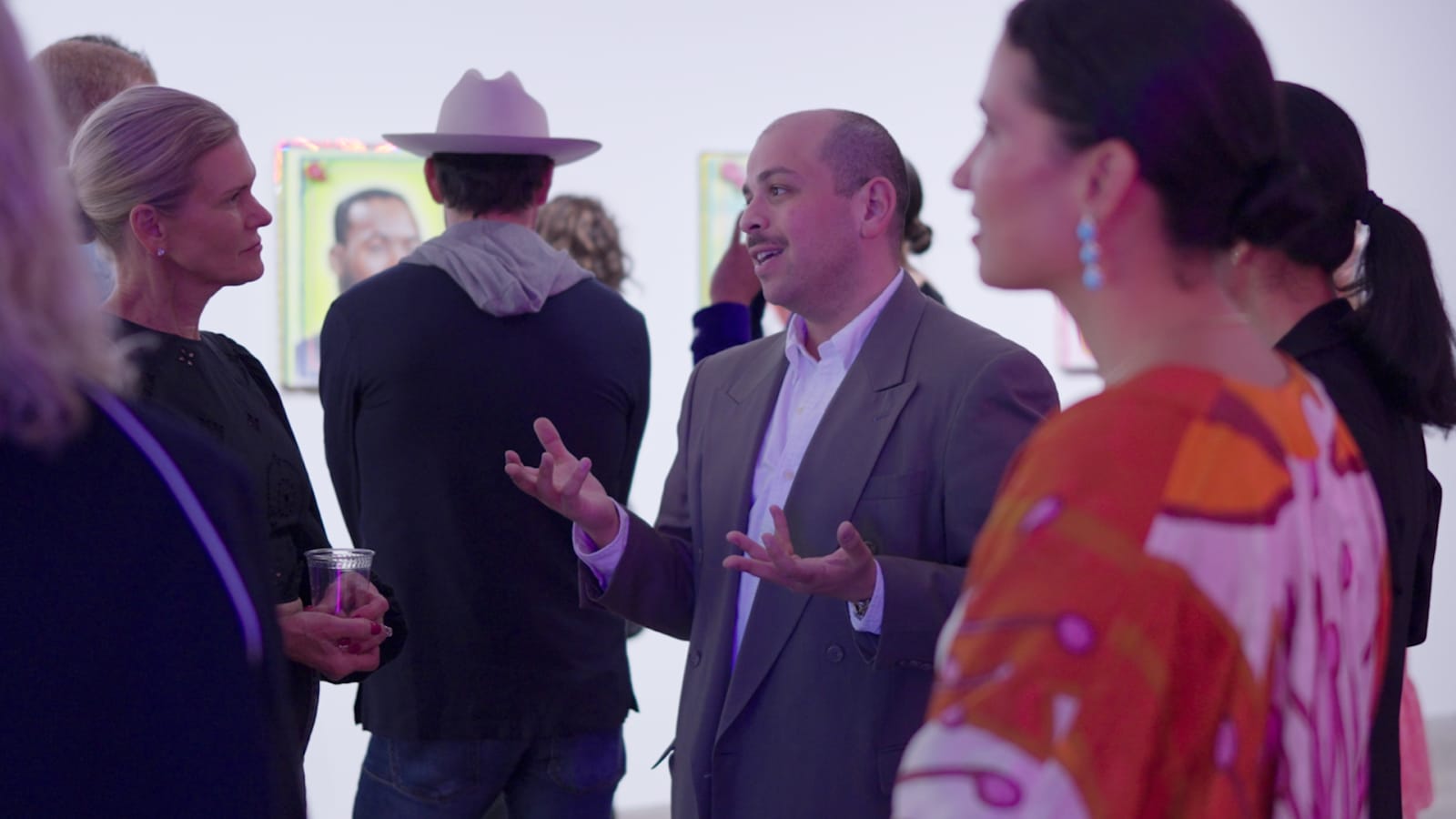
The shots that make fair coverage feel alive instead of catalog-like are usually small: someone leaning in to read a label, a gallerist mid-conversation with a visitor, an artist standing near their own work without posing for it. None of these need to be staged. They need a photographer paying attention during the stretches when nothing scheduled is happening.
It's worth naming who actually needs to appear before the fair starts. If the gallery director is the one making the sale, they're probably the person worth capturing in conversation. A shot of the artist near the work, engaged in it rather than posed for it, usually outperforms a formal portrait taken in a quiet corner. A short conversation with the gallery beforehand about who matters in the room saves a lot of guessing on the day.
Collectors and casual visitors deserve a light touch. A photographer working a booth is still a guest in a commercial space where people are making real decisions about real purchases. A camera pointed too directly at a private conversation about price can make a booth feel less comfortable to browse. Working from a slight distance with a longer lens usually gets a more natural result anyway.
Convention-hall light needs a fix, not a workaround
Convention centers and fair halls are usually lit for even coverage across a huge floor, not for any single booth. That overhead light is flat, sometimes an odd color temperature, and it doesn't flatter artwork the way a gallery's own lighting does. A booth's installed lighting, whatever the gallery brought in, is almost always the better light source to work with, but it usually needs backup.
A small amount of supplemental lighting, enough to correct color and add separation between the work and the wall, matters more at a fair than at almost any other event type. Confirm before the fair whether the booth has its own lighting plan or is relying entirely on the hall's overhead fixtures. That answer changes what a photographer needs to bring on the day.
Neighboring booths complicate things further. A fair booth often shares light, and sometimes color, with whatever's installed a few feet away: string lights, colored gels, a competing display bleeding into the frame. Scouting the booth's actual light at a few points in the day, not just once at setup, catches problems that only show up once the hall fills in.
Coverage timed to the fair's real schedule, with same-day files
A fair's real schedule usually has three distinct phases: a VIP preview with a smaller, quieter crowd, the main public days with heavier foot traffic, and a final day that's often calm again as people finish looking rather than start looking. Each phase produces a different kind of usable photo, and treating the whole fair as one continuous event wastes the preview's advantage.
The VIP preview is usually the best window for the clean booth shots and any portrait-style coverage of the artist or gallerist, since the room is calmer and there's space to work in. The public days are where the candid crowd and conversation shots live. Planning around these actual phases, instead of one generic call time, gets more usable material out of the same few days.
Ask early whether the gallery wants a handful of images to post while the fair is still running, versus a slower, fully edited set delivered after it closes. Fairs move fast on social media, and a same-day post from the booth floor does real work a polished image arriving two weeks later can't replace. Booth and installation coverage runs off the hourly event rate, $350 an hour with a two-hour minimum, editing included. Faster same-day turnaround beyond that gets quoted flat, case by case.
What the photos still need to do after the booth comes down
The fair ends and the booth comes down within a few hours, but the photos keep working long after that. A recap post needs material that reads as a story, not a folder of similar-looking booth shots. Next year's application to the same fair often wants proof of past participation, which means a wide, well-composed booth shot can matter more a year later than any single artwork photo. Press or press-adjacent use, a mention in a fair roundup, usually wants one strong, uncluttered image rather than a full gallery of options.
Flag to whoever's commissioning the shoot which of these uses matters most this year. A gallery chasing press coverage wants a different final image set than a gallery mainly building a portfolio for next year's application, even though the shoot itself covers mostly the same ground.
Set turnaround expectations before the fair starts, not after it ends. A gallery mid-fair, still working the booth on day three, doesn't have time to chase down a photographer about delivery. A rough timeline agreed in advance, even a same-week estimate, keeps the photos useful while the fair is still fresh in a collector's or journalist's mind.
Got a photo or video project taking shape in NYC?
Tell us what the files need to do, where the day is happening, and what has to go right, and we'll help shape a production plan around it.
Start a project →