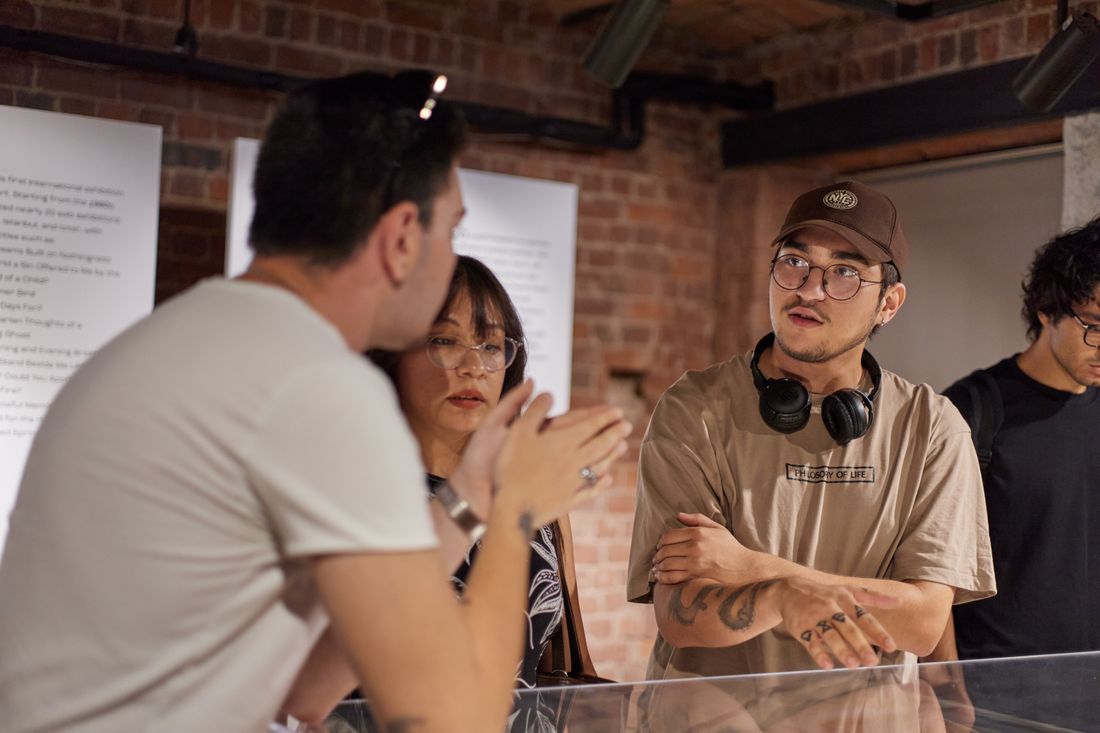
A studio open house for 25 people doesn't look anything like a packed opening night, and the coverage plan for it shouldn't either. It's easy to assume a small event is either too minor to book a photographer for, or that a plan built for a big reception will simply scale itself down. Neither is quite right. A small event still needs real coverage, just a plan built around a room with fewer people, less time, and fewer moments to work with.
A small event, a studio open house, a small artist talk, a show for 20 to 40 people, needs a different coverage plan than a big opening, not a smaller one. That means fewer crowd shots, tighter focus on the handful of people and moments that actually matter, a shorter window to catch them, and a photographer whose presence fits the size of the room instead of overwhelming it.
Does a small event actually need dedicated photography coverage?
Yes, a small event still needs dedicated coverage, but not a scaled-down version of a big opening's plan. A studio open house, a small artist talk, or a show for 20 to 40 people still produces images the artist or gallery will use for months, so the coverage still needs its own plan, just a different one.
The instinct to treat a small event as optional coverage usually comes from comparing it to a packed opening night. A big reception fills a room with movement, a wide guest list, and a program that runs long enough to give a photographer several passes at the same shot. A small event doesn't offer any of that, and it's easy to read the absence of a crowd as an absence of anything worth photographing.
That reading misses what the small event actually needs to prove. An open house or a small talk is often the only documentation of a specific room, a specific group of people, and a specific moment in a gallery's year. The lack of scale doesn't lower the stakes for the images, it changes what the images have to do. A gallery still needs a usable photo for a recap post, and an artist still wants a record of the night the studio opened its doors.
The plan just has to fit the room it's covering. A plan built around a big opening's assumptions, more crowd shots, more time spent waiting for a second wave of guests, comes back thin. A plan built around what the room actually holds comes back full.
What actually changes about the coverage plan for a small event?
The main shift is where the coverage puts its attention. A big opening leans on volume, wide room shots, a spread of candid crowd moments, multiple passes at the same wall of work, because there's enough traffic to justify it. A small event has fewer people to draw from, so the coverage has to lean on getting the handful of real moments right instead of collecting a wide spread of decent ones.
At a packed opening, a photographer can miss a good moment and reasonably expect another one to come along a few minutes later, another cluster of guests in front of the same painting, another wave of arrivals to work with. That safety net doesn't exist at an open house with 25 people in the room. If the artist's one real conversation with a collector happens once, it happens once, and the coverage plan has to be built around catching it the first time.
This changes the shot list more than it changes the equipment or the photographer. Wide room shots that read as "full" at a big opening read as empty at a small one, so the plan shifts toward tighter framing, more attention to individual exchanges, and fewer attempts to manufacture a sense of scale the room was never going to have. A small event photographed like a big one usually ends up with a set that highlights how few people showed up. A small event photographed on its own terms just looks like what it actually was, a good night with the right people in it.
Which moments matter most when only a few things are happening?
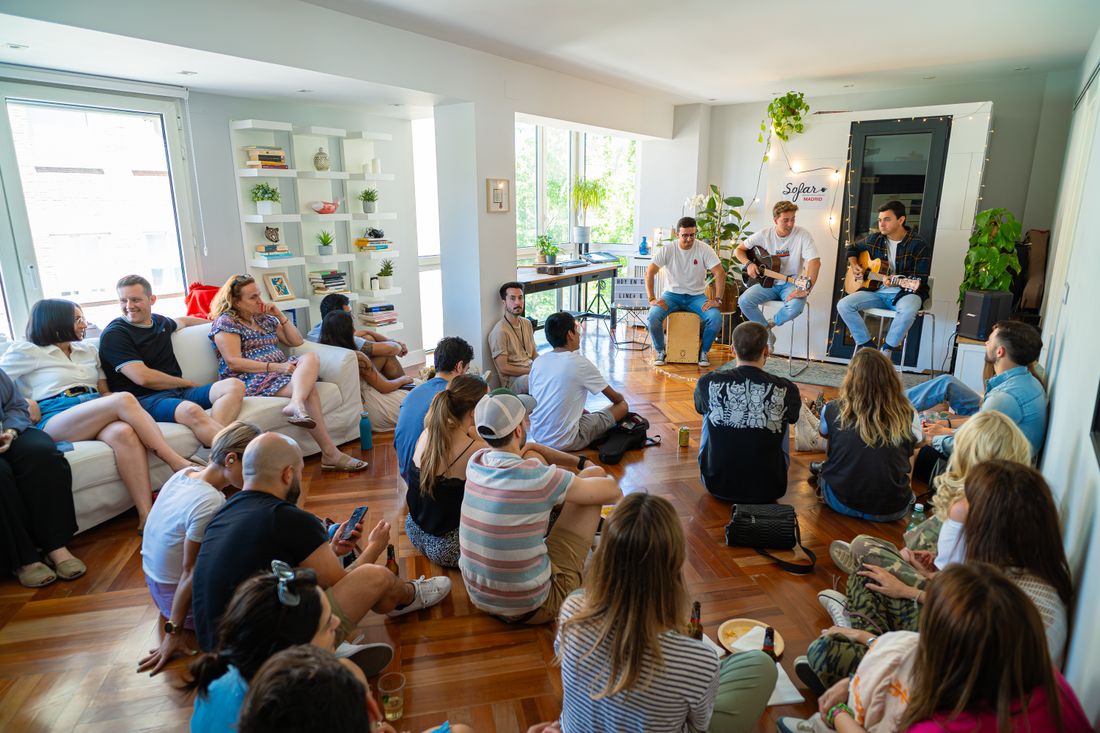
At a small event, the moments worth protecting are usually the artist or host actually talking with someone, the small group gathered around one specific piece, and any short remarks or a walkthrough, because there are only a handful of real exchanges happening and each one carries more weight than it would in a bigger crowd.
A big opening produces dozens of small conversations happening at once, so missing any single one barely registers in the final edit. A studio open house for 25 people might only produce four or five real exchanges worth photographing all night, an artist explaining a piece to a curious visitor, a longtime collector catching up with the host, a small cluster actually reading the wall text instead of walking past it. Each of those is now a meaningful fraction of the whole set, not a fraction of a much larger pool.
This is where a coverage plan built for volume works against the event. A photographer scanning for the next candid crowd shot can walk right past the one exchange in the room that actually mattered, because it's quiet and it's only two people. The better approach treats every real conversation as a priority moment rather than filler between wider shots, and stays close enough to catch it without hovering.
Remarks or a short walkthrough deserve the same weight. With no crowd noise competing for attention, a few sentences from the artist often become the emotional center of the whole set, and the coverage should treat it that way.
Why is timing tighter at a small event than a big opening?
Timing is tighter at a small event because there's no next wave of guests to fall back on. A big opening spreads its best moments across two or three hours and multiple arrival waves, so a missed shot early in the night often repeats later. A small event's best moments are concentrated in a much shorter window, and once they pass, they usually don't come back.
A studio open house or a small artist talk might run for 90 minutes total, with the actual gathering of everyone in the room lasting less than half of that. There's no late surge of arrivals to reset the room's energy, no second chance at a group shot because half the first group already left. Whatever the room looks like in its best twenty minutes is largely what the coverage has to work with.
This changes how a photographer has to move through the night. At a big opening, there's room to hang back, let a moment build, and come in when it peaks. At a small event, that same patience can mean missing the window entirely, because the window might only be a few minutes wide. The coverage plan has to assume less runway and prioritize accordingly from the first few minutes onward, not ease into the night the way a longer event allows.
Knowing this in advance changes how a photographer arrives, ready to work immediately rather than settling in first.
How should a photographer work inside a small room?
A photographer working a small room needs to move quietly, carry minimal gear, and avoid drawing attention to the act of photographing, because a room with 20 to 40 people notices a camera the way a room with 150 people never does. The goal is coverage that doesn't visibly change the tone of the gathering it's documenting.
At a large opening, a photographer with an obvious camera and a bit of visible movement disappears into the general activity of the room. Nobody clocks one more person moving through a crowd. In a small room, that same photographer becomes one of maybe 25 people present, and every visible move, repositioning for an angle, crouching for a shot, stepping between two people mid-conversation, registers to everyone nearby. A camera that feels invisible at a big opening can feel like a spotlight at a small one.
The practical response is working from fewer positions, keeping physical movement calm and predictable, and favoring a smaller camera setup over a bulky rig with an obvious flash. A photographer who plants themselves at the edge of the room and works with quiet, deliberate framing reads very differently than one who's constantly circling the space looking for angles. Guests relax faster around the first kind, and that ease usually shows up in the photos themselves.
The point isn't invisibility, guests should know coverage is happening. The point is a presence that fits the size of the room instead of overwhelming it.
What should you tell a photographer before a small event?
Before a small event, tell the photographer the expected head count, who the two or three people are that absolutely need coverage, and whether there's a specific moment like brief remarks or a walkthrough, because that information shapes the whole plan differently than it would for a large opening where the photographer can rely on volume to catch what matters.
Head count matters first because it tells the photographer how much runway they'll actually have. A photographer expecting 150 people plans for a night of steady, distributed coverage. A photographer told to expect 25 plans for a much narrower window and prioritizes differently from the first minute. Without that number in advance, a small event risks getting treated like a quiet start to a big one, with the photographer waiting for a crowd that was never coming.
Naming the two or three people who matter most, the artist, a specific collector, the gallery director, gives the photographer a concrete target instead of a vague instruction to "get good shots." At a big opening this kind of guidance is useful but not essential, because there's enough happening to fill a set regardless. At a small event, it's often the difference between a set that captures the night's actual purpose and one that captures whoever happened to be standing nearby.
A short note about remarks or a walkthrough lets the photographer position early instead of scrambling once it starts.
How many photos should come back from a small event?
A small event usually produces a smaller, more curated final set than a big opening, often somewhere in the range of 20 to 40 finished images rather than the 80 to 150 a packed reception can generate, because there's simply less raw material to pull from and more attention paid to selecting for quality over range.
This isn't a shortfall, it's the natural output of a smaller room. A big opening's larger set reflects genuine variety, different corners of the room, different clusters of guests, different points in a longer night. A small event's tighter set reflects the same honesty applied to less raw footage. Padding a 25-person open house out to 100 final images usually means including a lot of near-duplicate or low-value frames just to hit a number, which makes the set feel thinner, not more thorough.
Setting this expectation before the event avoids a mismatch later. A gallery or artist expecting a large-event-sized set from a small gathering may read a smaller delivery as underperformance, when it's actually the correct output for the room size. The useful conversation happens beforehand: what the event actually needs the photos for, a recap post, a portrait update, an archive entry, and how many strong images that use case realistically requires.
A tight set of 25 genuinely useful images usually serves a small event better than a padded set of 80 that's mostly filler.
What happens when a small event gets the big-opening treatment?
Treating a small event like a scaled-down big opening usually produces a thin, awkward set, wide room shots that emphasize how few people were there, missed key exchanges because the photographer was waiting for a crowd that never built, and a photographer whose presence felt oversized for the room, all of which shows up in the final images even if nobody names the cause directly.
The wide shots are the most visible symptom. A room shot that reads as full and lively with 150 people reads as sparse and slightly sad with 25, even if the actual gathering was warm and successful. Leaning on that same shot type at a small event doesn't just fail to help, it actively works against the story the images are supposed to tell.
The missed exchanges are less visible but more costly. If a photographer spends the short window of a small event scanning for a crowd moment that isn't coming, the two or three real conversations that did happen might go uncaught entirely. Unlike a big opening, there's no larger set to absorb that gap. It just shows up as an empty spot in the final delivery.
A small event covered on its own terms, tighter framing, faster attention to real moments, a presence that matches the room, comes back as a set that actually represents the night. That's the standard worth planning for, not a smaller version of a big night's coverage, but the right coverage for the night that actually happened.
Frequently asked questions
How many people counts as a "small event" for photography coverage?
There's no strict cutoff, but most small events fall somewhere between 15 and 40 people, small enough that everyone in the room notices new arrivals and there's no steady flow refreshing the room's energy. That range is what shapes the coverage plan more than the event type itself. A studio open house, a small artist talk, or a quiet toast can all fall in it and need the same tighter, moment-focused approach instead of a scaled-down big-opening plan.
Do you need a photographer for a casual studio open house?
Yes, and it's often more important than at a big opening, not less. A casual open house still produces the artist's only record of that studio, that group of visitors, and that evening. Without dedicated coverage, the record depends on whatever guests happen to capture on their phones, usually a handful of inconsistent, badly lit shots. A short, focused session built around the room's actual size gives the artist something usable without turning a casual gathering into a formal shoot.
Should a small event still get a second shooter?
Usually not. A second shooter earns their spot at a big opening by covering more ground, a second angle on remarks, a different corner of the crowd, while the first shooter stays close to the artist. A room with 25 to 40 people rarely has enough separate activity to justify splitting attention that way, and two photographers working a small space can start to outnumber the actual moments worth capturing. One photographer, well briefed, usually covers a small event fully.
How far in advance should you book a photographer for a small event?
Booking two to three weeks ahead is usually enough for a small event, noticeably less runway than a major opening might need. The shorter lead time isn't about lower stakes, it's about a simpler logistical footprint, one photographer, one location, no second shooter to coordinate. What matters more than the lead time is sending the details early: expected head count, the key people in the room, and whether there's a walkthrough or short remarks to plan around.
What if more people show up to a small event than expected?
A well-briefed photographer can usually adjust in real time, widening the shot list slightly and covering a bit more ground if the room fills up more than expected. What matters most is flagging the possibility beforehand rather than discovering it on site, since a photographer who planned for 20 people and gets 60 needs a moment to recalibrate. Mentioning that turnout is uncertain in the initial brief keeps that adjustment smooth instead of scrambled.
Got overlapping openings already on the calendar?
We work out the coverage plan well before the night gets close, whether that's two shooters, a tight schedule, or simply booking early enough to avoid the conflict entirely.
Explore event coverage →