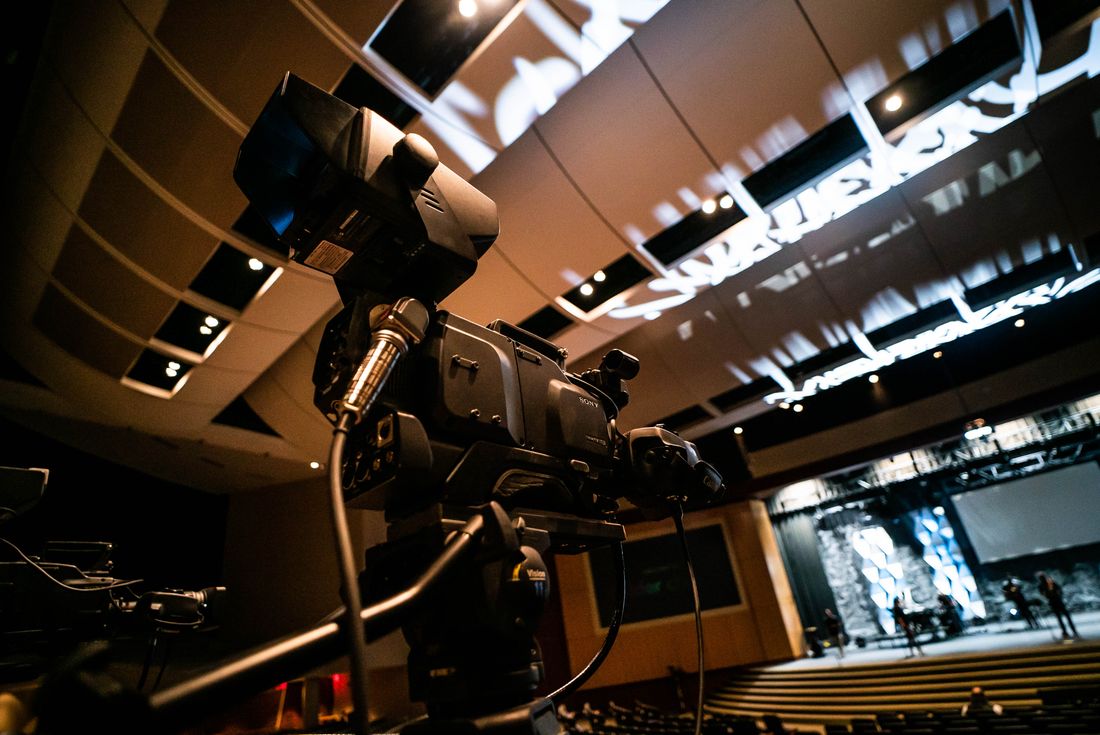
Booking a photographer for a gallery opening usually assumes coverage and live posting are the same job. They are not. Real coverage needs a camera up and attention on the room; a usable story needs a phone in hand within ten minutes, several times a night. Both jobs want the same ninety minutes from the same person, and most galleries only discover the conflict once the room is already full.
Live posting and full event coverage compete for the same person during the same window, since one needs eyes on a phone and the other needs eyes on the room. The honest fixes are a second person handling live posts, a scheduled hand-off partway through the night, camera-to-phone transfer accepted for its real time cost, or a deliberate decision that live content gets phone-quality images.
Why Do Live Posting and Real Coverage Compete for the Same Ninety Minutes?
During a gallery opening, live posting and real coverage need the same person doing two incompatible things at once. Posting a usable image within ten minutes means stopping to pick up a phone, choose a shot, and write a caption. Real coverage means the opposite: eyes up, camera ready, attention on the room instead of a screen.
Most galleries don't plan around this because it looks like one job on paper. The booking conversation covers coverage, maybe a mention of "posting a few things live," and everyone assumes the same person can do both without much friction. The friction shows up later, once the room fills and the two jobs start actively competing for the same ninety minutes instead of sitting politely next to each other.
The math is the problem. A photographer who steps away from the camera to select, edit, and post a phone photo isn't pausing coverage for a few seconds, they're pausing it for however long that phone task takes, repeated every time a new story goes up. Multiply that across a night with several live posts, and a meaningful share of the event happens with the photographer not actually watching it.
Naming the conflict early is the useful move. Once a gallery sees live posting and real coverage as two separate jobs competing for one set of eyes, the rest of this piece is about picking an honest way to split them, rather than hoping one person quietly does both without anyone noticing the cost.
What Does Adding a Second Person for Live Posting Actually Solve?
Adding a second person for live posting solves the conflict by removing it: one person shoots the event with a camera and full attention, the other handles the phone, captions, and story timing. Neither job interrupts the other, because each has its own hands and its own ninety minutes to work with.
This is the cleanest fix precisely because it doesn't ask anyone to split focus. The primary photographer never has to choose between raising a camera and checking a phone screen. The person handling live content never has to worry that pulling out a phone mid-toast will cost the room's best frame. Each job gets a person who is only doing that one job.
The tradeoff is cost and coordination, not quality. A second person is another line on the invoice, and the two people need a shared understanding of what the night needs before it starts: who's covering the toast, who's grabbing candid guest reactions for stories, whether the live feed leans on the photographer's shots or the second person's own phone photos entirely.
This option fits best when the live feed genuinely matters that night, an opening with real reach on the gallery's account, a sponsor expecting visible activity in real time, or a program that has committed to posting through the evening rather than after it. Where that pressure is lower, a scheduled hand-off or a deliberate quality tradeoff, both covered next, usually costs less and does nearly as much.
What Does a Scheduled Hand-Off Look Like During the Night?
A scheduled hand-off means deciding in advance that the photographer shoots real coverage clean for a set stretch, often the first thirty to forty minutes, then shifts to checking a phone and posting live for the rest of the night. It turns an ongoing conflict into two bounded jobs done in sequence instead of at once.
The early window is deliberate. The first part of an opening usually has the cleanest light, the least crowding, and the artwork still visible before the room packs in front of it, making it the highest-value stretch to protect from interruption. Handing that time to uninterrupted coverage, then loosening the reins once the strongest images are already in the camera, protects the shots that are hardest to recreate later in a crowded room.
What the second half loses is coverage during the busiest, often most photogenic part of the night, the room at full capacity, guests deep in conversation, the energy an opening is actually known for. A hand-off accepts that tradeoff on purpose rather than by accident, which is the point: everyone involved knows going in which stretch gets full attention and which gets split.
This works best when the gallery can name which forty minutes matter most, usually the arrival and the first real look at the work, and is willing to accept lighter, phone-driven coverage once that window closes. If no stretch of the night matters more than any other, a second person or a phone-quality decision may fit better.
How Does Camera-to-Phone Transfer Work, and What Does It Cost in Time?
Camera-to-phone transfer sends an image straight from the camera to a phone over Bluetooth or Wi-Fi, without pulling a card or opening a laptop, but it still costs real time: connecting, choosing the shot, waiting on the transfer, then switching to the phone to caption and post. None of that happens while the camera is also shooting.
Manufacturer apps handle this differently depending on the connection. Nikon's own SnapBridge documentation describes a Bluetooth low-energy link that automatically downsizes transferred images to roughly 2 megapixels for easy handling on a phone, with full-resolution files only available by switching to a Wi-Fi connection and downloading manually. Canon's Camera Connect app similarly pairs over Bluetooth or Wi-Fi and lets a user browse images on the camera and save selected ones to a phone, rather than pushing every frame automatically.
In practice, the fast path (Bluetooth, small file, quick post) and the good-quality path (Wi-Fi, full file, slower handshake and larger transfer) are different workflows, not one button. A photographer chasing a ten-minute deadline is usually choosing the smaller, faster file on purpose, a reasonable trade, just one worth naming instead of assuming the transferred image matches what's actually on the card.
The realistic cost per image, connect, select, transfer, switch apps, caption, post, tends to land in the low minutes rather than seconds, which adds up fast across a night that needs several posts rather than one.
What's the Case for Letting Live Posting Use Phone-Quality Images on Purpose?
Deciding in advance that live posting gets phone-quality images means accepting that stories shot from a phone won't match the camera's output, and treating that as fine rather than a compromise to apologize for. It removes the pressure to route every live post through the camera, often the single biggest source of the conflict this piece opens with.
The case for this option rests on what a story actually is. Instagram's own help documentation confirms a story disappears after 24 hours unless it's saved into a Highlight, which makes it disposable by design, not a permanent record competing with the gallery's best possible images. A phone photo that's a little soft or unevenly lit still does that disposable job completely, because nobody views a story expecting gallery-quality light and composition.
This isn't a downgrade so much as matching the tool to the job. The camera's real output, the images worth keeping, is still being captured throughout the night by the person doing real coverage. Live posting just stops needing to borrow from that pipeline in real time, freeing the photographer to keep shooting instead of stepping in and out of a phone workflow all evening.
The one thing this option requires is buy-in before the night starts. A gallery expecting story-quality images to look camera-shot needs to hear, in advance, that the plan is intentionally lower-effort live content plus a stronger set of real photos delivered afterward.
How Should a Gallery Choose Between These Four Options?
Choosing between a second person, a scheduled hand-off, camera-to-phone transfer, or accepting phone-quality live content comes down to two questions: how much does live posting actually matter this specific night, and what's the budget for solving it. Neither has a universal answer, which is why most galleries need to work through it event by event.
A second person makes sense when live content genuinely carries weight, a program-defining show, a sponsor watching the feed in real time, an account with real reach that grows off during-event activity. That weight justifies the added cost, because the alternative options all ask the photographer to give something up instead.
A scheduled hand-off fits a gallery that cares about one specific window, usually the early arrival and first look at the work, more than the rest of the night. It's a middle-cost option: no second invoice line, but a deliberate loss of coverage once the hand-off begins.
Camera-to-phone transfer suits a gallery that wants the camera's actual images live, and is willing to accept the real time cost of connecting, selecting, and transferring each one throughout the night. Phone-quality-on-purpose suits a gallery that mainly wants presence during the event, arrival photos, a sense the room existed, without asking the photographer's attention to leave the camera at all.
None of these is the automatically right answer. The wrong move is not choosing, and letting the photographer improvise a split-attention compromise mid-event instead.
What Needs to Be Decided Before the Night Starts, Not During It?
What needs deciding before the night starts is simple to name and easy to skip: which of the four approaches is being used, who's responsible for live posting, and what quality bar the gallery expects from anything posted during the event itself. Deciding this in the booking conversation, not the room, keeps the photographer from guessing under pressure.
This matters because the decision is invisible until it isn't. A shot list covers what images the gallery wants. It rarely covers who's checking a phone during the toast, or whether the photographer is expected to post anything before the night ends. Without that detail written down, the default becomes whatever the photographer decides to do in the moment, rarely the outcome either side actually wanted going in.
The conversation doesn't need to be long. It needs to cover three things plainly: is someone dedicated to live posting or is it the same person shooting coverage, is there a specific window worth protecting from interruption, and is phone-quality content acceptable for anything posted live. Answering those three questions in advance turns a real-time judgment call into a plan everyone already agreed to.
Galleries that skip this step aren't being careless, they're usually just assuming the two jobs fit together the way they do on a shot list. They don't, and the fix costs nothing more than a conversation before the event, well before the room fills and someone has to choose on the spot.
What Happens When Nobody Decides in Advance?
When nobody decides in advance, the photographer ends up choosing in real time, all night, under pressure, usually settling into a compromise that serves neither job well: coverage gets thinner because attention keeps drifting to the phone, and live posts get slower because the phone only comes out when coverage allows a break.
This is the quiet failure mode worth naming plainly. Nobody looks back at a night like this and points to one obvious mistake, because there isn't one. What happened instead is a long series of small, reasonable-seeming choices, one more crowd shot instead of a story update, one more caption instead of catching the toast, that add up to a night where neither the live feed nor the final gallery is as strong as either could have been on its own.
The gallery usually notices after the fact rather than during. The live feed felt slow or thin compared to what was hoped for, and the delivered photos, while good, are missing a moment or two that mattered. Neither failure is dramatic enough to flag in the moment, which is exactly why it keeps happening at events that never sat down and picked an approach beforehand.
The fix isn't more effort from the photographer on the night itself. It's picking one of the four honest options ahead of time, so nobody has to improvise a compromise between two jobs that were never going to share one person's attention cleanly.
Frequently asked questions
Can one photographer really handle both live posting and full event coverage well?
Not at the same level either job could reach alone. The two tasks pull attention in opposite directions, phone-down and camera-up versus phone-in-hand, during the same window. One person can manage both adequately, especially with a scheduled hand-off or a deliberate phone-quality decision made in advance, but expecting both to run at full quality at the same time usually means both come out a little thinner than planned.
Is hiring a second person for live posting worth the extra cost for a small opening?
It depends on how much the live feed matters that specific night. A second person removes the conflict entirely, which is valuable when the account has real reach or a sponsor is watching in real time. For a smaller opening without that pressure, a scheduled hand-off or accepting phone-quality live content usually delivers most of the benefit without adding a second person's fee to the invoice.
Does camera-to-phone transfer send the exact same quality image that's on the memory card?
Not automatically. Manufacturer apps like Nikon's SnapBridge downsize Bluetooth-transferred images to roughly 2 megapixels for quick handling, with full resolution requiring a Wi-Fi connection and a manual download instead. Canon's Camera Connect works similarly, letting a user browse and save selected images from the camera rather than pushing every frame at full size automatically. The fast option and the full-quality option are genuinely different workflows, not a single setting a photographer flips mid-event.
Why would a gallery choose phone-quality images for live posting on purpose?
Because a story is disposable by design. Instagram's own help documentation confirms stories disappear after 24 hours unless saved to a Highlight, so a slightly soft or unevenly lit phone photo still does that job completely. Choosing phone quality on purpose frees the photographer from stepping in and out of a camera-to-phone workflow all night, protecting attention for the coverage that becomes the lasting record.
What's the single most important thing to decide before an event with a live-posting expectation?
Who is actually responsible for it. Every other decision, a scheduled hand-off, camera-to-phone transfer, or accepting phone-quality content, follows naturally once it's clear whether the photographer is doing both jobs alone or someone else is handling live posts. Deciding this in the booking conversation, not during the event itself, keeps the photographer from having to improvise a compromise under pressure once the room is full.
Not every month has an opening, but the feed still needs to run.
We plan content for the ordinary weeks as carefully as the big nights, mixing archive work with what's actually going on in the gallery.
Explore monthly media →