A gallery adds an artist to its roster, and somewhere inside that announcement is a page that needs a photo, a press release that needs a photo, and a fair application that needs a photo in a size nobody has settled on yet. The date for all of it gets set by the gallery's own calendar, not the artist's, and it is rarely a generous one. The portrait that results has to do more work in less time than most people expect from a single sitting.
A portrait commissioned around a gallery signing has to serve several uses at once, a roster page, a press release, a fair application, and a newsletter, usually on a deadline the gallery set for reasons that have nothing to do with photography. Planning the crop, the background, and the timeline around those actual uses is what makes a rushed shoot still deliver something the gallery can use everywhere it needs to.
Why a Gallery Signing Turns Into a Photography Deadline
A portrait becomes urgent the moment a gallery sets a launch date for an artist's page, because that date gets fixed for reasons that have nothing to do with photography and everything to do with the gallery's own calendar, a newsletter send, a fair deadline, or a press cycle already in motion.
The trigger is rarely the artist deciding they want a new portrait. It's a gallery staffer working backward from a date set for other reasons entirely, a fair application window, a newsletter that goes out on the first of the month, a press list that closes before an opening. The portrait becomes one more item on that list, usually added late, because pictures are easy to forget until someone notices the artist isn't on the page yet.
That's what makes the timeline feel unfair even when nobody meant it that way. The artist agreed to representation, not to a photo shoot deadline, and the gap between those two events can be a week or less once the gallery actually asks. We've found the calmest way through is treating the date as fixed and planning everything else around it, rather than negotiating for time from a calendar that was never built with photography in mind.
The gallery staffer chasing this down usually isn't being difficult. They're managing pressure from a director, a printer, or a marketing calendar, and an unbooked portrait is one more open item between them and a page that's supposed to already be live. Understanding the pressure is structural, not personal, makes the booking conversation faster for everyone.
Why the Gallery's Request Is Rarely Just a Headshot
When a gallery asks for a portrait, they usually need one image doing several jobs at once, a square crop for the roster page, a vertical for the press release, a specific ratio for a fair application, and a looser crop with room to breathe for the newsletter.
A roster page usually wants a consistent square or near-square crop that sits cleanly in a grid next to every other artist on the program. A press release wants more headroom, often vertical, because a printed program or a PDF needs space above the subject for a headline or caption. A fair application frequently specifies its own exact dimensions, sometimes a ratio the gallery has never had to think about until the deadline is already close. A newsletter wants something looser still, an image that can survive a smaller crop without losing the person inside it.
None of these crops can be faked convincingly from a tight three-quarter shot after the fact. A frame composed for one specific use rarely holds up once it's forced into a different one, which is why a single well-planned session with enough negative space around the subject saves everyone a second round of emails a week later asking for one more crop.
We ask what the image needs to do before we plan how the artist should stand, because the answer changes the actual shoot. A session built only around a tight headshot crop leaves the gallery short the moment a fair application's dimensions turn out wider than anyone expected.
Studio Background or Neutral Ground: What Each One Signals
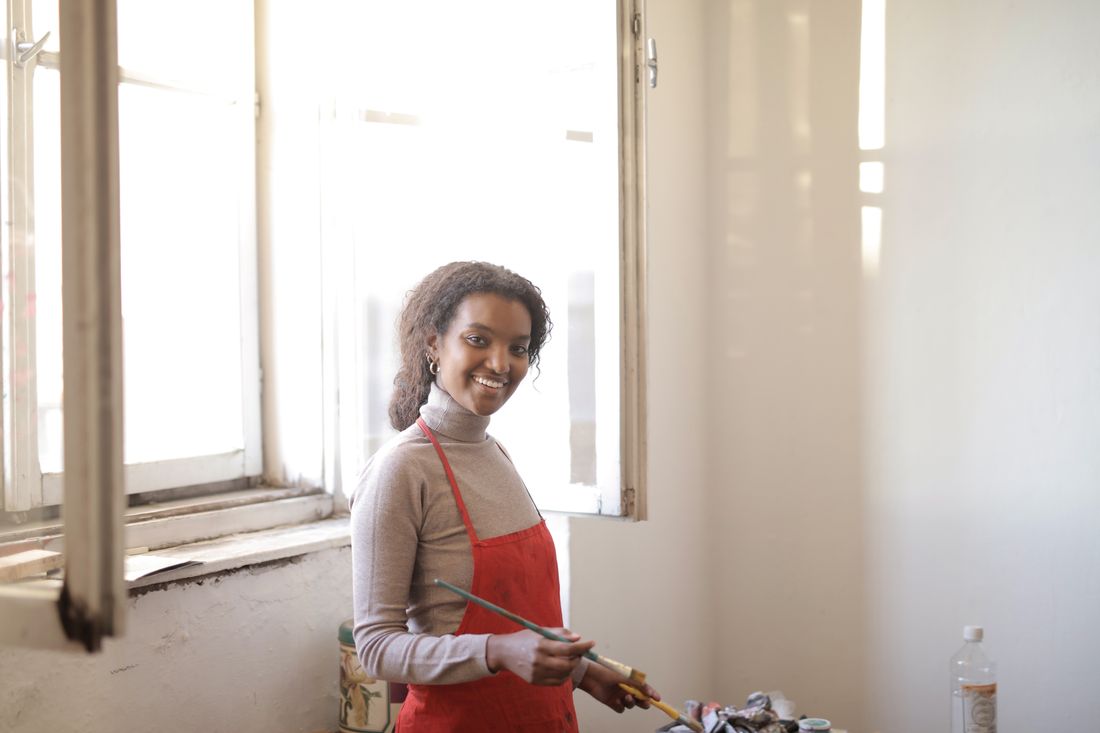
A studio portrait shot in the artist's own workspace signals process and specificity, this is where the work gets made, while a neutral background signals the person more than the practice, useful when the work itself isn't ready to be shown or doesn't photograph cleanly behind someone.
The studio choice puts the artist inside their own context, tools, materials, half-finished pieces, the particular light a specific room happens to get. It reads as evidence rather than performance, which matters to collectors trying to picture how the work actually gets made. It also asks more of the location itself. A working studio isn't staged for a camera, and the same clutter that makes it feel real can also make it feel chaotic in frame if nobody thinks through what's visible behind the subject.
A neutral background removes that variable entirely, a plain wall, even light, nothing competing with the face. It's the safer choice when a studio isn't camera ready on short notice, when the work in progress isn't representative of what the gallery is actually showing, or when the gallery simply wants a portrait that reads as consistent with other artists already on its roster.
Neither choice is more serious than the other. A neutral portrait next to a strong body of work photographed separately can carry just as much weight as a studio shot, and a studio shot of the wrong work can undercut the whole point of showing it. The decision comes down to what's actually ready, not which background looks more impressive on its own.
Why the Work Behind You Has to Be the Work Being Represented
A studio portrait only works for a gallery announcement if the pieces visible behind the artist are the work the new gallery is actually taking on, because showing older, sold, or unrepresented pieces in a launch photo quietly misstates what the relationship actually covers.
This sounds obvious stated plainly, but it's an easy detail to miss on a short timeline. An artist's studio usually holds years of work at once, pieces from an earlier series, commissions already sold, experiments that never went anywhere, alongside whatever the new gallery is actually planning to show. A camera doesn't know the difference. It photographs whatever's in the room, and once that image goes out under the gallery's name, it can read as an implicit claim about what the gallery represents.
The fix isn't complicated, but it does take a short conversation before the shoot, not during it. We ask the artist or the gallery contact which specific pieces are part of the current representation before we walk in, then plan the composition so those pieces are visible and everything else stays out of frame, or genuinely out of the room, for the session.
This matters more for artists represented by more than one gallery at once, which is common enough that it can't be assumed away. A portrait meant for one gallery's launch shouldn't visibly feature work that belongs to a different relationship entirely, even by accident. Sorting this out ahead of time is a short conversation. Sorting it out after the image is already published is not.
Wardrobe and Register When the Audience Is Collectors, Not Peers
A portrait built for a gallery's collector-facing channels calls for a slightly different register than one built for an artist's own feed, because the audience reading it is deciding whether to trust the work, not scrolling past it between friends' posts.
An artist's personal account can carry paint-stained clothes, a candid expression, whatever feels honest to their day-to-day practice, and that honesty is often the whole point there. A gallery's press kit, roster page, and fair application are read by a different audience entirely, collectors, curators, press, people encountering the artist's face for the first time alongside the work itself. The same paint-stained honesty can read as unpolished in that context, not because it's wrong, but because the audience doesn't yet have the relationship to interpret it generously.
This doesn't mean formal. It means considered. Clothing that's clean and fits well without looking like a costume, an expression that's composed rather than caught mid-sentence, a background that doesn't compete for attention. The goal is a portrait that holds up next to every other artist on a gallery's roster page without looking like it's trying too hard to belong there.
We talk through wardrobe with the artist ahead of the session rather than leaving it to guesswork on the day, because most artists already own something that fits this register. It's rarely a shopping trip. It's usually a short conversation about which two or three pieces already in their closet read as considered rather than casual.
Getting Usable Frames When the Artist Hates Being Photographed
An artist who dreads being photographed still needs a portrait that reads as calm and natural, which usually comes from shortening the session, giving them something to do with their hands, and shooting more frames in less time so nobody has to hold a pose long enough to feel it.
Discomfort in front of a camera almost always shows up as stiffness, a fixed smile, shoulders that creep toward the ears, hands with nowhere to go. Asking the subject to relax rarely works, because being told to relax is its own kind of pressure. What actually helps is giving them something concrete to focus on instead of the lens, a tool, a piece of work, a task connected to their actual practice.
Shorter, faster sessions tend to outperform long, careful ones for a reluctant subject. The stiffest minutes are usually the first few, and natural frames tend to arrive once the artist has stopped thinking about the camera at all, often mid-sentence or partway through a small task rather than a held pose. We keep the technical setup simple and predictable so nobody waits through long pauses between frames.
It also helps to be honest with the artist about the actual ask upfront, roughly how long the session will take and how many usable frames the gallery actually needs, which is usually far fewer than people expect. Knowing there's a finish line in sight, and that it's a short one, does more to ease a reluctant subject than any coaching about posture.
What a Week Can Honestly Buy, and What Needs Three
A week is enough time to book a straightforward session, shoot it, and deliver a small set of crops if the artist and location are already available, but it leaves no room for a studio that needs prep, a wardrobe conversation that takes more than a day, or more than one round of edits.
A one-week timeline works when three things are already true, the artist is actually available inside that window, the location doesn't need special preparation, and the gallery already knows which crops it needs rather than discovering new ones after delivery. Under those conditions, a session can be booked, shot, and turned around inside a week without rushing the parts that actually matter.
What a week doesn't honestly buy is a rescue project. If the studio isn't camera ready, if the artist's schedule is genuinely tight, or if wardrobe needs a real conversation rather than a same-day decision, compressing all of that into a week produces a session that feels rushed, even when every technical step went fine. Rushed portraits show it in small ways, tension in the shoulders, a background nobody had time to consider.
Three weeks buys margin, not extra work. It's enough time for a wardrobe conversation, a location check before the shoot day rather than during it, and a second look at the edited set before it goes to the gallery. We'd rather tell a gallery staffer honestly that a request needs three weeks than promise a rushed week and hand back a set that undersells the artist on the page it's meant to launch.
How the Artist and the Gallery Staffer Coordinate This Without Friction
The smoothest version of this shoot has one person confirming the deadline, one person confirming which crops are actually needed, and both of those conversations happening before the booking call, because most delays trace back to a detail nobody asked about until the images were already due.
The artist usually knows their own schedule and the work in the room. The gallery staffer usually knows the actual deadline and which specific deliverables are due where. Neither person always has the other's half of the picture, and the shoot goes smoothest when both pieces get confirmed together before anything is booked, rather than assembled piecemeal over the week that follows.
A short list settles most of it. What's the real deadline, not the soft one. Which crops are actually needed, and for which specific use. Which pieces in the studio belong to the current representation. Is the artist genuinely available inside the timeline being discussed, or is someone simply assuming they are. We ask for these answers upfront because chasing them mid-shoot costs more time than gathering them costs before it.
When that coordination happens early, the actual photography becomes the easy part. Most of what makes this kind of shoot feel stressful isn't the camera work, it's the number of open questions still floating around on the day of the session. Closing those questions before booking turns a rushed, deadline-driven request into a session that just happens to run on a short timeline, which is a very different feeling for everyone involved.
Frequently asked questions
How much notice do we actually need before a gallery signing announcement?
A straightforward session can usually be booked and delivered inside a week if the artist is available and the location needs no special preparation. Anything involving a wardrobe conversation, a studio that isn't camera ready, or crops the gallery hasn't decided on yet needs closer to three weeks. The honest answer depends on how many of those pieces are already settled before the booking call, not on the calendar alone.
What's the difference between a portrait for a roster page and one for a press release?
A roster page usually wants a consistent square or near-square crop that sits in a grid beside every other artist on the program. A press release wants more headroom, often vertical, so a printed program or PDF has space for a headline above the subject. Both can come from one session if the framing leaves enough negative space around the subject, but they rarely come from a single identical crop.
Should the portrait be shot in the artist's studio or somewhere neutral?
It depends on what's actually ready. A studio portrait works when the space is presentable and the visible work belongs to the current gallery representation, since it reads as evidence of practice rather than performance. A neutral background is the safer choice when the studio isn't camera ready on short notice, or when the work in the room doesn't match what the gallery is actually showing. Neither option outranks the other on its own.
What if the artist doesn't have new work ready to be photographed with them?
That's a strong argument for a neutral background rather than a studio setting. Showing an artist beside older, sold, or unrelated pieces can misstate what the new gallery actually represents, even by accident. A composed portrait against a plain background carries the announcement just as well, and it avoids implying a body of work is finished or ready to be shown before it actually is.
Can one wardrobe choice work for both the gallery's press kit and the artist's own site?
Often, yes, if the wardrobe reads as considered rather than costumed or overly casual. Clean, well-fitted clothing that doesn't compete with the work photographs well across a roster page, a press release, and an artist's personal site. What changes more between those uses is the crop and the background than the outfit itself, so one wardrobe conversation before the session usually covers every use the images end up serving.
Let's find out which one you actually need.
We shoot both refresh sessions and full new concepts, and we'll tell you honestly which one your portrait needs before we book anything, not after.
Explore portrait sessions →