
Most gallery websites lead with one portrait: the director, alone, framed against a clean wall. That photo does real work, but it also tells a client the gallery is essentially one person, even when the actual relationship runs through a registrar coordinating a shipment, a preparator confirming condition notes, or a sales associate answering the first inquiry. A team photo session is a different brief than a single portrait sitting: more people, tighter per-person timing, and a technical setup that has to stay identical across everyone so the set reads as one gallery instead of a stack of unrelated headshots. Done well, it gives clients faces to recognize before they ever set foot in the space, faces that already match the names in their inbox.
A single director portrait undersells a gallery because most client relationships run through other people: a registrar, a preparator, a sales associate. A team photo session usually needs both individual portraits and one group shot, built on the same backdrop, lighting, and framing so the set reads as one gallery. It takes more planning and tighter pacing than a single gallerist portrait, since several schedules and comfort levels have to be managed at once.
Why does a single director portrait undersell a gallery's credibility?
A single director portrait undersells a gallery because it represents leadership, not the relationship a client actually has day to day. Most client contact runs through a registrar, a preparator, or a sales associate, not the director. An About page with one face makes a staffed gallery look smaller and less established than it actually is.
Trust in a gallery relationship gets built with whoever a client actually deals with, and that's rarely the director alone. A collector emailing about a shipping date, an artist checking on a consignment, a press contact confirming an image request: all of them are forming an impression of the gallery through a person who may never appear anywhere on the website.
This is useful information more than it is a critique of the standard About page. The site is presenting one relationship as the whole gallery, when the working relationship a client experiences is usually spread across several people over the course of a sale, a loan, or a show. Many galleries built their About page early, before the staff grew past one or two people, and never revisited it once the team did.
A team photo set doesn't replace the director's portrait. It adds the faces a client will actually recognize once the relationship is underway, which tends to do more for credibility than a second angle of the same person. It also gives a smaller gallery a way to visibly show the depth of a team that a director-only page can't communicate on its own.
Which staff members actually belong in a gallery team photo?
The people who belong in a gallery team photo set are whoever a client actually emails, calls, or meets: the director, but also the registrar handling paperwork and logistics, the preparator who installs and packs work, and any sales associate who fields inquiries. If a role touches the client relationship, it belongs in the set.
Galleries sometimes default to photographing only the people with titles that sound public-facing, director, owner, senior curator, and leave out the staff who actually generate most of the written correspondence. A registrar coordinating a shipment or a preparator confirming condition notes is often the person a collector remembers most clearly, simply because that's who answered the most emails during the actual transaction.
Front desk and gallery assistant roles are worth the same consideration, especially at a gallery where that person greets every visitor and fields the first call from a new inquiry. That first impression carries real weight, even when the title doesn't sound senior on paper.
Part-time or contract staff are worth including if they're a consistent point of contact. A gallery that brings in the same install crew or the same registrar on retainer every season can reasonably treat them as part of the visible team, even if they're not full-time employees on paper.
The simplest test: pull up the last twenty client emails and note who sent them. That list, not the org chart, is the accurate guide to who belongs in the photo set.
Should a gallery do individual portraits, a group shot, or both?
Most galleries get more use out of doing both: individual portraits of each staff member for bios and directory pages, plus one group shot for the About page or press kit. Individual portraits alone miss the "we're a team" signal, and a group shot alone can't carry individual bios.
The individual portraits do the heavier lifting. They're what gets swapped into a staff directory, a press mention, or an email signature, and they need to hold up on their own without context from the rest of the set. The group shot does something different: it signals scale and cohesion in one glance, which is useful on a homepage or an About page but far less useful anywhere the site needs to identify one specific person.
A gallery with only two or three staff members can sometimes skip the group shot without losing much, since a small team already reads as cohesive without a formal lineup. Once a gallery has four or more people a client might interact with, the group shot starts pulling its weight, because a directory of disconnected headshots doesn't communicate that these people work together toward the same shows and the same clients.
Both formats come out of the same session. There's no reason to split individual portraits and a group shot across two separate bookings, and doing both in one sitting keeps the lighting and setting consistent between them.
How do you make individual portraits read as one team?
Individual portraits from different staff members read as one team when they share the same backdrop, the same lighting setup, and the same framing distance, shot in the same session or matched carefully if scheduling forces a second date. Consistency in the technical setup does more to unify a set than matching outfits or posed similarity.
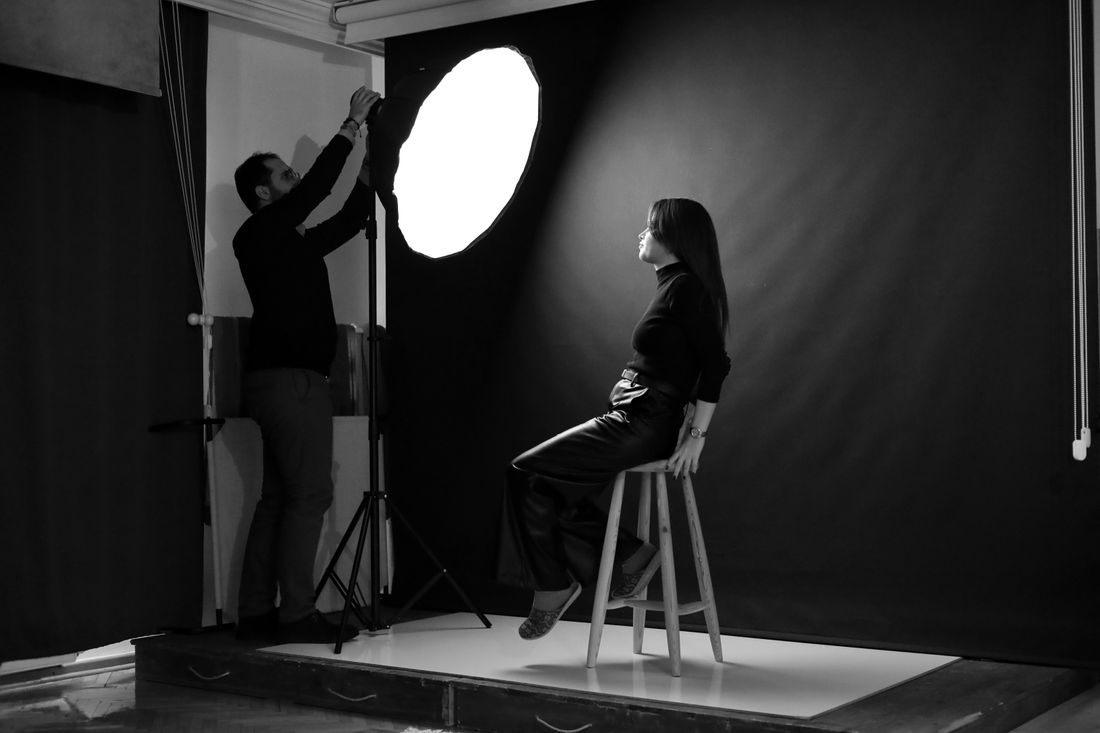
The backdrop is the easiest variable to lock down and the first one worth deciding on: a plain wall, a specific spot in the gallery, or a portable backdrop, used identically for every person. Lighting comes next. A softbox position that flatters one face can wash out another if it moves between sittings, so the setup gets fixed once and left alone rather than adjusted per person.
Framing distance and crop matter more than most galleries expect going in. If one portrait is a tight headshot and another includes shoulders and half the background, the set reads as mismatched the moment they sit side by side on a page, even if both photos are individually strong on their own.
When staff can't all be photographed the same day, which happens more often than not with gallery schedules, the setup gets documented (light position, camera height, backdrop distance, even the exact spot on the floor) so a later sitting, weeks or months on, can match the earlier ones closely enough that nobody looking at the finished set notices the gap.
How much direction does a non-model staff member need?
A non-model staff member usually needs more direction than a gallerist used to being photographed, not less. Someone who spends their day on installation or paperwork rarely has a practiced expression or a sense of what to do with their hands, so the photographer ends up giving more specific, more frequent prompts than a single portrait session would call for.
This isn't about correcting anyone. It's simply a different starting point: a director who does press and studio visits regularly has usually built up some instinct for a camera pointed at them, while a preparator or registrar photographed for the first time in years benefits from clear, small instructions rather than open-ended ones like "just be natural."
Specific prompts work better than vague ones. "Rest your hands on the table" gets a more useful result than "relax your hands." "Turn your shoulders slightly toward the window" works better than "look more comfortable." A short warm-up, a few unused frames before the ones that count, helps more here than it does with someone who is already relaxed and at ease in front of a lens.
Budgeting slightly more per-person time for staff who aren't used to being photographed keeps the whole session from running behind, and it usually produces a noticeably more natural result than rushing everyone through at the same pace as a subject who's already done this many times before.
How is a team photo brief different from a single gallerist portrait?
A team photo brief differs from a single gallerist or curator brief mainly in scope: it has to account for several people's comfort levels, several schedules, and a shot list covering both individual and group needs, all settled before the session starts. A single-portrait brief is a conversation. A team brief is closer to a short production plan.
With one person, the brief can stay loose and adjust in the room, since there's only one personality and one schedule to read. With a team, decisions that could be made on the fly with one subject need to be settled in advance: who goes first, how long each person actually needs, and what happens if someone runs late and the group shot has to wait for them.
Wardrobe guidance also has to work across a wider range of comfort levels and existing wardrobes at once, rather than a single conversation tailored to one person's closet. A note that works for a director used to press photos might read as too formal for a preparator who's never been asked to think about what they're wearing to work.
None of this makes a team session harder to plan, just different from what most galleries expect. The brief moves earlier and gets more specific, because there's less room to improvise once several people's calendars are already locked into the same room together.
How does the pacing differ for a multi-person staff session?
A multi-person staff session runs on a different clock than a single portrait sitting: individual portraits get budgeted per person, in short blocks, while the group shot gets its own separate window at the end once everyone is already dressed, warmed up, and in the room together.
A single gallerist portrait session can spend most of its time exploring variations, different poses, different crops, different expressions, because there's only one person's patience and schedule to manage. A team session doesn't have that luxury. Each individual slot needs to move efficiently enough that four, six, or eight people can get through their portraits without the whole afternoon stretching into a second day.
The group shot works best scheduled last, after individual portraits are done, so people are already positioned near the set and don't need a separate call-back. Trying to do the group shot first usually means someone hasn't arrived yet or someone else needs to leave early, and the whole shot has to be reset later anyway, which costs more time than it saves.
Building in a short buffer between each person's individual portrait, even five minutes, keeps the pacing humane. Staff who aren't used to being photographed do better with a breath between sittings than being cycled through back to back like a factory line, and the extra minutes rarely add up to much across a full afternoon.
Where do gallery team photos actually get used?
Gallery team photos usually end up on the About page, a staff directory, press kits, and individual email signatures, and where a photo will live should decide its crop before the shoot, not after. A vertical headshot crops differently than a photo meant for a wide team banner, and deciding that in advance saves a reshoot later.
The About page and press kit tend to want the group shot, or a loose grid of individual portraits sized the same. A staff directory or a bio page wants the tighter individual crop, usually a headshot, sometimes with a little more room for a name and title beneath it. An email signature needs something small and simple enough to read at thumbnail size, which rules out anything with a busy or detailed background behind the subject.
Deciding this before the session means the photographer can shoot individual portraits with two crops in mind from the start, tight and loose, rather than trying to crop a single frame after the fact to serve every use it needs to serve later on.
A gallery that skips this step usually ends up with photos that work for the About page and nothing else, and finds out about the gap only later, when someone needs a small square crop for a directory listing and nothing in the existing set actually fits without awkward, last-minute cropping.
Frequently asked questions
Does every staff member need to be photographed on the same day?
Not necessarily. Individual portraits can be shot across more than one date as long as the setup, backdrop, lighting, and framing distance are documented and matched exactly on the later date. What can't happen easily is the group shot, which needs everyone in the room at once. Most galleries schedule individual portraits around whoever is available that week and save the group shot for a date when the full staff can gather.
What happens to a team photo set when someone leaves the gallery?
A team photo set doesn't need a full reshoot every time one person leaves or joins, since individual portraits are already separate files that can be swapped out on their own. The group shot is the piece that ages faster, since it shows a specific lineup at a specific moment. Most galleries either commission a new group shot when the roster shifts meaningfully or simply retire the old one until the next refresh.
Do small galleries with two or three people still need a group shot?
A gallery with two or three people can usually skip a formal group shot and lean on strong individual portraits instead, since a small team already reads as connected without a posed lineup. What still matters at that size is consistency: the same backdrop, lighting, and framing across everyone's individual portrait, so the set reads as one gallery rather than three unrelated headshots pulled from different sources.
What should staff wear for a gallery team photo?
Staff should wear what they'd actually wear to work on a normal day, kept simple and consistent in formality across the group rather than uniform. A director in a blazer next to a preparator in a plain shirt reads as honest, not mismatched, as long as everyone looks put together for their own role. Busy patterns and logo-heavy clothing are worth avoiding since they distract from the face and date the photo faster.
How often should a gallery update its team photos?
Once staff or the space changes enough that the current photos look noticeably out of date is a more useful trigger than a fixed schedule. For most galleries that's roughly every year or two, or sooner if there's meaningful staff turnover. Individual portraits can be refreshed one at a time as needed, but the group shot is worth a full new session rather than a patchwork update.
Not sure if you need a refresh or a whole new concept?
We shoot both, and we'll say plainly which one fits your portrait before anything gets booked, not after the invoice.
Explore portrait sessions →