
Most founder-artists don't ask for this distinction outright. They ask for "a professional photo" or "something for the website," the same language anyone uses when booking a headshot. But the moment a session starts, the difference shows up fast. A founder-artist has an actual practice behind them, a studio, materials, a way of working, that a plain headshot setup erases on purpose.
A standard corporate headshot is built to be interchangeable. Same backdrop, same lighting ratio, same three-quarter crop, so a directory page or a LinkedIn grid reads consistently across a hundred different faces. A founder-artist portrait works against that on purpose, because the whole point is that this person isn't interchangeable with anyone else in a directory. Their name is the product. The table below lays out where each one gets used, how much studio shows up in frame, what wardrobe is doing, and how directed the session actually is.
What each portrait is actually built to do
A corporate headshot has one job: look competent, look reachable, look like someone a client would trust across a meeting table. The brief is short on purpose. Plain or softly blurred background, even light, a close crop, done quickly because the client usually needs volume, not nuance. Nothing about the room, the wardrobe, or the expression is meant to say anything specific about the person. That's the design, not a shortcut.
A founder-artist portrait carries two jobs at once, and that's the whole difference. It has to prove the business is real, and it has to prove the artist behind it still is too. Skip the first job and the photo reads as a nice art portrait with nothing to say about running a business or being worth hiring. Skip the second and it reads like generic founder content that could belong to anyone who checked a box on a form.
Most founder-artists book this without naming any of that. They ask for "a professional photo," and the difference only shows up once someone starts asking where they actually work, what's true in that room, and what a working artist who also runs a business looks like on this specific person, since it's rarely a blazer and a bookshelf.
The comparison, side by side
| What changes | Corporate headshot | Founder-artist portrait |
|---|---|---|
| Setting | Deliberately invisible: grey backdrop or softbox, so the environment says nothing | Enough of the real studio to prove a working practice exists, without turning into a studio tour with a face in it |
| Wardrobe | Solid color chosen to disappear, nothing distracting from the face | Honest working clothes, whatever the artist would actually wear to the studio on a normal day |
| Direction on set | Highly directed: chin down, set expression, done in one short pass | Looser direction, real engagement with the work or the room rather than a held pose |
| Where it's used | Company directory, LinkedIn, a conference bio, anywhere consistency across many faces matters | Website hero, press feature, gallery or grant bio, anywhere the business and the artist need to be believed as one person |
| Typical crop | Tight, close to a traditional square or near-square headshot | Usually shot in more than one crop: a wide frame for a hero, a tighter one for directory-style uses |
| Session length | Short, often fifteen minutes or less, because the client needs one correct frame | Longer, generally closer to an hour, since most of the work happens before the camera comes out |

Where each one actually gets used
The corporate headshot's job ends the moment it's uploaded. A company directory, a LinkedIn profile, a conference program, a team page that needs a dozen faces to read the same way. None of those situations reward a photo with personality. They reward a photo that's fast to scan and doesn't distract from the name next to it.
A founder-artist portrait has to survive more contexts than that, and each one wants something slightly different from the frame. A website hero can carry real studio context because the environment is doing storytelling work there. A press feature wants a face that matches the voice in the piece, someone a journalist can run alongside a quick profile. A gallery or grant bio wants to believe the artist is serious and reachable at the same time, which is a harder thing for a plain headshot to prove.
None of these audiences need the exact same photo, but a founder-artist portrait built around a real room and real wardrobe usually satisfies more than one of them at once, because it isn't trying to erase who the person actually is.
How much environment belongs in the frame
In a corporate headshot, the setting is invisible by design, so the face carries the entire photo. A founder-artist portrait needs the opposite, but not the extreme opposite. The studio is almost always the strongest setting, and it doesn't mean photographing the whole room. One wall, one worktable, one piece of current work in soft focus behind the subject usually says more than a wide shot trying to document everything at once.
The goal isn't proving the room exists. It's context: enough visual evidence that this is a real working artist, not so much that the portrait turns into a studio tour with a person standing in it as an afterthought. Natural light is usually the easier starting point in a real studio, since most working spaces already have it and it tends to read as more honest than a fully artificial setup built to correct for a room's flaws.
A corporate headshot doesn't have this decision to make at all. The backdrop is chosen precisely so nobody looks at it twice, which is a different kind of craft, just aimed at a different result.
Wardrobe and how directed the session actually is
Wardrobe for a corporate headshot exists to disappear: a solid color, nothing distracting, something that reads as "professional" without anyone noticing what it actually is. Wardrobe for a founder-artist portrait has more work to do, since it's one of the only visual signals in the frame besides the face and the studio itself.
The mistake worth avoiding is dressing the artist as a stand-in for a business owner, a blazer over a t-shirt because it should look professional. Most founder-artists already have a working wardrobe that's honest, whatever they'd actually wear to the studio on a productive day, and that's usually the stronger choice than a costume borrowed from a different kind of business photo.
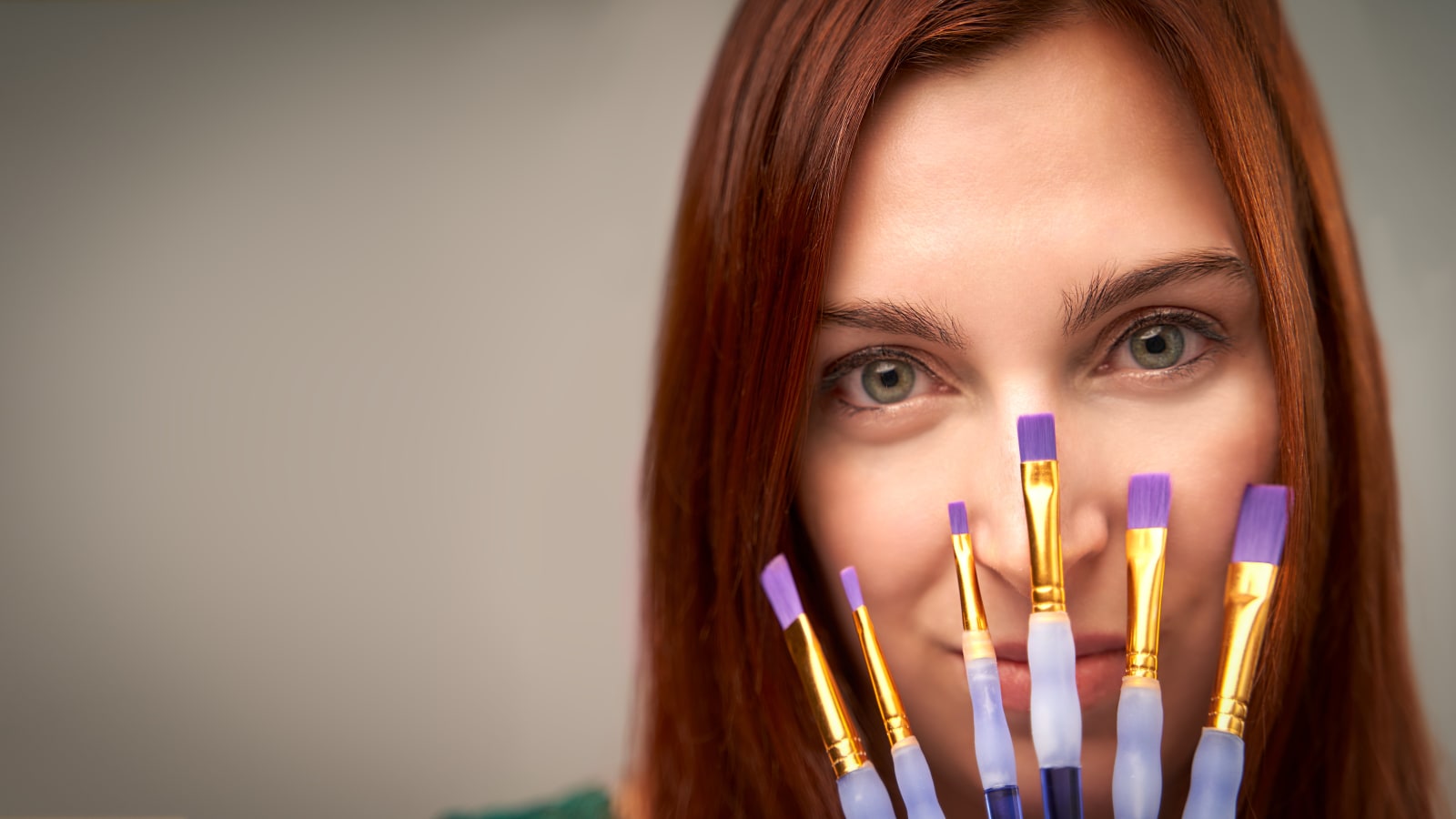
Direction follows the same logic. A corporate headshot is tightly directed because the goal is one repeatable, correct frame. A founder-artist portrait holds up better with less performed confidence and more actual engagement: hands doing something real, attention on the work rather than the lens. A paintbrush handed over for the photo that clearly isn't mid-use reads as staged almost immediately, even to a viewer who couldn't say why.
Which one to book
A standard headshot is still the right call for plenty of situations: a quick LinkedIn update, a team page that needs consistency across a dozen people, a conference bio that just needs a clear, professional face. None of those need a studio, a wardrobe conversation, or the longer session a founder-artist portrait usually takes.
The founder-artist version earns its extra time when the photo has to do real work beyond identification: a website hero, a press feature, a gallery or grant bio where the business and the artist need to be believed as the same person in one frame. If the photo's job is just "here's what I look like," a standard headshot does that fine. If the job is "trust this business and this artist at the same time," that's the different brief.
We scope every founder-artist session around the actual studio, the current work, and how the photo needs to be used, since that's what decides the setting, the wardrobe, and how directed the session should be, not a fixed formula applied to every artist the same way.
Frequently asked questions
Can one session cover both a corporate-style headshot and a founder-artist portrait?
Yes, usually across different frames from the same sitting rather than two separate bookings. A camera-aware, tighter crop covers directory and LinkedIn uses, while a looser, more engaged frame in the studio covers a website hero or press use. Planning both crops before the shoot works better than trying to force one framing to do both jobs after the fact, since the light and distance that suit a directory photo rarely suit a wider hero shot.
What should a founder-artist wear if they're not sure?
Whatever they'd actually wear to the studio on a normal working day, not a costume borrowed from a corporate headshot. A blazer thrown over a t-shirt to look professional usually reads as staged the moment it's next to real studio context. The honest working wardrobe almost always holds up better against a real studio background, and it photographs as more specific to that one artist instead of interchangeable with anyone else's headshot.
A portrait that's aged doesn't always need a full reshoot.
We'll look at what you have and tell you honestly whether a refresh session covers it or the work calls for a new concept.
Explore portrait sessions →