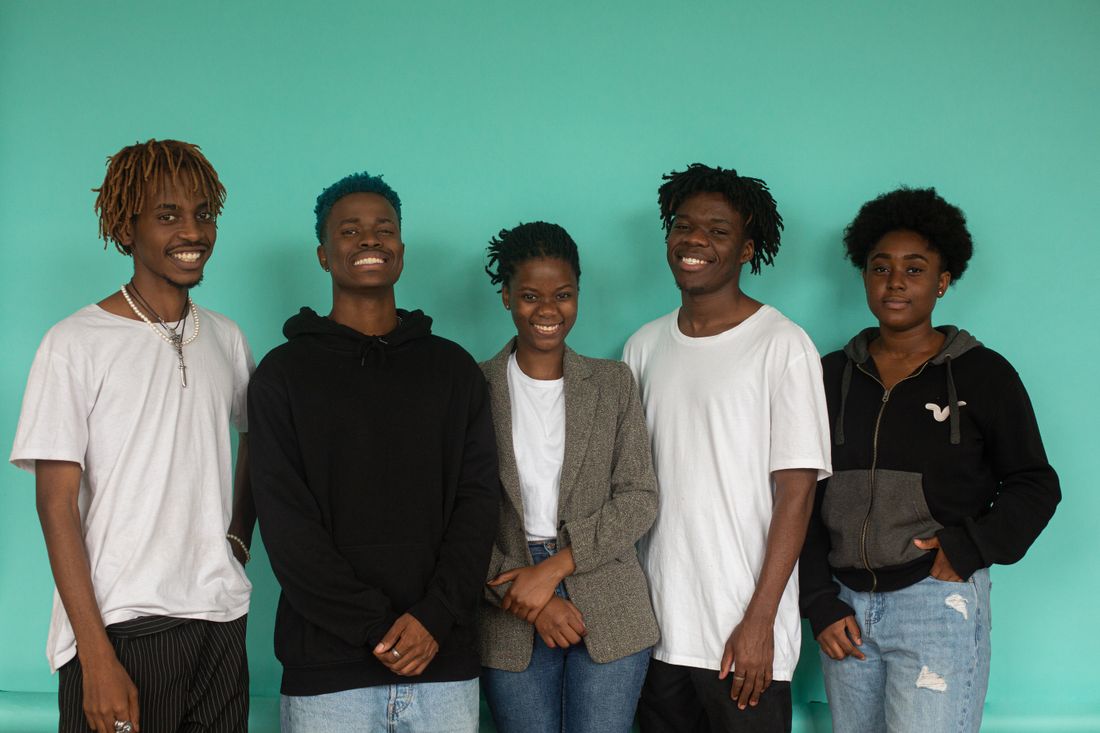
Five artists, one identity, and nobody wants to look like a corporate team. That is the actual brief behind most artist-collective portraits, whether or not the collective says it out loud. The group needs a single image that reads as one thing on a gallery wall, a grant application, or a press page, without flattening five distinct practices into a lineup of interchangeable professionals. Getting there is less about lighting or lenses and more about a handful of decisions the group has to make together before anyone stands in front of a camera: whether the picture admits a hierarchy, how five bodies get arranged so the group has a shape instead of a row, what wardrobe coordination looks like without turning into a uniform, and where the photo should even happen.
A collective portrait works when the group makes a handful of decisions together before the shoot: whether the picture shows an intentional front person or stays visually even, how five people get arranged into a shape rather than a row, a loose shared wardrobe range instead of matching outfits, and whether the location is a studio, a shared workspace, or the work itself.
What Makes A Collective Portrait Different From A Team Photo?
A collective portrait has to read as one identity built from several distinct people, not a lineup of professionals who happen to share a wall label. A corporate team photo solves for order and clarity. A collective's portrait solves for something closer to a working relationship: separate practices that share a name, a show, or a studio.
The instinct that ruins most collective portraits is treating it like a staff photo: same distance from the lens, same neutral expression, arranged by height. That reads as an office, not a collective. Artists who work together usually did not choose each other for uniformity. They chose each other for some combination of shared sensibility, overlapping ambition, or plain proximity, and the photo should carry a trace of that choice.
In practice, this means the planning conversation starts differently than a corporate headshot session. Instead of asking "how do we make everyone look equally professional," the useful question is "what does this group actually look like when they're in a room together, before anyone poses." A collective portrait that borrows too heavily from corporate team-photo conventions tends to flatten five distinct visual identities into one generic one, without erasing what makes each person's work their own. That undercuts the exact thing a gallery, press outlet, or grant panel is trying to learn from the image: who these people are, together and separately.
Does A Collective Portrait Need To Show Who's In Charge?
Not automatically, but the question has to be answered on purpose, not left to whoever ends up standing in the middle. Some collectives operate without a front person, and the portrait should say so through even spacing and shared eye lines. Others have a founder or spokesperson, and hiding that creates a mismatch with how the group functions.
The mistake to avoid is letting hierarchy get decided by accident, through whoever happens to be tallest, closest to the light, or most comfortable in front of a camera. A photo that visually promotes one member without the group intending that reads as a real signal to anyone looking closely, curators and journalists included, and it can outlast the group's own sense of how they work.
Many collectives land somewhere between fully flat and clearly hierarchical: one person handles press and scheduling without being "the leader," or founding members carry slightly more visual weight than someone who joined later. That's a legitimate answer, and a portrait can carry it honestly, a step forward, a slightly different angle, without turning into a spokesperson photo with background figures. The point is that this gets discussed before the shoot, not discovered by the group in the proof gallery afterward. A ten-minute conversation about who stands where, and why, usually prevents the awkward version of this problem: a photo that accidentally answers a question about status the group never meant to raise.
How Do You Arrange Five People So The Group Has A Shape?
Five people photographed in a straight row almost always reads as a lineup rather than a group. Giving the arrangement a shape, a loose triangle, a cluster with depth, two people slightly forward of three, does more to make a collective feel unified than matching outfits or matching expressions ever will.
Depth is the tool most portraits skip. Standing everyone on one plane, shoulder to shoulder, forces the eye to scan left to right like a police lineup instead of settling on the group as a single mass. Moving even two people six inches forward or back, or seating one person while others stand, breaks that flat line and gives the frame something closer to a real composition than an inventory of faces.
Height variation works the same way, and it doesn't require anyone to stand on a box. A natural range of heights in a group of five, combined with a few people turned slightly toward each other rather than every face square to the lens, reads as people who actually know each other rather than five subjects assembled for a photo. The arrangement conversation is also where the hierarchy decision from the previous section gets made physical: a flat group needs even, overlapping spacing, while a group with an intentional front person can use that same triangle shape to put one person legitimately closer to camera. Getting this right usually takes more time on set than the actual exposures, which is normal and worth planning for rather than rushing through.
What Does Wardrobe Coordination Look Like For A Group That Doesn't Want To Match?
Coordination without uniformity means agreeing on a shared color range, formality, or texture, then letting each person choose their own piece within it, not putting everyone in the same shirt. A collective in matching black turtlenecks reads as a brand. The same five people in a loosely shared palette reads as a group.
This overlaps with wardrobe planning for individual artist portraits, but the group version adds a coordination layer that a solo sitting doesn't need. The useful move is picking two or three loose parameters ahead of time, tonal range, dressy versus casual, whether anyone should avoid a pattern that clashes on camera, and sharing them with everyone the week before the shoot, each person choosing what actually fits their own practice within that range. That's a short message, not a styling meeting.
What tends to go wrong is either extreme: no guidance at all, which produces a group where one person is in paint-stained overalls next to another in a blazer, a jarring mismatch rather than a readable range, or over-coordination, where the group ends up looking like a uniform. The middle ground holds when everyone shows up in something that's recognizably them, inside a range loose enough to photograph as one group. A collective that already has visual language, a color a member's work tends toward, a material that shows up across the group's output, can sometimes borrow from that instead of inventing a new palette just for the photo.
Studio, Shared Workspace, Or The Work Itself: Where Should A Collective Shoot?
All three locations work, and each answers a different question about the group. A studio backdrop isolates the people and reads as neutral and press-ready. A shared workspace shows how the collective functions day to day. Shooting among the work itself ties the group directly to what they make, useful when the portrait doubles as promotion for a specific show.
A plain studio background is the safest default when the portrait needs to serve many uses: a press kit, a grant application, a gallery's artist page. It ages well and doesn't compete with anything in frame, but it also can't say much about the collective beyond who they are physically. A shared studio or workspace does more of that work automatically, real clutter, real materials, a sense of a place the group actually occupies, at the cost of needing more thought about what's visible behind them.
Shooting with the work present, canvases, sculptures, an installation in progress, raises the stakes and the payoff both. It ties the portrait to a specific body of work rather than the collective in the abstract, which is useful for a show announcement and less useful for a portrait meant to represent the group indefinitely. The honest answer to which location is "best" is that it depends on where the photo needs to live longest: a website that outlasts any one show favors the studio or workspace option, while a portrait built around one exhibition can lean into the work itself.
How Do You Schedule A Portrait Session Around Five People's Calendars?
Scheduling five working artists usually takes longer than the shoot itself, and treating it as a single quick group text tends to stall out. The more reliable approach is picking three or four candidate dates early, confirming them individually rather than waiting for a full group reply, and locking the session once a majority, not necessarily all five, can commit.
Five independent schedules rarely align on the first attempt, and waiting for unanimous agreement before booking anything can push a session back by weeks. A useful pattern is treating the scheduling itself like a small project: one person in the collective owns collecting availability, a short list of dates goes out with a real deadline for responses, and the session gets locked once enough of the group can attend rather than staying open indefinitely for the last one or two replies.
It's also worth deciding in advance what happens if someone genuinely can't make the date that works for everyone else. Some collectives push the whole shoot rather than photograph four out of five people. Others shoot the group that's available and schedule a short follow-up for whoever missed it, then composite or crop that person in later, an option worth naming honestly with the photographer rather than assuming it, since not every group shot supports a clean add. Neither answer is automatically right, but deciding it before the date arrives, rather than in a hallway conversation the morning of the shoot, keeps one person's conflict from becoming a crisis for the whole session.
Can One Session Produce Both A Group Frame And Individual Crops?
Yes, and planning for both from the start is more efficient than treating them as separate shoots. A single session can deliver a strong group frame plus usable individual crops of each member, but only if the lighting, spacing, and shot order are planned around both outcomes before the first frame is taken, not improvised afterward.
The practical constraint is lighting consistency. A lighting setup built purely for a five-person group, wide, even, flattering at a distance, will not automatically produce a clean individual portrait when cropped tight, because the light that reads well across a whole group can look flat or unflattering on a single face blown up to fill a frame. Planning individual coverage means budgeting a few extra minutes per person for a tighter, more deliberate frame within the same setup, not just cropping the wide shot after the fact.
Shot order matters more than it seems. Getting the full group frame first, while everyone is fresh and the arrangement is still holding, then rotating through quick individual frames without breaking the set, tends to produce better results than starting with individuals and trying to reassemble the group's energy afterward. A collective that knows in advance they'll need individual profile photos for a website or press kit should say so before the session starts, since a photographer planning for both from minute one gets meaningfully more usable range than one asked to improvise individual crops from a group-only shot list.
What Should A Collective Decide Before The Shoot Even Starts?
The shortlist that matters most: whether the group wants an intentional front person or even visual weight, a loose wardrobe range everyone agrees to, which location fits how the photo will be used, and whether individual crops are needed alongside the group frame. Deciding these before arrival turns the session into one calm decision instead of five people negotiating live.
None of these decisions need a formal meeting. A short shared message or a five-minute call covers all four, and it's worth having one person in the collective own gathering the answers rather than leaving it to the photographer to guess on the day. A photographer walking into a session without this information ends up making these calls under time pressure, with the whole group standing around waiting, which rarely produces the same result as a decision made calmly in advance.
The underlying idea across all of it is the same one that makes the rest of this article useful: a collective portrait works when it's planned as a group decision rather than five individual portrait sittings that happen to occur in the same room. The photo that results should look like something the group actually chose, its shape, its wardrobe range, its setting, rather than a default a photographer filled in because nobody had answered the question yet. That difference is usually visible in the final image, even to someone who wasn't in the room.
Frequently asked questions
Does every member of a collective need equal space in the group photo?
Not automatically, but the group should decide on purpose rather than let it happen by accident. A collective with no intentional front person needs even spacing and matched eye lines so no one reads as more prominent. A collective that does have a spokesperson or founder can let that show through position, without turning the rest of the group into background figures for one person's portrait.
What happens if one or two members can't make the shoot date?
Decide this before the date arrives, not the morning of the shoot itself. Some collectives push the whole session to a date that works for everyone. Others photograph the group that's available and schedule a short follow-up for whoever missed it, then work with the photographer on whether cropping or combining that person in later is realistic for how the final image gets used and sized.
Should a collective portrait be shot at a studio or at the members' own workspace?
Either works, and the right answer depends on where the photo needs to live. A studio backdrop is neutral and ages well across many uses, a press kit, a grant application, a gallery page. A shared workspace or the work itself shows more about how the collective actually functions or ties the portrait to a specific show, at the cost of needing more thought about what's in frame.
How many final images should a collective expect from one session?
That depends on what gets planned before the shoot, but a session built for both group and individual coverage typically delivers one strong group frame plus a set of individual crops of each member, using the same lighting setup. Planning for both outcomes from the start, rather than trying to crop individual portraits out of a group-only shot list, is what makes that range possible in one sitting.
Does a collective's wardrobe need to match for the portrait?
No, and matching outfits usually reads as a uniform rather than a group of artists. A shared color range, formality level, or texture, agreed on ahead of time, lets each person wear something that's recognizably their own while still photographing as one coordinated group. The goal is a loose range everyone fits inside, not identical shirts or a single dress code applied to all five people.
Let's find out which one you actually need.
We shoot both refresh sessions and full new concepts, and we'll tell you honestly which one your portrait needs before we book anything, not after.
Explore portrait sessions →