Artist talks run on a fragile kind of attention. The speaker is thinking out loud, the audience is leaning in, and the whole thing works because it feels unrehearsed, even when it isn't. A camera crew that shuffles, repositions, and visibly hunts for a better angle breaks that spell almost immediately, and once it breaks, the talk that gets recorded is a slightly more guarded version of the one that would have happened without a camera in the room.
None of that means the talk shouldn't be filmed. It means the filming has to be built around staying out of the way, which is a specific, plannable thing rather than a hope that the crew will just be quiet enough.
This guide covers where to put the camera, how to handle audio without adding visible gear, how much the crew should move, and what to tell the speaker and host ahead of time so nobody in the room is surprised by any of it.
Why filming breaks a talk's energy in the first place
It's rarely the camera itself that breaks the room. It's motion. A crew member crouching for a better angle, stepping into a sightline, adjusting a light mid-sentence, all of that pulls a few percent of the audience's attention away from the speaker every time it happens, and a speaker who's paying attention can usually feel it too. Enough small interruptions and the talk starts to perform for the room instead of think out loud to it, which is exactly the quality that made it worth filming in the first place.
The fix isn't invisible equipment, since nobody expects a camera to actually disappear. It's equipment and a crew that settle into the room early and then stop being an event of their own.
Where the camera should actually sit
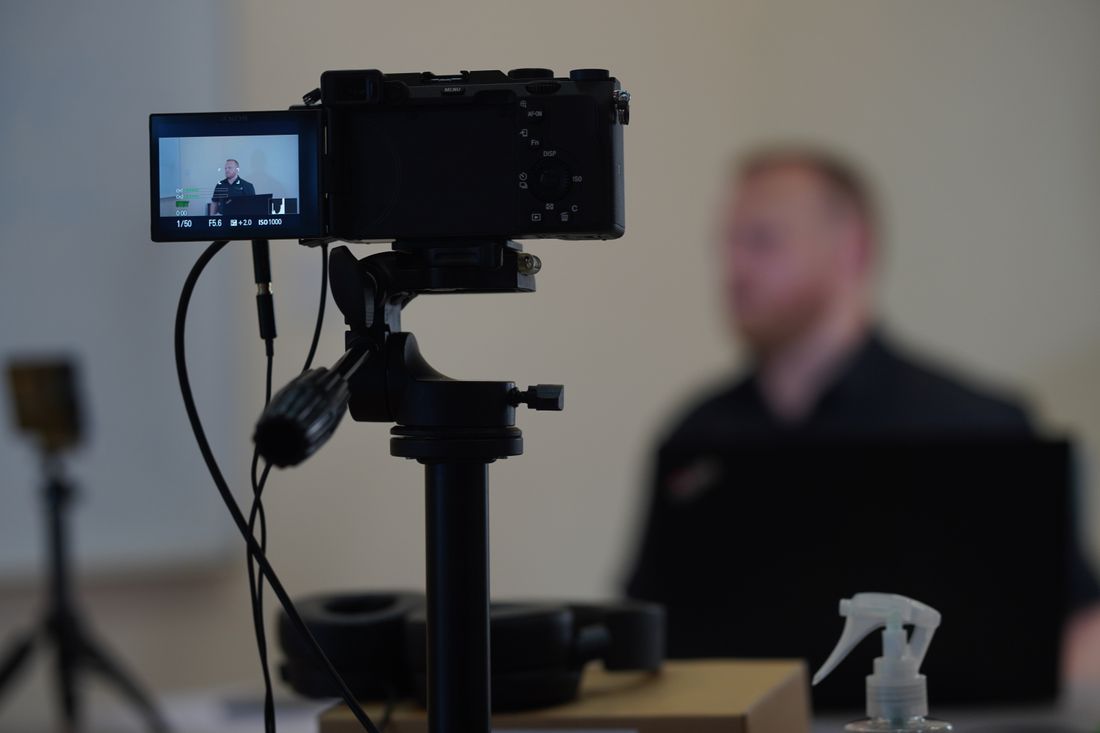
The strongest general position is off to one side, slightly behind the natural sightline between the audience and the speaker, angled to catch both without needing to pan. Directly in front of the speaker puts the camera in their eyeline for the entire talk, which subtly changes how they perform even if they never look at it directly. Directly behind the audience usually only catches the backs of heads and loses the speaker's expression, which matters more than most people expect for a talk that's meant to feel personal.
Height matters almost as much as angle. A camera set too low looks up at the speaker in a way that reads as either accidental drama or amateur setup. Roughly eye level with a seated audience member, angled slightly up toward a standing speaker, tends to produce the most natural framing without calling attention to itself.
Committing to one position
The single biggest visible-crew mistake is treating the talk like an event that needs continuous camera coverage from multiple angles. A talk isn't a wedding ceremony. It's closer to a long, single conversation, and a single well-chosen static position, with occasional slow reframing rather than constant adjustment, almost always reads as calmer and more professional than a crew that keeps moving to chase a better shot.
If a second angle genuinely adds something, a wider room shot for context, a tighter shot on the artwork being discussed, it's worth setting that camera up before the talk starts and leaving it running unattended rather than having a second crew member actively operating it throughout. Every additional visibly active camera operator is another source of small motion the room has to tune out.
Audio without visible gear
A camera's built-in microphone is almost never good enough for a talk, since it picks up room tone, HVAC noise, and distance in a way that becomes obvious the moment the footage is used for anything beyond a rough clip. That usually means a separate microphone, which introduces its own risk of becoming a visible distraction if it's handled wrong.
A small lavalier clipped discreetly to the speaker, run to a recorder rather than a visible cable snaking across the floor, solves most of this. Where a lav isn't practical, a directional shotgun microphone mounted on the camera itself, positioned to reach without needing to be moved, is the next best option. What doesn't work well is a handheld microphone passed around or held up mid-talk, since that turns a small conversational gesture into a visible production moment every time it happens.
What to tell the speaker and the audience beforehand
A short heads-up at the very start of the talk, from the host rather than the crew, does more for the room's comfort than any amount of quiet crew behavior. Something as simple as "this talk is being recorded, feel free to ignore the camera" settles the question once, for everyone, instead of leaving it as a low hum of uncertainty that resurfaces every time someone notices the lens.
The speaker specifically benefits from knowing the camera's plan in advance, not the technical details, just the shape of it. Whether it will move, whether there's a second angle, whether they need to project toward a particular part of the room for the microphone. A speaker who's been surprised mid-talk by a crew member repositioning tends to visibly lose their train of thought, even briefly, and that moment ends up in the recording.
Small rooms and tight gallery spaces
Gallery talks often happen in rooms that weren't designed for an audience, let alone an audience plus a film crew. In a tight space, the honest move is often accepting a slightly less ideal angle in exchange for a position that doesn't require the crew to be near the walking path between the audience and the work being discussed. A technically better shot that puts the camera in everyone's way isn't actually the better choice.
It's also worth scouting the room before the talk, not during it. Knowing where the light is strongest, where a window will blow out a background, and where a support column blocks the ideal position all changes based on the specific room, and figuring that out live, in front of a seated audience, is exactly the kind of visible fumbling this whole approach is trying to avoid.
Handling audience questions without breaking the flow
The Q&A section is usually where a well-planned single-camera setup starts to strain, since the room's attention shifts to whoever is asking a question, often from a seat the camera never anticipated. Chasing every questioner with a pan is one of the fastest ways to reintroduce the visible-motion problem this whole approach is built to avoid. In most cases, it's better to stay on the speaker and let the audio carry the question, rather than swinging the frame around to find a specific face in the crowd.
If a roaming microphone is being passed for questions, it's worth asking the host to repeat each question before answering, which is good practice anyway for audio clarity, and it also gives the camera operator a natural beat to make any necessary adjustment calmly rather than in a rush the moment a hand goes up.
What actually needs to be caught, beyond the talking
The talk itself is the obvious footage, but a few seconds of the room before it starts, chairs filling, quiet conversation, the artwork being discussed sitting there waiting, adds context that makes the final edit feel like it happened somewhere real instead of a disembodied talking head. The same goes for a few seconds of the audience's reaction at natural high points, a laugh, a moment of visible thought, caught from the same static position rather than a dedicated cutaway camera hunting for reaction shots.
None of that requires extra crew or extra equipment. It requires starting the recording a little earlier than the talk technically begins, and letting it run a little past the end, so the footage has room around it instead of starting exactly on the first word and cutting exactly on the last.
What the footage should actually become afterward
A full unedited recording of an artist talk is useful for an archive, but it's rarely what gets shared. The more useful output is usually a tighter cut, five to ten minutes of the strongest thinking, paired with a handful of thirty to ninety second clips built around a single clear idea each, the kind that work as a standalone post rather than requiring someone to watch a full lecture to get the point.
This is easier to do well when it's planned before the shoot rather than figured out afterward. Knowing that the edit needs a few strong, self-contained moments changes what the crew listens for during the talk itself, and it's part of why a calm, unobtrusive single-camera setup usually produces better usable footage than a busier multi-camera shoot that never quite settles into the room.
Frequently asked questions
How many cameras does an artist talk need?
One is usually enough for a small, intimate talk. Add a second only if the room is large enough that a single wide shot can't cover both the speaker and useful audience reaction without constant repositioning.
Should the audience be told they're being filmed?
Yes, a short note at the start, from the host or a visible sign, is enough. People settle into a talk faster once the camera has been acknowledged once, rather than left as an unexplained presence in the room.
Where should the camera be positioned during an artist talk?
Off to one side and slightly back, not directly in the speaker's eyeline and not in the main walking path between the audience and the work. The goal is a clean angle that doesn't require the crew to move once the talk has started.
Does an artist talk need a dedicated audio recording, separate from the camera's built-in mic?
For anything longer than a few minutes, yes. A camera's built-in microphone picks up room noise, HVAC, and distance in a way that becomes obvious the moment the footage gets used for anything beyond a quick clip.
How much should the crew move during the talk?
As little as possible. One well-chosen static position with a slow, occasional adjustment reads as calm coverage. Constant repositioning, crouching, and repositioning again pulls attention away from the speaker and toward the crew.
Get talk coverage that stays out of the room's way.
Camera and audio planned before the talk starts, so nothing shifts once people are listening.
Explore events →