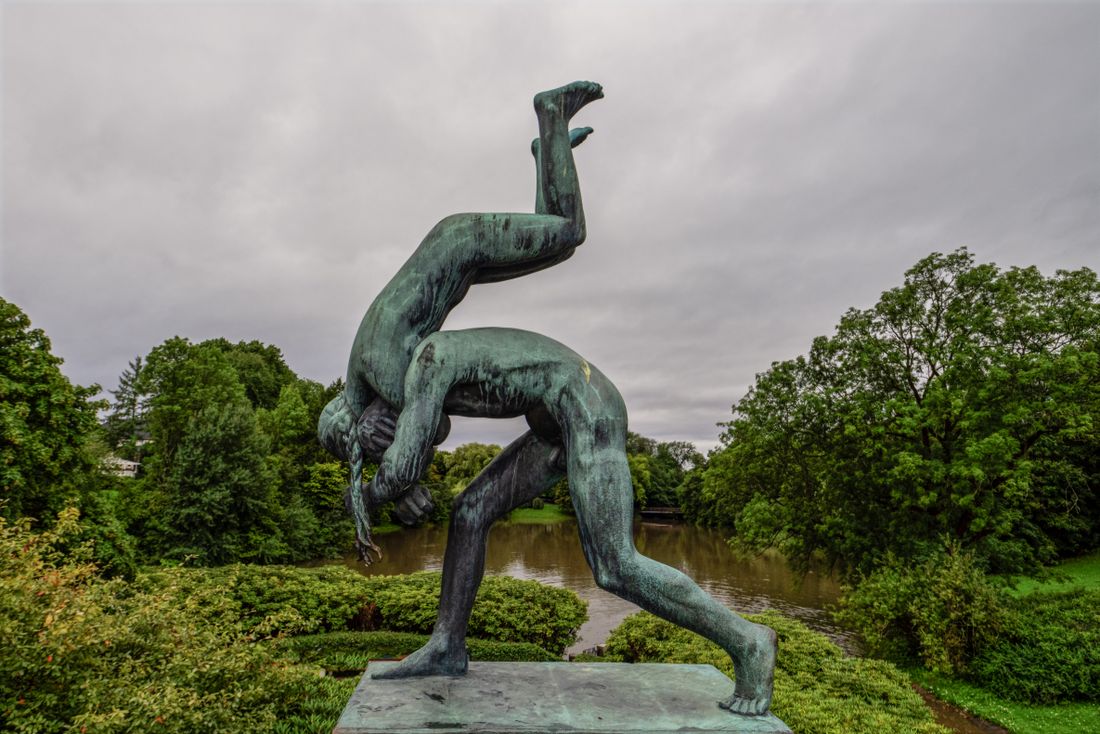
Outdoor art events don't get the luxury indoor openings have, a backup room to retreat to when the sky turns. The show happens anyway, rain or shine, which means the shot list, the gear plan, and the client conversation all have to be built around the version of the day nobody hoped for, decided ahead of time instead of improvised under a dripping tent.
Bad weather doesn't cancel outdoor art events. It changes the plan around them. Coverage needs a rain version of the shot list decided in advance, gear and artwork protection that don't slow the shoot down, a named decision-maker for on-site calls, and a client who already knows what grey skies do and don't affect.
What actually changes about outdoor art event coverage in bad weather?
An outdoor art event without a backup plan changes in one basic way: it almost always happens anyway, rain or shine, because there's no indoor room to retreat to. The shot list, the gear plan, and the client conversation all have to bend around the weather instead of the event moving to accommodate it.
An indoor gallery opening has a fallback built into the architecture. If it rains, the reception simply happens indoors, under the same lighting it would have used anyway, and the only real casualty is a sidewalk sign nobody photographs. An outdoor dedication, a sculpture garden reception, or a courtyard opening doesn't have that option. The tent might move ten feet, the schedule might shift by twenty minutes, but the event itself almost never relocates or cancels outright. Too much has already been arranged: caterers, remarks, an artist who flew in, guests who RSVP'd months ago.
That's the actual planning problem. It isn't "will this get rained out", it's "what does coverage look like when it doesn't." The honest starting point is to treat rain, wind, and flat grey skies as a second version of the day that needs its own plan, not an exception improvised in the moment. Everything downstream (the shot list, the gear bag, the light plan, and the conversation with the client) follows from accepting that upfront. Skip this step and the improvising happens live, in front of guests, which is the worst possible place to make it.
How do we pre-decide the rain version of the shot list?
We build two versions of the shot list before the event, not one: the sunny version and the rain version, mapped to the same schedule. The rain version swaps wide establishing shots and long sightlines for closer, more contained frames, and it moves fast because the decisions were already made before anyone got wet.
The planning happens at the walkthrough, not on the day. We look at the site and ask where people will actually cluster if it's raining (under an awning, inside a tent, near the entrance) and we build the shot list around those real gathering points instead of the ideal open-air composition we'd get on a clear evening. A shot that depends on an unobstructed view across a lawn doesn't survive a downpour; a shot built around a doorway, a tent line, or a cluster of guests does.
The rain version also reorders priorities. Group shots and wide crowd shots that look best with breathing room move down the list, because in weather nobody is spreading out. Everyone huddles. Close portraits, artwork detail shots taken under cover, and candid moments under umbrellas move up. The goal isn't to shoot a smaller version of the same list. It's a genuinely different list, built for how people actually behave when they're wet, cold, and trying to stay near the art anyway. Having both versions ready means the switch happens in seconds, not in a scramble.
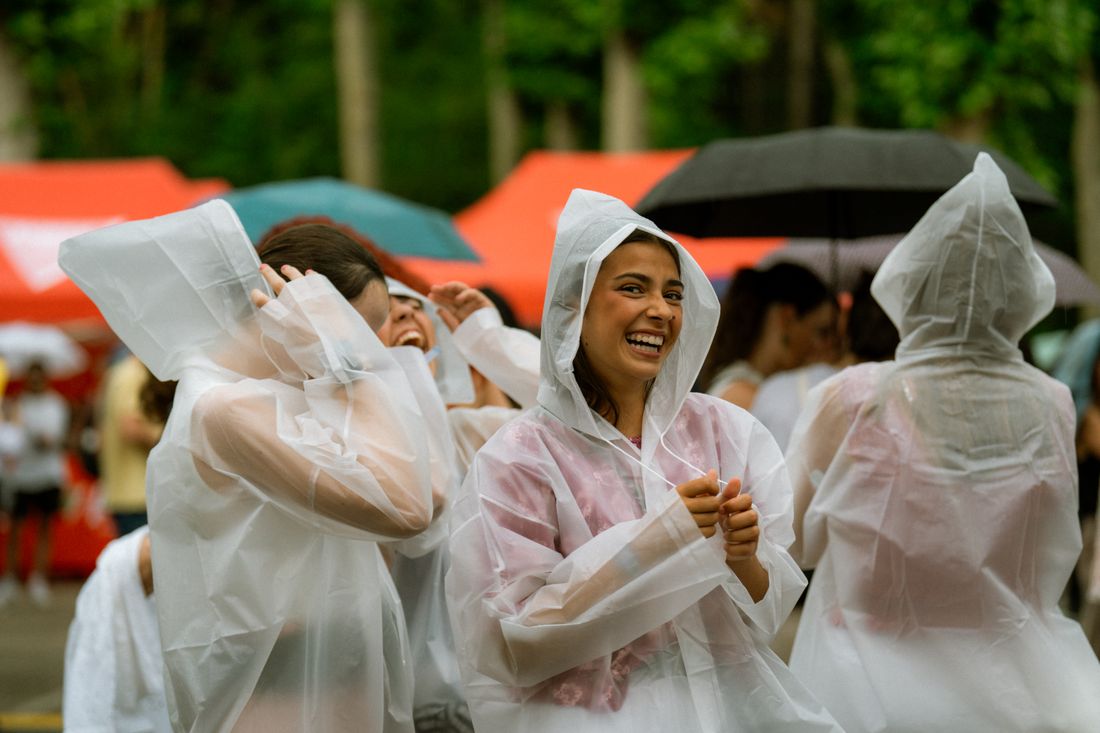
What actually protects the gear without slowing down the coverage?
Camera protection in bad weather is mostly about staying fast, not staying dry. A simple rain sleeve, a lens hood, a dry microfiber cloth, and a plan for where to duck for thirty seconds when it gets heavy cover the real risk. Elaborate rigs that take two hands to manage usually cost more shots than they save.
The actual failure mode on a wet shoot isn't a ruined camera body. Modern gear tolerates more moisture than people assume. It's losing time: fumbling with a cover, wiping a lens mid-moment, or missing a toast because the gear needed attention. So the working kit stays simple: a rain sleeve that goes on in seconds, a lens hood to keep drops off the front element, and a stack of dry cloths within reach the whole time, not buried in a bag.
We also build in a retreat point before the event starts (a tent flap, an awning, a doorway), somewhere to step under for a few seconds without leaving the room. That's usually enough to wipe a lens and reset. What we try to avoid is treating weather protection as a separate task that competes with shooting. The gear plan and the shot list are the same conversation: whatever keeps the camera dry also has to keep it ready, because a perfectly protected camera that's slow to raise is no better than one that's wet.
How do we protect the artwork itself, not just the gear?
The artwork usually needs more protection than the camera does. Canvas, paper, and unsealed sculpture surfaces don't tolerate moisture the way equipment does, so the coverage plan has to account for where the work is staged relative to wind-driven rain, not just where the crowd is standing.
An outdoor dedication or a sculpture unveiling often means the piece itself sits exposed for hours before and during the event, and wind can carry rain sideways under an awning that would otherwise keep it dry. Before we plan any shots, we ask the organizers what's already covering the work and whether that covering can hold up if the wind shifts. That's a question for the client and the installer, not something a photographer solves after the fact, but it does change how we shoot: if the piece has to be angled or partly covered for its own protection, the shot list needs a version that works around that, not one that assumes a clean, uncovered view.
We also stay alert to condensation and glare on protective coverings. A sheet of clear plastic over a piece can throw reflections that ruin a straight-on shot, so we look for angles that read past it. And we try not to be the reason a covering gets moved for a better photo. If protecting the work means an awkward angle for ten minutes, that's the trade we take. A slightly worse frame beats a piece that got rained on for a better one.
Is flat grey light actually a problem for outdoor art event coverage?
Flat grey light is not the disaster people assume. It's soft, even, and forgiving on faces and fabric, which makes it genuinely good for portraits and detail shots. Where it actually hurts is on work that depends on texture, dimension, or a strong light source, like deeply textured paint or reflective sculpture.
An overcast sky works like a giant softbox: no harsh shadows, no squinting, no blown highlights on someone's forehead. For crowd shots, remarks, and most portraits, that evenness is an advantage, not a compromise. It's the same quality a lot of indoor gallery lighting is designed to imitate. Many galleries actually try to recreate flat, shadowless light for exactly this reason, so grey-sky coverage often looks closer to a gallery's own lighting than a bright sunny day would.
The real cost shows up on the artwork itself. A painting with heavy impasto or visible brushwork relies on a directional light source to reveal that texture; flatten the light and the piece can read as duller or more two-dimensional in photos than it looks in person. The same goes for reflective or metallic sculpture, which needs some contrast to describe its form. In those cases we compensate with angle and distance rather than fighting the sky, moving to catch a bit of contrast from a nearby light source, or shooting closer to bring out texture a wider shot would lose in the flatness.
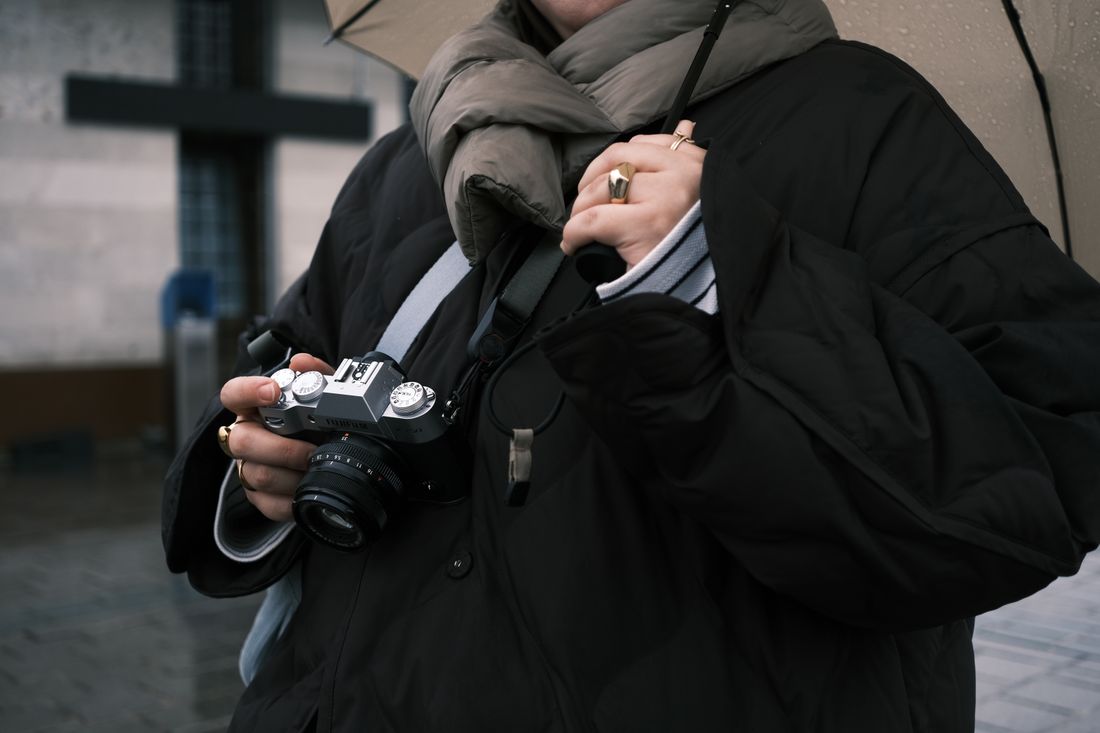
How do we shoot a crowd under umbrellas without every frame reading as misery?
The fix is mostly about timing and framing, not luck: we shoot the moments people are actually enjoying (laughing under an umbrella, leaning in to see a piece together) instead of the moments they're just enduring the rain, and we frame wide enough to catch body language, not just wet faces.
Umbrellas create a specific visual problem: they block faces from directly above, cast hard shadow lines, and can make a whole crowd look like it's hiding from the camera instead of enjoying the event. The instinct to shoot straight-on into that mess usually produces exactly the miserable, huddled look people worry about.
Angle solves most of it. Shooting slightly from below or from the side gets under the umbrella line and back to actual faces, and it usually reads as more natural than a shot fighting the umbrella head-on. We also wait for the in-between moments (someone tilting an umbrella back to talk to a friend, a shared laugh at getting caught in a sudden downpour) rather than shooting the walk between shelter points, where the grim expressions live.
The tone of the coverage still has to be honest. We're not trying to hide that it rained; a few atmospheric shots of umbrellas and wet pavement actually help tell the story of the night. The goal is balance: enough context to show it really was raining, and enough genuine, engaged moments that the event doesn't read as an ordeal everyone was suffering through.
Who actually decides when weather changes the plan on site?
One person needs the authority to make weather calls in real time (usually the event organizer or gallery contact, not the photographer), and that person should be named before the event starts, not figured out mid-downpour when everyone is looking at each other.
Bad weather produces small decisions all evening: move the remarks under the tent ten minutes early, pause the toast until a squall passes, shift the group photo to a covered spot. None of those are really our call to make alone, because they affect the program, not just the photography. What we can do is flag the option quickly and clearly ("if we move now we get better light for the toast") so whoever has authority can decide fast.
The failure mode we've seen is nobody having thought about this ahead of time, so decisions get made by committee in the moment, usually too late to help. We ask before the event: if it's raining hard during remarks, who makes the call to move things, and how do we reach them fast in a crowd. That's a two-minute conversation at the walkthrough that saves twenty minutes of standing around getting wet while three people politely defer to each other.
Having a named decision-maker also protects the coverage. If the photographer is the one deciding to move the whole event indoors, that's a scope change nobody agreed to. If the organizer decides and we adapt the shot list around it, that's just the plan working the way it should.
What should the client hear before the forecast turns?
Tell the client the plan changes with the weather, not the coverage itself. They'll still get a full shot list, a rain version of it, and honest expectations about what grey skies do and don't affect, ideally before the week of the event rather than the morning of.
The conversation that avoids surprise is simple and specific: explain that an outdoor event doesn't have an indoor fallback, so the plan is to adapt on site rather than reschedule, and that adapting means a different shot list, not a smaller one. Clients who hear this in advance tend to relax about the forecast; clients who hear it for the first time as the sky darkens tend to panic, which then shows up as pressure on everyone trying to work.
It also helps to say plainly what changes and what doesn't. Grey light is fine for portraits and most of the event; it can flatten certain artwork, and we'll compensate with angle rather than promise a fix that isn't real. Umbrellas will show up in some frames, and that's part of an honest record of the night, not a flaw to edit around. And if the rain is heavy enough to genuinely limit outdoor time, we say that early too, so the client can decide whether to shorten the outdoor portion rather than finding out afterward that half the shot list didn't happen. A client who knows the tradeoffs ahead of time makes better decisions in the moment than one hearing about them for the first time under a tent.
Frequently asked questions
Does rain automatically mean fewer usable photos from an outdoor art event?
Not usually. Rain changes which shots are usable, not how many. A rain-adapted shot list trades wide establishing shots and open sightlines for closer portraits, artwork details under cover, and candid moments near shelter points. Coverage volume stays similar because people don't leave. They cluster under tents and awnings instead of spreading across a lawn. The frames look different from a sunny-day set, but a well-planned rain version still delivers a comparable, usable gallery of the event.
Should an outdoor art opening be postponed if the forecast looks bad?
Rarely, and usually not for photography reasons. Outdoor dedications and gallery events involve caterers, remarks, and travel schedules that are hard to move, so most proceed regardless of forecast. The better question is whether the site has real weather protection for the artwork and a covered area for remarks. If those exist, coverage can adapt around the weather. Postponement is a client and venue decision driven by safety and logistics, not by whether photos will look different in rain.
Can editing fix a flat, grey-sky photo of artwork after the fact?
Editing can lift contrast and saturation, but it can't fully restore texture the light never captured. A painting shot in flat light loses some of its dimensional read, and heavy editing to compensate often looks unnatural rather than corrected. The more reliable fix happens on site: shooting from an angle that catches available contrast, moving closer to emphasize texture, or waiting for a brief break in cloud cover rather than trying to invent one afterward in post.
What's the biggest mistake clients make when weather turns bad for an outdoor event?
Assuming the photographer will simply figure it out in the moment without any prior conversation. That leaves nobody with clear authority to make calls about moving remarks, shifting group photos, or adjusting the schedule, so decisions happen late and under pressure. The fix is a short conversation before the event: who decides if plans need to shift, and what the rain version of the day actually looks like. That single conversation prevents most weather-day scrambling on site.
Do umbrella-heavy crowd photos always look bad in the final gallery?
No. They only look bad when every frame is shot the same way, straight into a wall of umbrellas. Mixing angles, catching genuine moments between shelter points, and including a few honest atmospheric shots of the rain itself usually reads as authentic rather than miserable. The goal isn't to hide that it rained. It's to balance real weather context with enough engaged, candid moments that the event still feels alive in the final set of photos.
Two openings on the same night doesn't have to mean a scramble.
We plan around clustered opening nights ahead of time, a split schedule, a second shooter, or booking early enough that the calendar stops being the risk.
Explore event coverage →