A brand film rarely shoots in one setup. It moves through an interview, a few passes of walking b-roll, and a handful of close detail inserts, often out of order and across several hours. The wardrobe has to survive all of it without ever reading as a costume change between scenes that are supposed to feel like the same continuous day. This is the on-set checklist for keeping it invisible, from the baseline set before the day starts to what happens if a reshoot lands weeks later.
Wardrobe continuity across a full brand-film shoot day comes down to a repeatable habit: set a wardrobe baseline before the day starts, take a continuity photo at every setup, write notes precise enough to rebuild the look, and pack backup only for what actually needs it. The same habit covers a reshoot that lands weeks later, when the original photos and notes are the only accurate record left.
Set a Wardrobe Baseline Before the Shoot Day Starts
Before the first take of a brand-film day, every hero piece needs a fixed, documented starting point. Jasmine photographs each outfit in its cleanest state, collar sitting flat, cuffs at whatever fold the plan calls for, buttons at the position the day will return to again and again, and writes down what the photo doesn't fully show. That baseline becomes the target for the rest of the day, not the outfit's condition at nine in the morning specifically, but the version everyone agrees is correct.
The reason this happens before anything else is that a shoot day almost never runs in the order it was planned. A scene meant to be shot first, while the wardrobe is freshest, can end up shot last if the schedule shifts, and by then nobody remembers exactly how a collar sat six hours earlier. A written and photographed baseline removes the guesswork a shifted schedule would otherwise force onto memory.
This is also where a spare of the hero garment gets confirmed, if one exists, and where the stylist flags anything fragile enough that a spill or a snag would be a real problem rather than a quick fix. Skipping this step doesn't save time. It just moves the cost to later in the day, when there's no clean reference left to check against.
Take a Continuity Photo at Every Setup
Continuity photos are the single habit that protects a brand-film day more than any other. Before the first take of every setup, the stylist takes a quick reference photo of the subject from roughly the angle the camera will use next, showing collar, cuffs, buttons, and any accessories exactly as they currently sit. That photo becomes the objective record to check against before the next take, instead of relying on memory.
Memory is the actual risk continuity photos solve. A stylist might remember an outfit looked right an hour ago, but "right" isn't specific enough to catch a cuff that has crept up half an inch, or a top button that came undone during a lighting adjustment. A photo shows the current state rather than a general impression of it.
The habit works best organized by setup, not by time of day. If the schedule reshuffles and the crew returns to a similar angle two hours later than planned, the fastest way to catch what has drifted is pulling up the reference photo for that exact setup, not scrolling through a folder in chronological order.
This matters more on a brand-film day than on almost any single still image, because video exposes a mismatch the moment an editor cuts between two takes that no longer agree. A continuity photo taken between setups is cheap insurance against something nobody notices until the edit.
Write Continuity Notes Precise Enough to Rebuild the Look
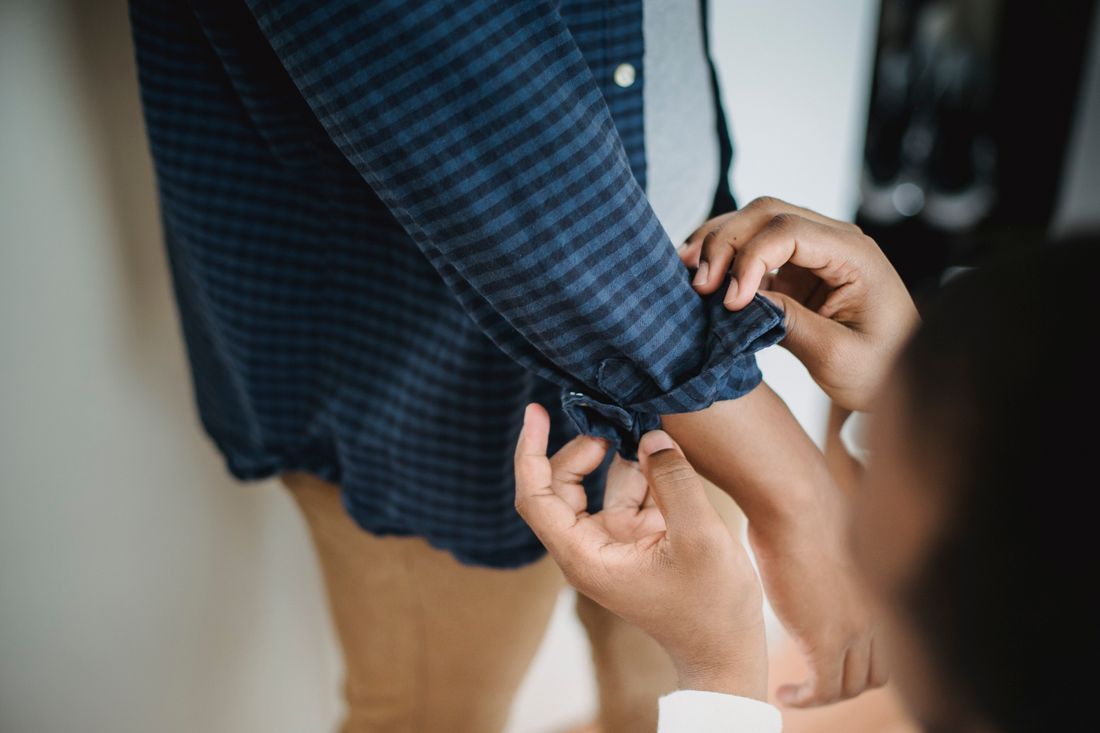
A photo shows the state of an outfit. A note explains it in words specific enough that someone could rebuild the look without seeing the photo at all. Continuity notes record how many times a cuff is rolled and to what point on the forearm, whether the top button is open or closed, how a scarf is tied, which side a watch sits on, and where any jewelry or accessory is positioned.
Vague notes fail in practice. "Sleeves rolled up" doesn't say enough to redo consistently, since rolled up could mean one fold or three, past the elbow or short of it. "Cuff rolled twice, folded edge sitting two inches above the wrist" is specific enough that a second stylist, or the same one hours later, can match it exactly.
The same precision covers details that seem small until an editor notices them mid-cut, which way a tie is knotted, whether a jacket is buttoned on the first or second button, whether a necklace pendant sits centered or slightly off. None of these matter on their own. All of them matter the moment two shots sit next to each other in the same sequence.
Notes work alongside continuity photos, not instead of them. If the exact photo angle isn't available for the next setup, the note is what rebuilds the state from words alone.
Know Which Wardrobe Changes Read as a New Chapter, and Which Read as a Mistake
Not every change in an outfit across a shoot day is a problem. A jacket coming off between an interview and a walking scene can read as a deliberate shift, the day moving forward, the subject settling into the work. A loosened tie or a rolled-up sleeve that nobody planned reads as a mistake instead, because it breaks continuity without telling the viewer why.
The difference isn't the change itself. It's whether the change is planned, logged, and consistent every time that scene gets cut into the film. A jacket removed for a b-roll segment needs to stay off for every take of that segment, not on in some passes and off in others depending on when they were shot relative to the interview. The moment it's inconsistent, what could have read as an intentional beat instead reads as an error.
This is where the stylist's judgment matters more than any checklist item. Before the camera rolls on a scene with a wardrobe shift, the stylist confirms whether that shift is part of the plan or something that drifted in unnoticed, and flags it either way so the editor isn't the one discovering it weeks later. A change caught and logged on set costs nothing. The same change discovered in the edit bay can cost a reshoot.
Pack the Backup Kit That Actually Gets Used
A few items genuinely need backup on a brand-film day: a spare of the exact hero garment when one exists, a steamer for wrinkles that build across hours, and safety pins or fashion tape for quick, invisible fixes. Most of the rest of the wardrobe is lower risk and doesn't need duplicate coverage, which keeps the kit manageable instead of a second closet.
The hero garment, whatever the subject wears in the most scrutinized shots, deserves an identical spare whenever the production can source one, since a spill or a tear on that specific piece has no quick fix otherwise. A steamer earns its space in every kit. It solves the single most common continuity problem, creeping wrinkles, in under a minute between setups without pulling anyone off set for a change.
Safety pins and fashion tape handle the small, silent failures, a gaping button placket, a collar that won't sit flat, a hem that has started to fall. These fixes are invisible on camera and fast enough to apply between takes without holding up the crew.
Lower-risk items are anything with no close-up planned, anything layered under a jacket that stays closed all day, or accessories that aren't central to a specific shot. Backing up everything equally spends a production's budget and a stylist's attention on pieces the camera will barely register.
Treat Interviews, Walking B-Roll, and Detail Inserts Differently
A seated interview is the easiest continuity problem on a shoot day, since the subject holds one framing and largely one position for long stretches. The risk there is slow: wrinkling that builds while someone sits still, a jacket riding up from leaning forward, a collar shifting between questions. The quieter danger is time. A thirty-minute interview gives sweat and creasing far more time to build than a thirty-second walking shot does, even though nothing dramatic is happening on camera.
Walking b-roll tests the opposite thing, whether a jacket stays put, a hem swings the same way twice, a cuff creeps up with each stride. That only shows up by watching the actual walk, not by checking the outfit while the subject stands still. Detail inserts flip the priority again. Nobody cares how a cufflink or a stitched seam moves in a two-second close-up. They care whether that exact patch of fabric is smooth and clean, because the frame magnifies it past what the eye would notice at normal distance.
All three need the same discipline for different reasons. An interview needs a mid-session check, b-roll needs a rehearsal pass before the take that matters, and inserts need a close visual check immediately before the lens gets near the fabric.
What Happens When a Reshoot Lands Weeks Later
Sometimes a scene has to be redone weeks after the original shoot day, because an edit decision changes, a piece of footage doesn't cut the way anyone expected, or a schedule conflict pushed a setup off entirely. By then, nobody remembers exactly how a collar sat or a cuff was rolled, and the garment itself may have been cleaned, altered, or simply isn't sitting in a closet the same way it did on set.
This is the moment the original continuity photos and notes stop being a same-day convenience and become the only real record. Without them, matching a reshoot to footage from weeks earlier is a guess. With them, it's a comparison, pull the reference photo and the written note for that exact setup, and rebuild the look the same way a second stylist would on the original day.
If the exact garment isn't available anymore, the reference photo is what a close replacement gets checked against, not a general memory of what the outfit looked like. This is also the practical argument for keeping continuity photos and notes archived after a shoot wraps rather than discarding them once editing finishes. A reshoot weeks or months out is not a rare edge case on a brand-film production. It's common enough that the archive should assume it will happen.
Not sure what to wear for your portrait session?
We build the wardrobe plan around your actual work and how you present it, so the clothes support the portrait instead of competing with it.
Explore styling services →