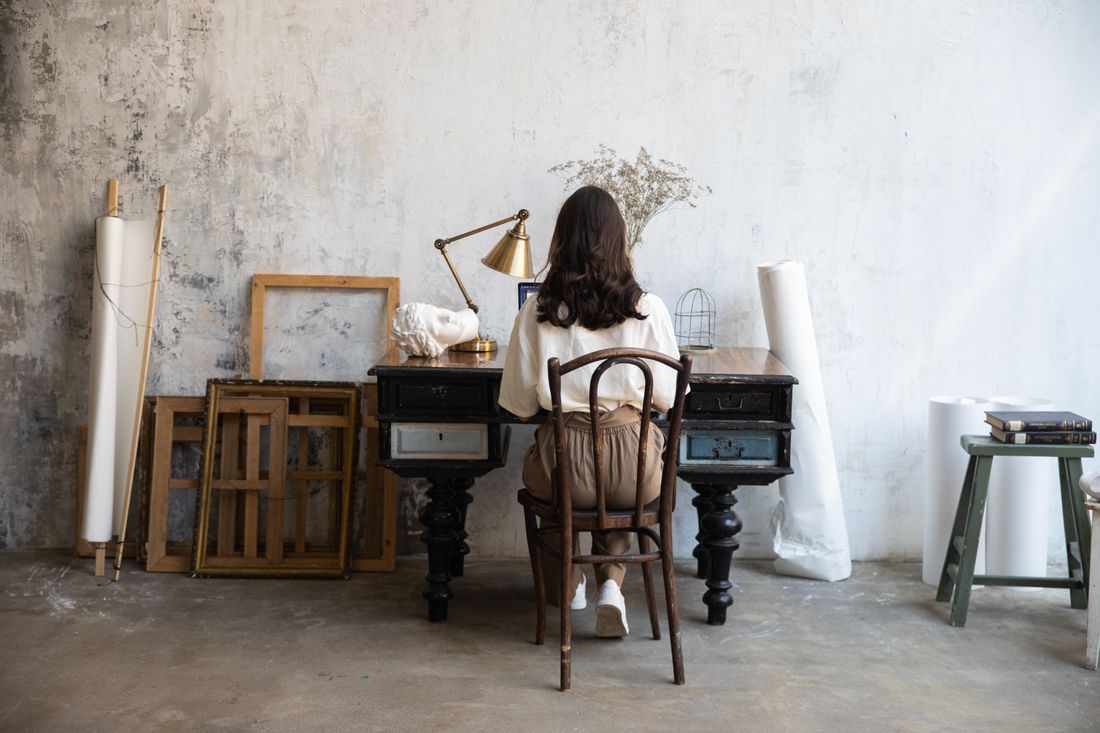
Not every artist will sit for a camera pointed at their face, and that does not have to end the conversation. A portrait built around hands, tools, and a figure turned into their own work has its own grammar, and its own limits, which are worth knowing before the shoot instead of after a submission bounces.
A portrait without a face (hands mid-task, a tool held the way only that person holds it, a figure turned into their own space) is a legitimate way to photograph someone who won't sit for a camera, not a lesser substitute. It has real limits: a press desk or grant panel sometimes requires a recognizable face, and no amount of styling changes that. The decision belongs before the shoot, not during it.
What actually counts as a portrait without a face?
A portrait without a face is exactly what it sounds like: an image that identifies a person through everything except their face. Hands caught mid-task, the specific tool they hold, the back of a head bent over a table, the shape of someone inside their own space. It is a real photographic approach with its own rules, not a workaround for someone who would not sit still.
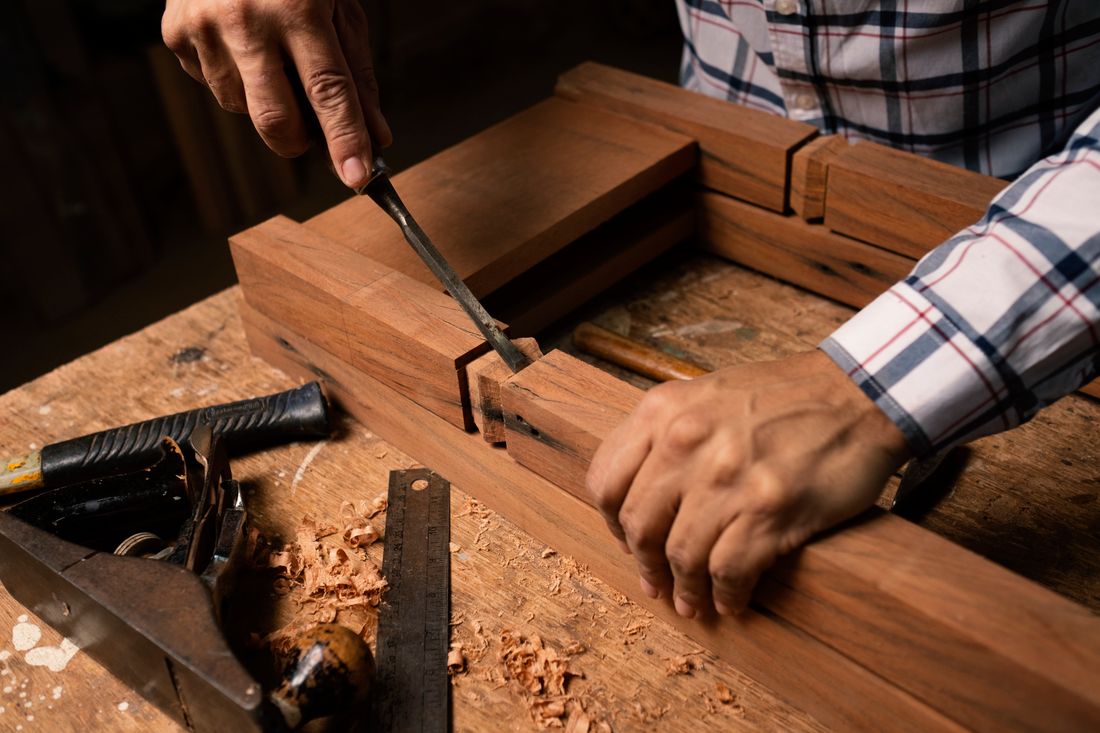
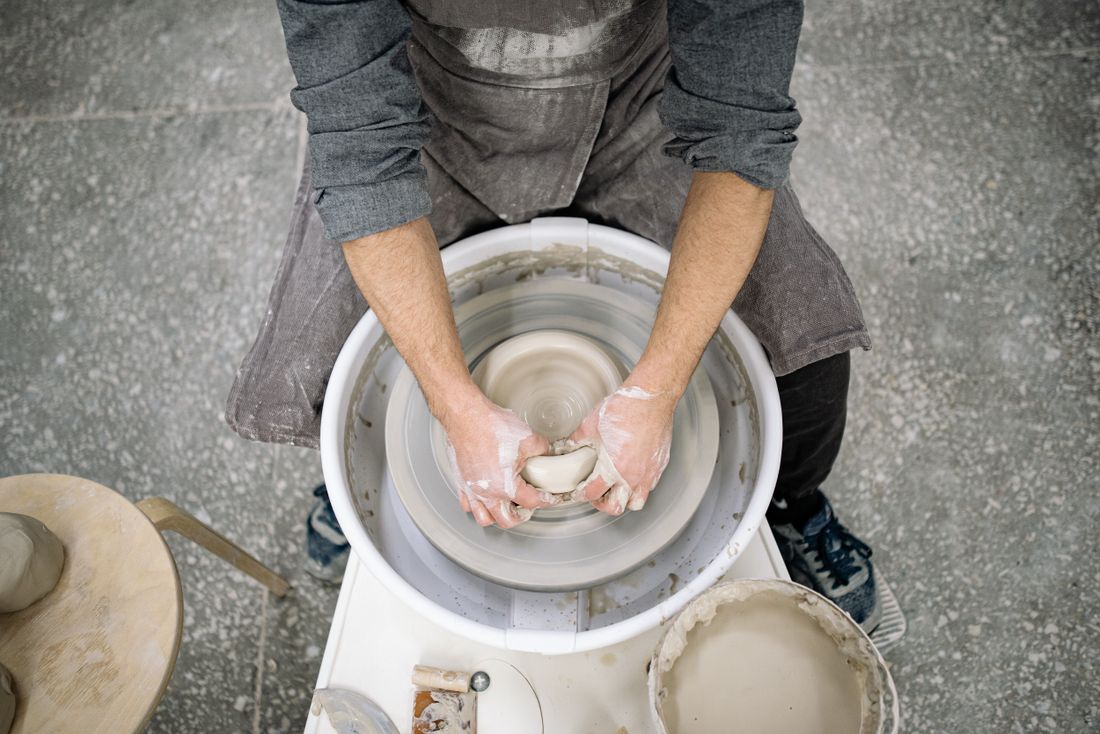
The approach has been used for as long as portraiture has existed, usually for one of two reasons. Sometimes the subject genuinely does not want to be photographed head-on. Some artists find a lens pointed at their face uncomfortable in a way that has nothing to do with vanity, and forcing the issue produces a stiff, unusable image anyway. Other times the face was never the point. A woodworker's hands on a chisel, a painter's forearm streaked with pigment, a potter's back curved over a wheel. These can say more about the work than an expression ever would.
What makes it a portrait rather than a process photo is intent. The frame is still built around one specific person: their scale, their gesture, the particular way they hold something nobody else would hold quite the same way. Remove the face, and the photograph has to work harder everywhere else: posture, light, the objects chosen to sit in frame, the crop. Done well, it reads as a deliberate choice. Done carelessly, it reads as an image that is simply missing something, which is the risk worth naming honestly before deciding to shoot this way.
Who does a faceless portrait actually serve?
This approach serves two different groups for two different reasons: artists who find a straight-on lens genuinely uncomfortable, and artists whose identity is more legible through process than expression. The first group needs an alternative that still functions as a portrait. The second group is usually better served by this approach on its own merits, not as a substitute for anything.
The first group is real and worth taking seriously rather than treating as a client-management problem to smooth over. Many artists spend their working life avoiding attention, and a camera pointed at their face can produce a flat, guarded expression no amount of direction fixes in the moment. For that subject, a faceless portrait is not a lesser image; it is often the more honest one, because it does not force a performance the person cannot give.
The second group is different. A maker whose whole practice is tactile (someone who works with their hands, at a bench, in front of a kiln, at a loom) often communicates more through the object and the gesture than through a headshot ever could. In that case a faceless portrait is not a workaround at all. It is simply the stronger image, chosen because it tells the truth about how the person actually works, not because a face was unavailable. Knowing which group a given artist falls into changes how the session gets planned, even when both end up using the same visual language.
What replaces the face: hands, tools, and posture
When the face is out of frame, three things carry the identity of the portrait instead: the hands, the tool or material in them, and the posture of the body in its space. Each one has to be specific to the person, not generic. A stock gesture of holding a paintbrush reads as illustration, not portraiture.
Hands are the most expressive substitute available. The way a person actually grips a tool (loose or tight, high on the handle or low, steadying with the other hand or not) is as individual as a face, and a camera close enough to catch that detail does real work. Knuckles, calluses, the tension in a wrist mid-motion: these are not filler, they are the portrait's main subject now, so they need the same attention to light and focus a face would normally get.
The back of the head and the line of the shoulders matter more than they would in a face-forward portrait, because they are doing more of the storytelling. A figure turned three-quarters away, angled toward the work rather than the camera, reads as absorbed rather than evasive. Distance matters too: a wide shot of someone turned away in their space says something different from a tight crop on hands alone, and the two are not interchangeable. The wide version places the person in context, the tight version isolates the gesture. A strong faceless portrait usually needs both to feel complete rather than partial.
How do you direct a session where the face never shows?
Directing a faceless session means giving the subject a real task to do rather than a pose to hold, then shooting the genuine motion that results. Without an expression to coach, the photographer's job shifts almost entirely to timing, framing, and reading the body. Asking someone to act natural without a face to read is a much emptier instruction than it sounds.
In practice, this starts before the camera comes out. The subject needs something real in front of them (work in progress, a tool they actually use, a surface they actually work at) because faked motion looks faked even with the face removed. A hand pretending to sketch reads differently than a hand actually sketching, and a camera close enough to matter will show the difference. Give the person their normal task and let several minutes pass before shooting seriously; the first attempts are almost always more self-conscious than the ones that follow.
Framing decisions do more of the work here than direction does. Where the crop falls, how much of the room is visible, whether the light falls across the hands or flattens them. These choices carry the meaning an expression would normally carry elsewhere. It also helps to shoot more variation than a face-forward session would need: more angles, more distances, more moments inside the same task, because there is no single decisive expression to wait for. The best frame usually turns up in the middle of real, repeated motion, not in a held position.
Where does a faceless portrait actually earn its place?
A faceless portrait works best anywhere the goal is to communicate identity, practice, or atmosphere rather than provide a literal likeness: an artist's website, a studio page, social content, or an image sitting next to a written profile. It struggles anywhere the image itself has to function as proof of who someone is.
On a website or portfolio, a faceless portrait can sit comfortably alongside or even instead of a conventional headshot, especially when the site already includes other photos of the person elsewhere, or when the artist has deliberately kept their public image process-focused rather than personality-focused. It pairs particularly well with studio or process content, where a hands-and-tools image extends the same visual language a studio-visit shoot already uses.
It also works well as a secondary or supporting image even when a conventional portrait exists. An about page rarely needs only one photo, and a faceless shot can carry mood or texture a straight headshot cannot. Editorial and lifestyle use cases are generally forgiving of it too, since the point of that kind of coverage is usually the work and the setting, not a verified likeness, and a caption can do the identifying that the image itself does not. The common thread across every use case where this succeeds: nobody downstream needs the image to confirm identity on its own. The moment that requirement enters the picture, the calculation changes completely.
Where will a press desk or grant panel reject it?
A faceless portrait falls short anywhere the image has to do identification work: press submissions, wire distribution, grant and residency applications, and any panel or committee that reviews a body of applicants by face as part of the process. In those contexts, a photo that deliberately omits the face can read as evasive even when that was never the intent.
Press desks in particular tend to have unwritten expectations about what an artist photo looks like, and a hands-only or back-of-head image can get quietly passed over in favor of a submission from another artist that shows a recognizable face, simply because it is faster to use. A picture editor working on deadline is not going to puzzle over an artistic choice; they will move to the next file. The same logic applies to some grant panels and fellowship committees, where reviewers may be looking at dozens of applications and using the photo, fairly or not, as a quick anchor for the person behind the work.
This is not a universal rule (plenty of publications and panels care only about the work) but it is common enough that it should not be discovered after a submission has already gone out. The honest version of this section is not never submit a faceless portrait, but check what the specific desk, program, or panel actually requires before assuming a faceless image will be accepted in place of a straightforward one.
Why does this need deciding before the shoot, not during it?
This decision needs to happen before the shoot because a faceless portrait and a conventional one require different setups, different light, and often a different mood from the subject, and trying to improvise both in the same short window usually weakens each one. Deciding in advance lets the session build toward a real plan instead of a scramble.
In practice, that means asking a short set of questions before booking anything. Where will this image actually be used, this year and likely next year? Does any of those uses have a stated requirement for a recognizable face: a press kit, a grant application, a professional directory? Is there a second, separate use case, like a website about page, that has no such requirement at all? The answers usually sort an artist into one of three positions: needs a conventional portrait only, wants a faceless portrait only, or needs both for different purposes.
Sharing this upfront changes how a session gets planned: the order of setups, how much time goes to each, and whether wardrobe or grooming decisions matter at all for the faceless portion. It also avoids the worst version of this problem, which is finishing a session with only faceless images and then discovering, weeks later, that a submission needed a face after all. That is a scheduling problem a short conversation before the shoot avoids entirely.
Is there a middle ground that shoots both in one session?
Yes, and it is usually the safest default: most sessions can produce a small set of conventional portraits alongside a set of faceless images without meaningfully lengthening the shoot, because the same location, light, and subject are already in place. The faceless portion often takes less time than expected once the conventional portraits are done.
A practical order is to start with the conventional portrait while the subject is fresh and the light is at its best, then move into the faceless work once the person has settled into the space and stopped performing for the camera. By that point, real, unguarded motion is easier to get, and the faceless images often end up feeling more natural than anything shot earlier in the session. Running the order the other way, faceless first, risks the subject staying self-conscious even once the camera turns toward their face.
This hybrid approach also solves the archive problem: an artist who only has faceless images has one option for every future use, while an artist with both has a choice every time a photo gets requested. It costs a little more session time and a little more planning up front, but it removes the guesswork later, when a press desk or grant panel asks for something the faceless set cannot provide and there is no time left to reshoot before the deadline passes.
Frequently asked questions
Does a faceless portrait still count as a professional headshot?
Not usually. A headshot is expected to show a recognizable face for identification purposes: a directory listing, a byline, a professional profile. A faceless portrait can be professional in quality and used in many of the same places, but it is not a substitute wherever the specific requirement is a visible face. Treat it as a different image type with a different job, not a stylized version of the same headshot.
Will a faceless portrait hurt an artist's website or social presence?
Not on its own. Many artist websites and social accounts mix faceless process shots with occasional conventional portraits, and audiences generally respond well to images that show real work happening. The risk shows up only when faceless images are used exclusively, so a visitor never gets any sense of who the artist is. One conventional portrait somewhere on the site usually closes that gap without a full portrait session.
Can a faceless portrait be turned into a face-forward one later if needed?
Not from the same images. A photo taken to deliberately exclude the face cannot be reshot into showing one after the fact, no matter how it gets cropped or edited afterward. If there is any chance a future submission will require a recognizable face, the safer move is scheduling a short conventional portrait alongside the faceless session now, rather than assuming a reshoot can happen later when the need actually comes up.
What should an artist bring to a faceless portrait session?
Whatever they actually use in their normal working process: real tools, real materials, work in progress rather than a finished, staged piece. Faked or borrowed props tend to look faked once the camera gets close, because the way someone handles an unfamiliar object reads differently from the way they handle their own. The most convincing faceless portraits use the ordinary objects and gestures already present in the artist's regular practice.
Is a faceless portrait cheaper or faster than a conventional one?
Not inherently. It typically takes a similar amount of session time, since it still requires careful light, framing, and multiple takes of real motion. Where it can save time is when it is added onto an existing session that already has the subject, location, and light in place, since no new setup is required. On its own, budget and schedule it the same way as any other portrait session.
A portrait that's aged doesn't always need a full reshoot.
We'll look at what you have and tell you honestly whether a refresh session covers it or the work calls for a new concept.
Explore portrait sessions →