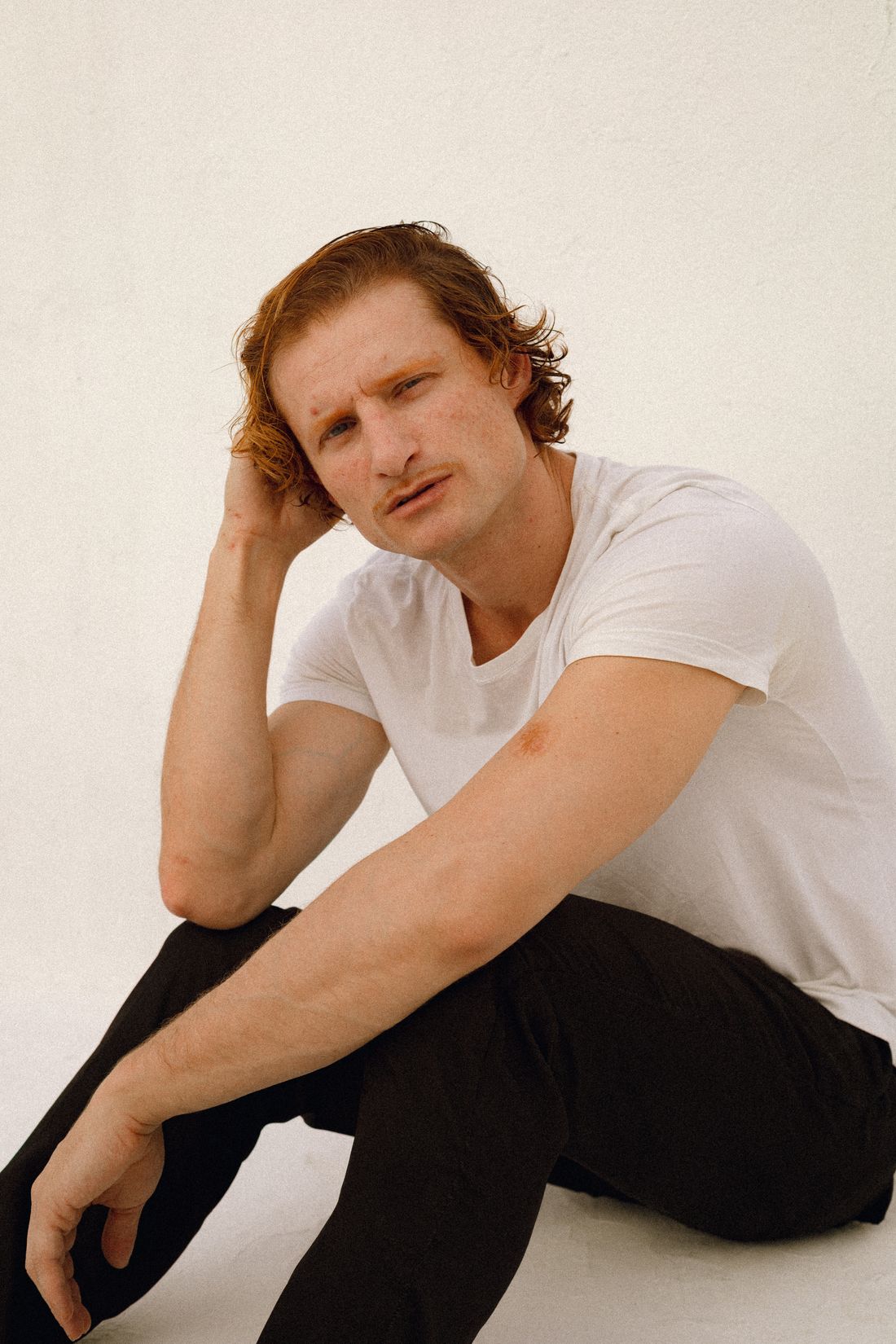
A writer doesn't have a painting to stand beside. A composer doesn't have a sculpture. A curator of digital work doesn't have anything you can point a camera at and say, there, that's the thing they made. The usual artist portrait solves itself by leaning on the object: shoot the person next to the piece, and the piece does half the work. Take the object away and the whole formula stops working, which means the portrait has to find a different kind of evidence entirely, built from the room, the tools, the hands, or the plain fact of what's missing.
When there's no object to stand beside, a portrait leans on the room, the tools, the hands, or the process residue instead: a stack of pages, an instrument case, a desk mid-thought. The person becomes their own evidence, and the environment carries the specificity a physical artwork would normally supply.
Why the “Artist in Their Studio” Portrait Doesn’t Work Here
The standard artist portrait leans on a second subject: the artist next to the canvas, the sculpture, or the finished piece. A writer, a composer, or a curator of digital work has no comparable object. Their evidence lives in a manuscript, a score, a screen, or a decision nobody can see, so the usual formula has nothing to stand next to.
That formula works because it solves two problems in one frame. It gives the composition a second point of interest, and it proves the subject's authority at a glance: this is the person who made that. Take the object away and the photographer loses both the anchor and the proof. A painter shot empty-handed in a plain room still reads as a painter, because the room carries paint stains, canvases leaning against the wall, brushes standing in a jar. A composer photographed in that same bare room just reads as a person standing in a room.
This isn't a case where the subject is simply harder to light. The entire mental template behind a “creative portrait,” the one every art director and picture editor pictures automatically, assumes an object that doesn't exist for this subject. Naming that early changes the whole session, from the questions asked beforehand to the lens chosen on the day. The fix isn't better lighting on an empty desk. It's finding what actually stands in for the missing object, and that's a planning decision before it's a photography decision.
The Room as the Second Subject
The room a person works in usually carries the most immediate substitute for the missing object: a writer's desk with its own worn geometry, a composer's studio with instrument cases and cable runs, a curator's office with stacked folders and a wall of pinned notes. Shot from three-quarter distance, the room becomes the evidence the object would have provided.
What makes a room read as lived-in rather than staged is specificity, not tidiness. A perfectly ordered desk photographs as a furniture catalog. A desk with an actual stack of pages, a chipped mug, and a lamp angled the way the person always angles it photographs as a place someone actually works. The goal on a shoot day isn't to clean up before the camera arrives, it's to leave the room exactly as it is and choose the angle that shows the truth of it.
The risk with a room-as-subject portrait is letting the space upstage the person. A wide shot of a beautiful office with a small figure in the corner reads as architecture photography with a person included, not a portrait. Keeping the subject at three-quarter distance rather than full environmental-portrait distance, with the room visible but secondary in the frame, keeps the balance where it belongs: on the person, with the room doing quiet supporting work behind them. Soft directional window light helps here too, since it keeps the room readable without turning it into the kind of even, catalog-flat lighting that erases the texture the room was chosen for in the first place.
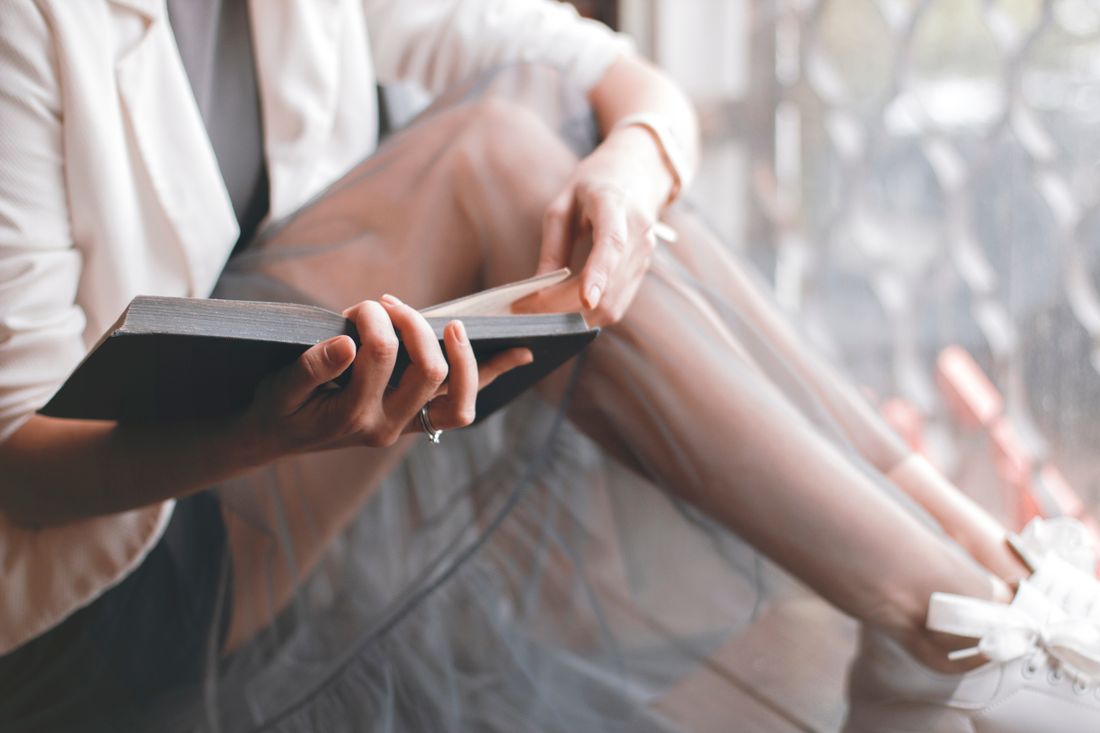
Tools and Instruments as Evidence of the Work
A tool the subject actually uses, an instrument, a notebook, a specific pen, a stack of index cards, can do the same job an artwork does in a traditional portrait: it proves the work is real without needing to show the work itself. The tool doesn't have to be the finished piece. It has to be recognizably theirs.
This works best when the tool shows use. A guitar with worn finish where a hand rests a thousand times a year reads differently than a guitar propped up for the photo. A notebook with a cracked spine and a rubber band holding loose pages reads differently than a blank one bought that morning. The object needs history, and history is what a prop chosen for the shoot, rather than lived with, can't fake convincingly.
The other advantage of a real tool over a generic backdrop is that it narrows the portrait to this specific person's practice rather than a generic version of their field. A composer's particular notation software, open on a particular screen and angled so nothing readable is visible, still communicates something a stock image of “a person at a keyboard” never could.
None of this requires the tool to be central in the frame. A tool sitting slightly out of focus at the edge of a three-quarter portrait often communicates more than one held up for the camera, because it looks like something the person happened to be near rather than something staged for the visit. Its job is to support the read, not compete with the person for attention.
Hands and the Residue of Process
Hands at rest, ink-stained fingers, calluses from a bow or a keyboard, a hand mid-gesture over a page, can carry as much information as a face when the work itself can't be shown. A close, quiet shot of hands says something a wide environmental shot often can't: this is what the work actually costs the body.
Process residue works the same way. A stack of notebooks left face-down, a coffee ring on a manuscript, a whiteboard half-erased from the last working session, all of these are physical traces of thinking that happened, even though the thinking itself was never visual. A single close frame of that residue, shot from the side at medium distance, can carry more truth than a posed shot of the person holding up a laptop and smiling at it.
The caution here is the same one that applies to a formal hands-only or faceless portrait approach: this works as one element inside a fuller set, not as the entire solution on its own. A full portrait built around this subject usually needs at least one frame that includes the face, because the residue supports the story of the work, it doesn't replace the story of the person doing it. A close hands frame reads best as a second or third image in a small set, sitting alongside a three-quarter portrait that shows who the hands belong to, rather than standing in for the whole assignment on its own.
When Absence Itself Becomes the Subject
Sometimes the most honest frame is the one that shows nothing where the object would normally be: a blank page under a hand that hasn't started yet, an empty chair in a recording booth, a closed laptop on an otherwise busy desk. Absence photographed deliberately reads as intention, not as a missed shot.
This only works when the emptiness is composed on purpose rather than happening by default. A blank page shot because there was nothing better to point the camera at looks like a failed still life. A blank page shot because the piece's whole subject is the moment before the work exists reads as a genuine editorial choice, and it usually needs a caption or a nearby line of text to land that way for a reader who wasn't in the room.
Absence also solves a problem the room and the tools can't: it's honest about work that genuinely has no physical form at any stage, a curator's decision-making, a critic's read on a show, an editor's judgment calls. For those subjects, showing nothing where the reader expects something is often closer to the truth than inventing a prop that implies a physical process that never happened. It also tends to be the option that ages best, since a deliberately empty frame doesn't date the way a specific piece of software or a specific model of equipment eventually does.
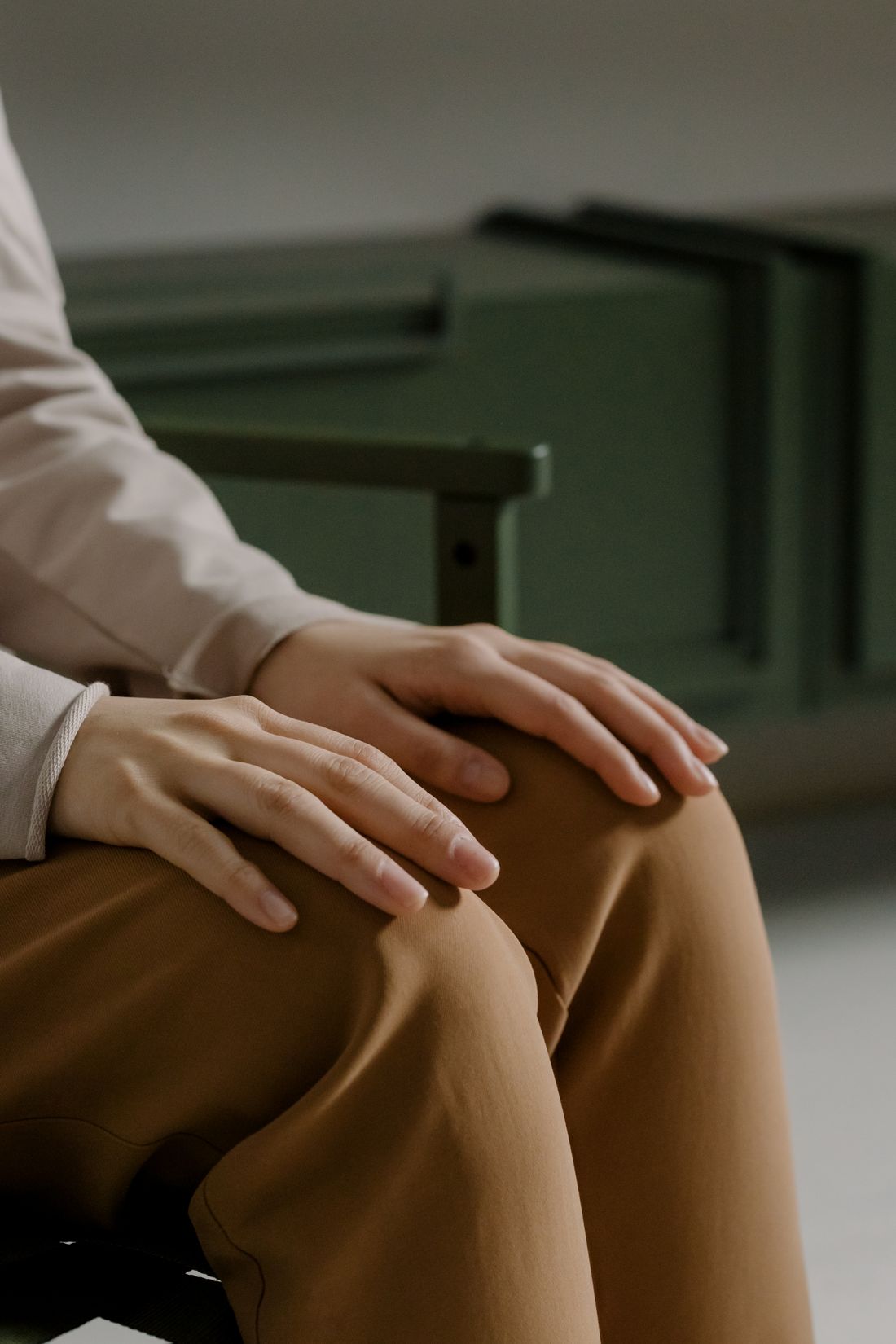
How the Pre-Shoot Conversation Changes
A normal portrait pre-shoot asks what to bring: which piece, which finished work, which version looks best in daylight. For a subject with no physical work, the conversation has to ask a different question entirely: what in your daily practice would a stranger recognize as evidence of what you do, even without an explanation attached to it.
That question usually surfaces answers the subject hadn't thought to offer on their own. A novelist might mention the specific chair they always write in, not because it's interesting to them, but because it's simply where they are every morning. A sound curator might mention the mixing desk, or the particular pair of headphones, or a shelf of hard drives labeled by project. None of those would come up if the only question asked was “what should we shoot?” because the subject doesn't think of their own habits as photographable.
This is also where a photographer earns their fee on this kind of shoot: not by arriving with a lighting plan for a known object, but by asking enough specific questions beforehand that a visual proxy exists to build the plan around. Skipping that conversation and showing up to improvise on the day is exactly how a shoot ends up leaning on the laptop as a default. A short call or a written questionnaire beforehand, asking the subject to describe an ordinary working hour in detail, usually surfaces the proxy faster than trying to spot it cold once everyone is already standing in the room.
The Risk of Leaning on a Laptop or a Manuscript
The easiest fallback, when there's no clear visual proxy, is to hand the subject a laptop or a stack of printed pages and treat it as the object. It photographs cleanly, but it flattens a writer, a composer, and a game designer into the same generic image: a person looking at a screen or holding paper.
The problem isn't that a laptop or a manuscript is a bad object on its own. It's that a screen reads as interchangeable with any other screen, and a stack of pages reads as interchangeable with any other stack of pages, unless something in the frame makes it specifically theirs. A closed laptop with a worn sticker on the lid says more than an open laptop showing a blank document. A single handwritten page with visible cross-outs says more than a clean printout held for the camera.
The other risk is treating the stand-in as a substitute for the real proxy work described above rather than a last resort. A laptop shot chosen because nothing better came up in conversation reads as generic on sight, especially to an editor who has seen the same laptop-on-desk portrait a hundred times. When a genuine proxy exists, whether it's the room, a specific tool, or the residue of process, it almost always outperforms the literal object photographed for its own sake. Save the laptop or the manuscript for a genuine last resort, and treat it as one option among several rather than the default answer to a subject with nothing visual to show.
What the Portrait Has to Do Afterward
These portraits rarely exist for their own sake. They get cropped into a press photo, run small on a book jacket, printed in a program alongside a short bio, or attached to a grant application next to a paragraph nobody will read carefully. Knowing which of those jobs the image needs to do changes how it should be composed.
A press photo needs to survive being cropped tight and run small, so a wide, cluttered room with a lot of visual noise around the subject often fails exactly where a book jacket or a program credit needs it to succeed. A grant application, by contrast, often has more room to run the image larger, and a slightly wider frame that includes the room or the tool can do real work there that a tight headshot can't.
The practical move is to ask, before the shoot, where the image is actually going to live, not just what it should look like. A portrait built only to look good on its own, without a use in mind, tends to hedge everything into a safe middle ground: enough environment to feel like a real place, not enough for any specific placement to work well. Building the shot around its actual afterlife is what makes the visual proxy earn its place instead of just filling the frame. A small set that covers a tight three-quarter frame, a wider room shot, and a close detail gives whoever places the image later a real choice instead of one photo stretched to do every job at once.
Frequently asked questions
What do you photograph when the subject's work has no physical form?
Look for a visual proxy instead of the work itself: the room they work in, a tool or instrument with real signs of use, their hands at rest or mid-gesture, or the physical residue of their process, like notebooks, sketches, or a marked-up score. The right choice depends on what actually exists in their daily practice, not on what looks most polished for a camera.
Why does the usual “artist next to their work” portrait fail for writers, composers, and curators?
That formula relies on a physical object doing two jobs at once: giving the frame a second point of interest and proving the subject's authority. A writer, composer, or curator of digital work has no comparable object to place beside them, so the same setup that works cleanly for a painter or sculptor leaves nothing for the camera to point at besides the person standing alone.
Is it fine to just photograph someone with their laptop or manuscript?
It can work, but a plain laptop or printed manuscript often reads as generic, since one screen or stack of pages looks like any other. It works better when something makes the object specifically theirs: a worn sticker, visible handwriting, cross-outs, or a screen turned to show something other than a blank document, rather than a clean prop handed over for the photo on the day.
How does the pre-shoot conversation change when there's no object to shoot?
Instead of asking which finished piece to bring, the conversation asks what in the person's daily practice a stranger would recognize as evidence of their work without any explanation attached. That question usually surfaces a specific chair, tool, desk, or habit the subject wouldn't have thought to mention on their own, and it becomes the visual proxy the rest of the shoot gets built around.
What does this kind of portrait actually need to do after the shoot?
Most of these portraits get cropped for a press photo, run small on a book jacket, placed in a program next to a short bio, or attached to a grant application. Knowing that ahead of time changes the composition: a press photo needs to survive a tight crop, while a grant image often has room to run wider and show more of the room or the tool.
Let's find out which one you actually need.
We shoot both refresh sessions and full new concepts, and we'll tell you honestly which one your portrait needs before we book anything, not after.
Explore portrait sessions →