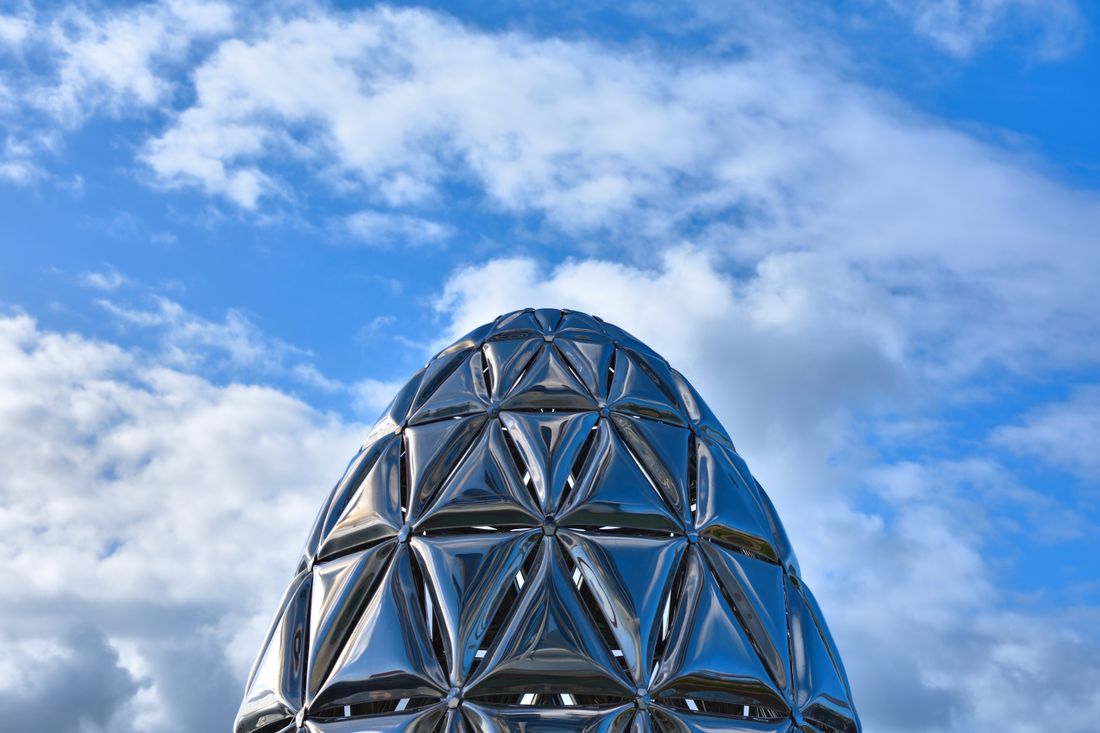
Most artwork sits still and lets the camera do the work of showing it accurately. Mirror, high-gloss resin, chrome, polished metal, and foil leaf don't sit still that way. They show whatever is opposite them, so before any light gets set, the real question is what the piece is going to be allowed to see.
A reflective surface doesn't have a fixed look the way a matte painting does. It shows whatever sits in front of it, including the studio, the lights, and the camera. Photographing mirror, resin, or polished metal starts with controlling what the piece can see, not with lighting the piece itself.
Why does a reflective surface photograph the room before it photographs the work?
A reflective surface doesn't have a fixed appearance the way a matte painting does. It shows whatever sits in front of it: studio lights, the ceiling, the camera, the person holding it. Photographing mirror, resin, or polished metal starts with controlling what the piece can see, not with lighting the piece itself.
Most lighting problems have a known fix: move the light, add a diffuser, change the angle until the shadow looks right. A reflective surface breaks that logic, because it isn't showing light falling on it, it's showing an image of whatever is opposite it. Point a softbox straight at a mirror and the mirror doesn't get lit, it just shows a bright rectangle where the softbox is standing.
That's the real difference between documenting reflective work and documenting almost everything else in a studio. A painting or a piece of fabric absorbs and scatters light, so its surface reads as color and texture. Mirror, chrome, high-gloss resin, and polished metal behave more like a second camera pointed back at the room. Every object nearby becomes a candidate for showing up in the frame, whether it's a light stand, a coffee cup nearby, or a reflection of the photographer.
None of this makes reflective work harder to shoot well, it makes it a different kind of problem. Lighting still matters, but it comes second. The first decision is what the piece is allowed to see, and that shapes every choice after it, including how the room is arranged and how close anyone stands while the shutter is open.
How do mirror, resin, and polished metal misbehave differently in front of a camera?
Mirror gives a near-perfect image of whatever faces it, so it shows the room with almost no distortion. Cast resin adds depth and refraction on top of a reflection, so light bends as it passes through the material. Polished metal and chrome curve, so they compress a wide room into a small, warped strip. Each one needs a different fix.
A flat mirror is the most literal of the group. It works like glass with a silvered back, so a reflection in it lines up the way it would in a real mirror at home: same size, same angle, minimal warping. That predictability is useful, because it means the fix is usually about position rather than guesswork. Move the camera and light off-axis enough, and the reflection of the room moves with it, out of frame.
Cast resin adds a second layer to the problem. Its glossy top surface reflects like glass, but the material underneath is often clear or semi-clear, so depth, air bubbles, and embedded objects all read through the surface at the same time as the reflection. Lighting for resin means separating what's happening on the surface from what's happening inside it.
Curved metal and chrome are the hardest to reason about, because the surface itself bends the reflection. A straight studio wall becomes a curved smear across a chrome sculpture. There's no single camera position that avoids every reflection on a curved piece, so the choice becomes which distortion is least distracting, not how to eliminate distortion entirely.
What does a clean shooting environment actually require for reflective work?
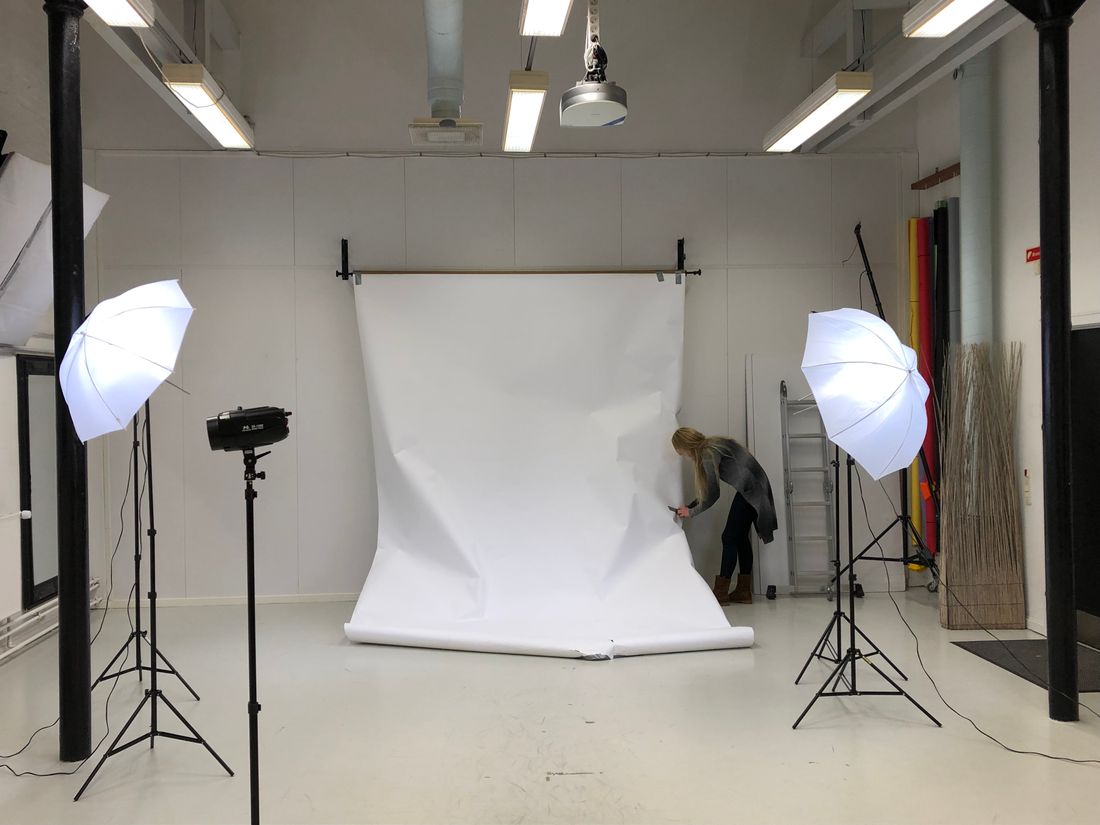
A clean environment for reflective work usually means large, evenly diffused light sources set wide of the piece, black flags or negative fill placed to absorb stray light instead of bouncing it, some form of tenting around the piece, and enough distance between camera and subject that gear and bodies read as small, soft shapes instead of sharp, identifiable ones.
Large diffused sources do two things at once. They soften the light itself, and they turn what the piece reflects into a broad, even shape instead of a small, hot, obviously artificial one. A bare light reflected in chrome reads as a bright dot that pulls the eye. The same light through a large diffuser reflected in the same chrome reads as a soft gradient that looks closer to how the piece would sit in a real room.
Black flags and negative fill matter just as much as the lights. Every wall, ceiling, and piece of gear near the shoot is a potential reflection, so surrounding the piece with black material absorbs that light instead of letting it bounce into frame. A simple black tent, fabric on stands built around the piece with a gap for the lens, removes most of the room from what the surface can see before any retouching enters the conversation.
Distance helps for a simpler reason: a longer lens from farther back keeps the camera itself smaller in the reflection, and it flattens perspective in a way that's usually more flattering for a flat or gently curved reflective piece anyway.
How do you keep the camera and photographer out of a reflective piece?
The most reliable ways to keep the camera out of a reflective piece are honest, physical ones: shooting from an angle instead of dead-on, using a polarizing filter to cut glare and some reflection, and masking the lens itself with black material so it reads as a small dark shape rather than a recognizable camera body.
Shooting at a slight angle rather than straight-on is the simplest fix and the one worth trying first. Dead-center shots put the camera directly in the piece's line of sight, the same way a person can't avoid seeing their own reflection standing straight in front of a mirror. A few degrees off-axis usually clears the camera out of frame without changing the piece's proportions enough to matter.
A polarizing filter helps on non-metallic reflective surfaces, cast resin especially, by cutting down glare and some reflected light depending on the angle between camera, light, and surface. It's not a universal fix. It does very little on bare polished metal, since that reflection isn't the kind of polarized light a filter can act on.
Masking the lens in black cloth or a black card with a hole cut for the barrel shrinks the camera's visible footprint in the reflection down to something small and dark, closer to a shadow than an object. Combined with distance and angle, this usually gets a clean piece without needing to touch the file afterward, which matters for the reasons in the next section.
When does retouching a reflection cross into misrepresenting the work?
Retouching crosses into misrepresentation when it removes a reflection that was genuinely part of how the piece looked in the room, not an artifact of the shoot. Cleaning up a stray light stand or a visible camera is normal production work. Erasing a reflection the piece would cast in a gallery or a collector's home changes what the photograph promises.
The distinction comes down to what caused the reflection. A softbox, a lens, a photographer's arm, none of those exist for the piece outside the shoot. Removing them is closer to cleaning dust off a lens than altering the artwork, because a viewer standing in front of the real piece would never see them there either.
A reflection of the room itself is different. If a mirror or chrome piece is going to sit in a gallery, a living room, or a lobby, it's going to reflect that space every time someone looks at it. That's part of the object's actual behavior, not a shooting condition. Smoothing that away in post can make documentation look cleaner while making it less accurate, which matters most for insurance, archival, or sale-listing photography where the photograph needs to represent the object honestly.
A useful habit here is asking whether a collector standing in front of the real piece would see what's been removed. If yes, it likely belongs in the photograph. If it's studio equipment that has nothing to do with the piece, taking it out is closer to standard cleanup than any kind of misrepresentation.

When is the reflection part of the work, not a flaw to remove?
A reflection is part of the work whenever the artist built the piece to interact with its surroundings on purpose, which is common with mirror pieces, some resin work, and metallic sculpture meant for a specific room or outdoor site. Removing that reflection in editing doesn't clean up the photograph, it edits out a real property of the object.
Site-specific and interactive pieces make this easiest to see. A mirrored sculpture commissioned for a particular lobby or courtyard is often designed to catch that exact space: the light through a window, the movement of people walking past, the color of a nearby wall. Photographing that piece with every trace of its environment scrubbed out produces an image of a different object than the one the artist made.
The harder cases are smaller studio pieces where it isn't obvious from looking at the object alone whether the reflection is intentional. That's a conversation worth having with the artist before the shoot, not a call to make alone during editing. Some artists want the environment minimized because they're documenting the object itself for a catalog or archive. Others want a controlled, recognizable reflection left in, because it's part of how the piece is meant to read.
Either answer is fine. What matters is that it's a decision made with the artist ahead of time, based on what the piece needs, rather than a default setting applied to every reflective surface that comes through the studio.
How do you photograph depth and clarity in cast resin?
Depth and clarity in cast resin show up through light angled to pass through the material rather than only bounce off its surface, paired with a dark, controlled background that lets embedded elements, air bubbles, and internal color read clearly instead of getting lost behind surface glare.
The surface of cured resin behaves like glass: hard, glossy, and reflective at a steep angle. But resin is usually not shot for its surface alone, the point is often what's happening a few millimeters or a few inches beneath it. That means the lighting job splits into two related problems: keeping surface glare off the parts of the piece that need to show what's inside, while still using some reflected light to describe the glossy quality of the surface itself.
Backlighting or side-lighting through the material, when the piece allows light to pass through at all, tends to reveal internal detail that front lighting flattens out. A resin piece with layered color or suspended objects can look almost solid and opaque under flat front light, then show real depth once light is allowed to travel through it from behind or the side.
Background choice matters more with resin than with most materials. A dark, matte, non-reflective background keeps the camera's own reflection and the room's ambient light from competing with what's happening inside the resin. A busy or light-colored background usually reads as noise layered on top of the piece rather than context around it.
What should an artist expect before a mirror, resin, or metal shoot?
An artist should expect a reflective-surface shoot to take longer than a comparable flat painting, to involve a genuine conversation about how much of the environment should show in the final images, and to sometimes need the piece moved into a room, or a room built around the piece, rather than lighting it exactly where it normally sits.
Time is the most common surprise. Building a clean environment, testing camera angles, and confirming which reflections are acceptable takes longer than most flat-work sessions, because so much of the process is trial and adjustment rather than a repeatable lighting formula. A session that would take twenty minutes for a framed painting can reasonably take an hour or more for a chrome or mirrored piece.
The environment conversation matters just as much as the technical setup. Before the shoot, it helps to know whether the piece is meant to be documented in isolation, closer to a catalog image, or whether some context and reflection should stay visible because it's part of how the piece reads. That decision changes the whole approach, so settling it ahead of time avoids reshoots later.
Physical logistics come up more than people expect too. A piece that lives against a busy wall at home may need to travel to a space that can be controlled, or need temporary black tenting built around it on-site. Neither is unusual. It's simply part of what accurate documentation of reflective material actually requires.
Frequently asked questions
Why can't a mirror or chrome piece just be lit like any other artwork?
Because it doesn't scatter light the way most surfaces do, it reflects an image of whatever is in front of it. Standard lighting setups point light at the piece and expect it to bounce back diffused. On mirror or chrome, that same light shows up as a sharp, recognizable shape, so the fix is controlling the environment the piece reflects, not just adjusting brightness or angle.
Is it acceptable to remove the camera from a reflection during editing?
Yes, generally. A camera, light stand, or photographer's arm in the reflection is a byproduct of the shoot, not something the artwork would show in normal use. Removing that during editing is closer to standard cleanup than altering the piece. The line worth watching is removing a reflection of the room itself, especially when that reflection is genuinely part of how the finished piece behaves once it's living in a real space.
Should reflections of the surrounding room always be edited out?
Not always. If a piece is built to interact with its environment, a mirrored sculpture designed for a specific lobby or window, for example, its reflections are a real property of the object, not a flaw. That decision belongs to a conversation with the artist before the shoot, since the right answer depends on whether the piece is meant to be documented in isolation or in context.
Does a polarizing filter solve reflections on metal and chrome?
Only partly, and less on bare metal than people expect. A polarizer works well on cast resin and other non-metallic glossy surfaces, cutting glare and some reflected light. It has much less effect on polished metal and chrome, since that kind of reflection isn't the type of light a polarizing filter can act on. Angle, distance, and tenting do more of the real work on metal.
Why does photographing cast resin take longer than photographing a flat painting?
Because resin has two things happening at once: a glossy, reflective surface and, often, visible depth underneath it. Lighting has to manage surface glare and interior clarity separately, which usually means testing more angles and light positions than a flat, matte piece needs. Background choice adds another variable, since a busy or reflective background competes directly with whatever fine detail is actually happening inside the material itself.
Build a paper trail your insurer can't argue with.
We shoot artwork documentation the way an appraiser or adjuster actually reads it, full views, true color, condition notes, and files that stay tied to the right piece.
Explore artwork documentation →