
Fairfield County, the East End of Long Island, and Philadelphia are now part of where documentation days happen. Every one of them changes a basic assumption the studio never has to think about at home: there is no coming back next week to fix something. That single constraint runs through every decision below, from what goes in the van to when the crew actually walks back out the door.
A documentation day away from New York runs on one rule: there's no return visit. The kit gets packed for redundancy, the shot count and inventory get locked in advance, color gets verified on site before anyone leaves, and access, power, and approval authority all get confirmed with the client before the date.
Why a documentation day outside the city has no do-overs
A documentation day in Fairfield County, on the East End, or in Philadelphia runs on one rule a Manhattan shoot doesn't have to think about: the crew leaves at the end of the day and isn't coming back next week. Whatever would normally get fixed on a second visit has to be resolved and finished before anyone packs the van.
In New York, a missed detail shot or a color question that needs a second look is a minor inconvenience. Someone drives back across town the next morning. Travel changes that math. A trip to Greenwich, the East End, or Philadelphia is real drive time on both ends, longer with summer traffic during benefit season on Long Island. A return visit stops being a quick fix and becomes a second full day, which usually isn't something anyone planned for.
That single fact reshapes how the day gets planned, not just how it gets shot. It changes what goes in the van, since a travel day needs more backup than a studio job would. It changes how the shot list gets built, since the count has to be locked before departure, not discovered on arrival. It changes how color gets checked, on site, on real files, before the lights come down. And it changes what gets confirmed beforehand (access, power, and who has the authority to sign off in the room). None of this changes the documentation standard itself. It changes every point where a missing answer would otherwise wait for a return trip that, out here, isn't really available.
How the kit gets packed differently for a travel day
For a travel day, the kit gets packed for redundancy rather than the single best tool for each shot. A backup light, a spare card, an extra battery, and a second cable for anything that can fail all go in the van, because one dead unit with no second option can end the day early. There's no studio down the block to borrow from, no evening run to a rental house nearby.
A Manhattan job can lean on a favorite modifier or a specific lens, because a substitute is twenty minutes away if something breaks. On site in Stamford or Philadelphia, twenty minutes away is nothing close. The next equivalent piece of gear might be a two-hour round trip, and that's two hours a fixed schedule doesn't have. So the packing logic flips. Instead of choosing the single best light for the job, the choice is two lights that can each do the job adequately, so one failing doesn't strand the shoot. The same thinking applies to color targets, memory cards, tripod heads, and power: anything with a single point of failure gets a second one riding along, even when it adds weight to the load-in.
This isn't about traveling heavier for its own sake. It's a direct answer to distance. Every piece of gear gets asked the same question before it goes in the van: if this fails at eleven with forty pieces still left, what covers it, and is that backup already packed?
Why the inventory and shot count get agreed before the date
The inventory and shot count get agreed before the date, not estimated on arrival, because discovering twenty more works once the crew is already set up breaks the schedule for the whole day, not just the extra pieces. A documentation day is timed around a known number of works, and that number is what the lighting setup, the file-review windows, and the departure time all get built around.
In a studio, an underestimated count is annoying. The session runs long, someone reschedules the next booking. On a travel day, running long has a harder ceiling. The crew has a drive home, sometimes a flight, or a next-day booking somewhere else. There's no simply staying an extra two hours once the light outside is fading and the room only has the windows it has. So the count agreed beforehand (usually worked out with whoever is coordinating the collection, often an art advisor rather than the collector directly) gets treated as the real number the day is planned around, not a rough guess revised once the team is already standing in the room.
That agreement also shapes what gets asked before the date: are there works in storage, in another room, or out on loan that should be included; is there anything unusually large, glazed, or fragile that needs more time per piece than a standard canvas. Settling the inventory before the date is what keeps a travel day's schedule realistic instead of aspirational.
What a client needs to confirm about the space before the date
Before a travel date is set, we confirm parking and the carry distance from the car to the work, whether there's a working elevator or only stairs, and whether power is available in the room where the work actually hangs. None of these come up for a session in a Manhattan studio, where all of it is already solved.
Outside the city, the physical setup is a different problem in every home. A driveway that fits one car but not a loaded equipment cart changes how gear gets moved in. A fourth-floor apartment with narrow stairs and no elevator changes how many trips that move takes, and how long it takes before shooting even starts. A finished lower level with the best available wall space but no outlet nearby means extension cable becomes part of the plan rather than an afterthought found on arrival. These aren't incidental questions. They're the difference between a day that starts shooting at ten and one still hauling cases at eleven.
We also ask which room actually has the most usable wall for larger pieces, since a beautiful room and a workable one for documentation aren't always the same room. A favorite wall might have a window throwing hard light across it all morning, or furniture that can't easily move. Working this out ahead of time, from photos or a conversation, means the crew arrives already knowing where setup happens instead of spending the first half hour of a fixed day figuring it out in front of the client.
Why someone with real approval authority needs to be in the room
Someone with the actual authority to approve color, crop, and any reshoot needs to be on site for the full day, not just reachable by phone. Without that person present, decisions stall while someone off site gets a call, and a delay waiting on a decision costs real time on a day that has a fixed end, not an open one.
In a Manhattan studio, this rarely comes up, because the artist or client is usually standing right there the whole time. Outside the city, the person who owns the collection isn't always the person who can be present for a full documentation day, so the role often falls to a family member, a house manager, or the art advisor who coordinated the visit in the first place. Whoever it is, they need to be able to look at a file on screen and say yes, that's right, or no, do that piece again, in the moment, not after the crew has already packed the van and left.
This gets confirmed before the date for the same reason the inventory does: finding out on arrival that no one present can actually sign off turns every judgment call into a waiting game. A missing decision-maker doesn't just slow down one piece. It stalls the file review that's supposed to happen before departure, which is the same review that catches color or framing problems while there's still time to fix them. Confirming this ahead of time is a small conversation that protects the entire schedule.
How color gets verified before anyone packs up
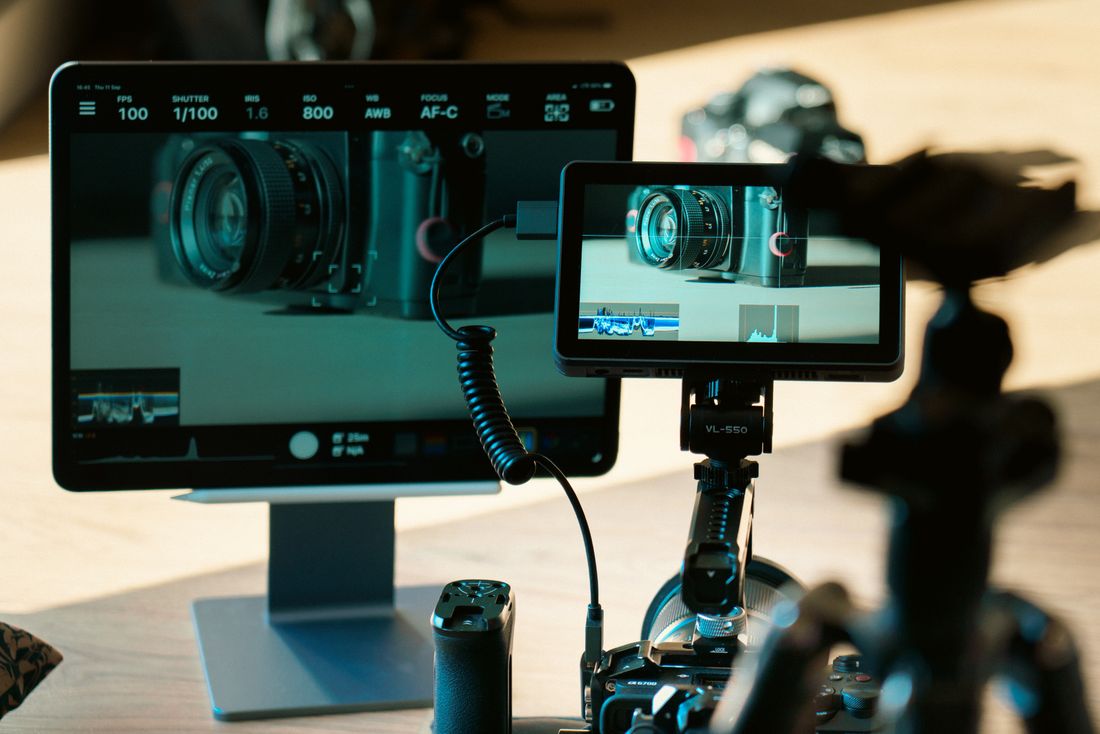
Color gets checked on site, on real files, before anyone starts packing up, not estimated from the camera's rear screen and not left to be caught later back in New York. Whoever has the authority to approve looks at actual frames on a calibrated screen or a properly lit laptop, compares them against the real work on the wall, and signs off before the crew moves on to the next piece.
This step exists everywhere documentation happens, but it carries more weight on a travel day because there's no efficient way to redo it later. In a studio, a color problem discovered during editing can sometimes be corrected against the artist's memory of the piece or a quick follow-up visit. Outside the city, correcting color after the fact means guessing without the actual work in front of anyone, or scheduling a second trip that the day was specifically designed to avoid. Neither is a real option.
So the review happens in the room, while the light and the work are both still there to compare against. It's not a glance at a thumbnail. It's genuinely looking at full files next to the piece, checking that whites read as white and that a saturated color hasn't shifted under the shoot's lighting. If something is off, that's the moment to reshoot it, while the setup is still standing and the crew hasn't started breaking down. Once the van is packed and the road trip home has started, that option is gone for good.
When a travel day actually starts and ends
A travel day starts and ends with the drive built in, not treated as a separate errand around the edges of the shoot. If the work is ninety minutes outside the city, that ninety minutes is part of the day the same way setup and breakdown are, and an early departure from New York is not padding. It's the only way to protect a full working day once travel time is accounted for.
A Manhattan session can start at a normal hour because the studio is already where the team is. A travel day works backward from the number of pieces and the amount of light the room actually gets, then adds real drive time on both ends, plus a buffer for traffic that a summer Friday out toward the East End can make considerably worse than a normal weekday. Arriving early isn't about looking eager. It's what keeps a delayed train or a backed-up highway from eating directly into the hours meant for shooting and review.
The same logic applies at the other end of the day. Breakdown, the final color check, and the drive home all have to fit before the crew is too tired to drive safely or the light is gone. Planning the day around a set number of works, discussed in advance, is what makes this arithmetic work, a day that starts on time and ends with everything actually finished, instead of a day that runs late because travel wasn't counted as part of the schedule from the start.
What's actually better about shooting where the work lives
Traveling to the work has one real advantage over asking a client to bring it into a studio: the work never moves. It doesn't get crated, doesn't ride in a vehicle, doesn't get carried down a staircase or through a doorway it might not fit, and nobody pays to ship it anywhere, let alone twice, once to the shoot and once back home.
Every one of those steps is a place damage can happen to a painting, a piece of glass, or an object that was never built to travel. A studio session for artwork always includes some version of transport risk before the documentation even starts. A travel day removes that risk by bringing the equipment to the work instead, which is the more fragile and more valuable side of the equation in almost every case. A camera, a light stand, and a stack of backup gear can absorb the friction of driving to Connecticut or Philadelphia. A hundred-year-old frame or a fragile sculpture generally shouldn't have to.
It also means the work gets documented exactly as it actually lives, on the wall it hangs on, in the room it's usually seen in, without the slightly staged quality of a studio backdrop standing in for a home. For a private collection being recorded for insurance, estate, or archival purposes, that's not a small detail. The file represents the piece as it exists, not as it looked after a trip somewhere and back. The extra planning a travel day requires is the tradeoff, and it's one worth making.
Frequently asked questions
Do you shoot documentation days outside New York City?
Yes. The team travels for whole-collection documentation days in private homes throughout Fairfield County, the Hamptons and East End of Long Island, and Philadelphia. There's no second location or local staff. It's the same New York crew and equipment, on site for a single day. Most of these jobs are commissioned through an art advisor coordinating the collection on a collector's behalf, rather than by the collector directly.
How far in advance should a travel documentation day be booked?
Earlier than a studio session, because parking, access, power, and the full inventory all need confirming before the date, not discovered on arrival. Several weeks gives enough time to work out logistics with whoever is coordinating the visit, often an advisor, and to agree the shot count the whole day gets planned and scheduled around before anyone actually loads the van and gets in the car and travels.
What happens if a piece needs a reshoot after the crew has left?
That's exactly what the on-site color and file review before departure is designed to prevent. Whoever holds approval authority reviews real files against the actual work before anyone packs up, so problems get caught and corrected on the spot, while the lighting is still set and the room hasn't changed. A true return visit gets treated as a separate, planned trip, not a routine fallback for something missed.
Do you need a second location to shoot outside Manhattan?
No. The Lightroom Studio doesn't keep an office, address, or staff in Connecticut, Long Island, or Philadelphia. It's the same New York team and kit traveling for the day. Calling it a second studio would be inaccurate. The more accurate picture is a portable documentation setup built to arrive, do the full day's work, and pack down completely in a single visit, then travel home.
What should a collector or advisor prepare before a travel documentation day?
Confirm parking and the carry distance, whether there's a working elevator or only stairs, which room has the most usable wall space, and that power is available near the work itself. Also settle the full inventory in advance and make sure someone with real approval authority will be present in person for the entire day, not just reachable by phone if a decision comes up.
Build a paper trail your insurer can't argue with.
We shoot artwork documentation the way an appraiser or adjuster actually reads it, full views, true color, condition notes, and files that stay tied to the right piece.
Explore artwork documentation →