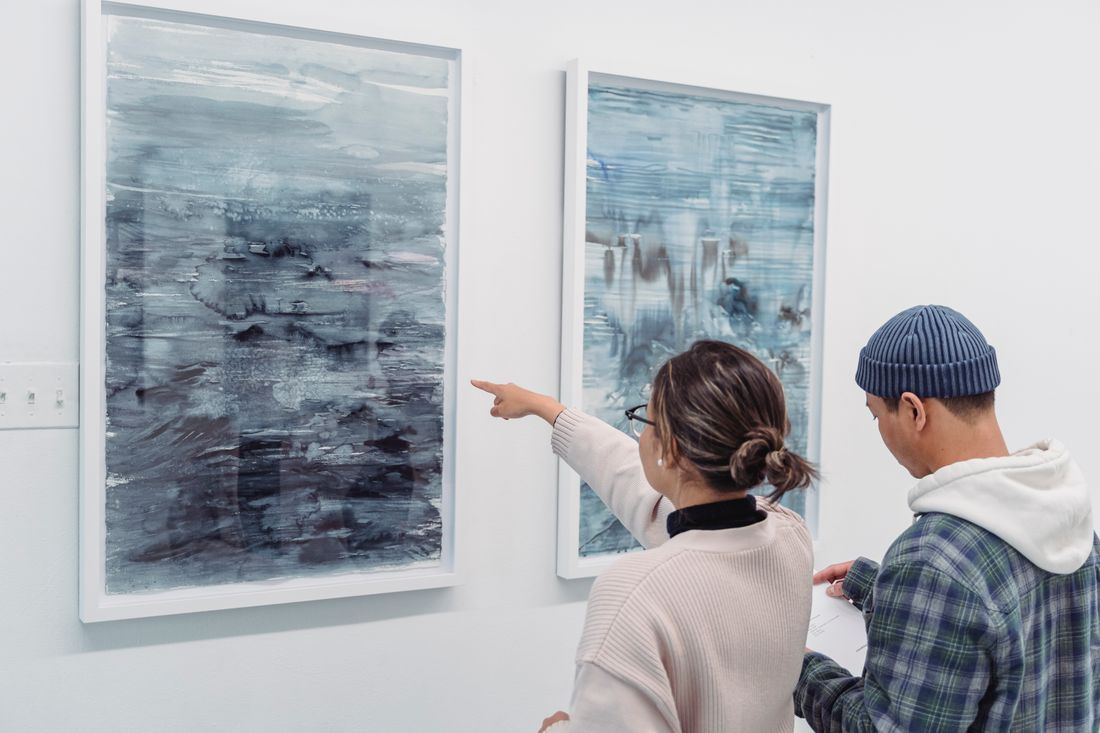
A seated talk gives a photographer one fixed problem to solve and hold for an hour. A curator-led walkthrough resets that problem at every stop, as the curator, the group, and the room's visual center all move together on a schedule nobody wrote down.
A curator-led walkthrough is a moving event, not a seated one, so coverage has to travel with the group instead of holding one fixed position. That means resetting the angle, the light, and the shot list at every stop the curator makes, while staying out of the sightline between the group and the work.
What makes a curator-led walkthrough different to shoot?
A curator-led walkthrough moves. The curator, the group, and the visual center of the room shift from stop to stop on a schedule nobody wrote down beforehand, unlike a seated talk where the audience holds one position for the whole hour. Coverage has to travel with the group without becoming part of it.
A panel discussion or an artist talk gives a photographer one fixed problem: find the angle on the room, hold it, and wait for the right expression. A walkthrough resets that problem at every stop. The curator plants themselves in front of a different piece every few minutes, the group reshapes around them differently depending on the room, and the light, the crowding, and the sightlines change along with it.
That constant reset is the actual job. A photographer who treats a walkthrough like a talk with better scenery ends up chasing the group from behind, catching the backs of heads and half-turned shoulders instead of the moment the curator makes their point. The useful frames come from anticipating where the group lands next, not reacting once it gets there.
It also changes what counts as the shot. A talk has one hero image: the speaker at the podium. A walkthrough has a small hero moment at every stop, and the job is catching enough of them that the finished set reads as one coherent tour through the show rather than a stack of unrelated room photos.
Where should a photographer stand during a walkthrough?
The strongest position is usually to the side and slightly ahead of the curator, not directly behind the group and not blocking the sightline between the curator and the work. That spot catches the curator's gesture, the piece being referenced, and enough of the group to show the room is actually paying attention.
Standing behind the group seems safest because nothing is in the way, but it produces the same photo over and over: a wall of backs facing a curator whose face nobody can see. Standing directly in front, facing the curator, gets a clean portrait but loses the work entirely and puts the photographer between the group and the thing they came to look at.
The side position works because it treats the curator, the artwork, and the group as three points that need to stay in frame together, not three separate subjects to choose between. It also lets a photographer step half a room ahead between stops instead of pushing through a crowd that's already moving, which is the fastest way to end up inside someone else's photo.
None of this holds for every room. A narrow gallery corridor might only leave one workable angle, and a large open space might let a photographer circle the group entirely. The side-and-ahead position is a default to adjust from, not a fixed mark to hit in every space the tour passes through.
What should the shot list cover beyond the curator?
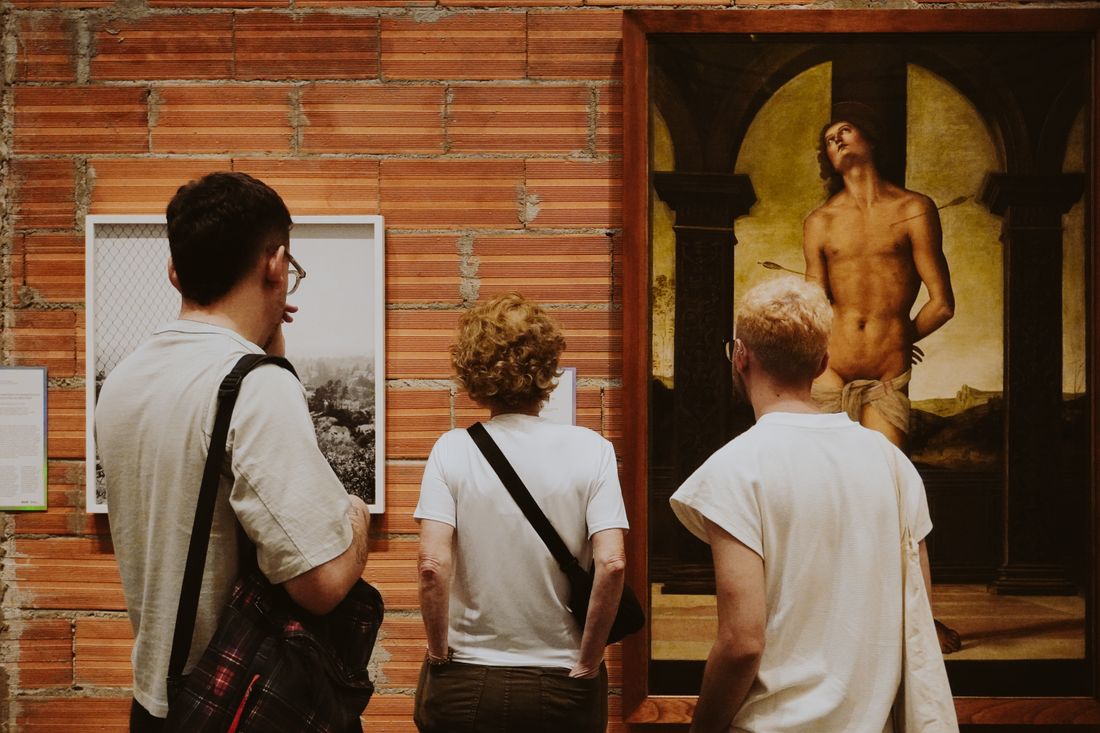
A walkthrough shot list needs four things at every stop: the curator mid-gesture, the specific work they're pointing at, the group's reaction, and a wider frame showing how the room is arranged around that moment. Missing any one of these turns the finished set into portraits rather than a record of the actual tour.
The curator shot is the easy one; most photographers get it by instinct. The piece itself is the one that gets missed, because it means turning away from the curator for a second to get a clean, well-lit frame of the actual work under discussion, ideally without a shoulder or a phone screen drifting into the corner.
Group reaction shots matter more than they look. A tight frame of someone leaning in, or a wider shot of the group clustered around one wall, is what makes a recap post feel like a room full of real attention instead of a curator talking to an empty space. Skip it and every walkthrough set starts to look the same.
The wide establishing frame at each stop is what lets a viewer follow the tour later, in the order it happened. Without it, the individual photos still hold up, but stringing them into a sequence for a recap or a slide deck gets much harder, because nothing shows where in the room each moment actually took place.
How does group size change the coverage plan?
A walkthrough of eight people and one of thirty are two different jobs. A small group lets a photographer move freely around the curator and catch faces easily, while a large group turns into a crowd-management problem where the real risk is losing the curator entirely behind other people's heads and shoulders.
With a small group, the photographer can afford to work closer, moving between the curator and the work without disrupting anyone's sightline, because there's room to step around. The coverage can lean toward more intimate, close frames of individual reactions, since nearly everyone in the group stays visible in most shots taken that way.
A large group changes the priority to height and position rather than closeness. Standing on slightly higher ground, or working from a spot just outside the main cluster, becomes more useful than getting physically near the curator, because proximity inside a crowd usually just means shooting the back of someone's jacket at close range. Wider frames do more of the work here than tight ones do.
Group size isn't always known in advance, and it can change mid-tour as people join or peel off along the way. The practical fix is deciding the default position before the walkthrough starts, then treating the first two stops as a quick check on whether the small-group or large-group approach actually fits the room that day.
How do you handle lighting that changes with every room?
A walkthrough usually passes through several rooms with different lighting, so the plan has to assume exposure will change at every stop rather than searching for one setting that works everywhere. The fix is fast manual adjustments made between stops, not a single fixed camera setup carried through the whole tour.
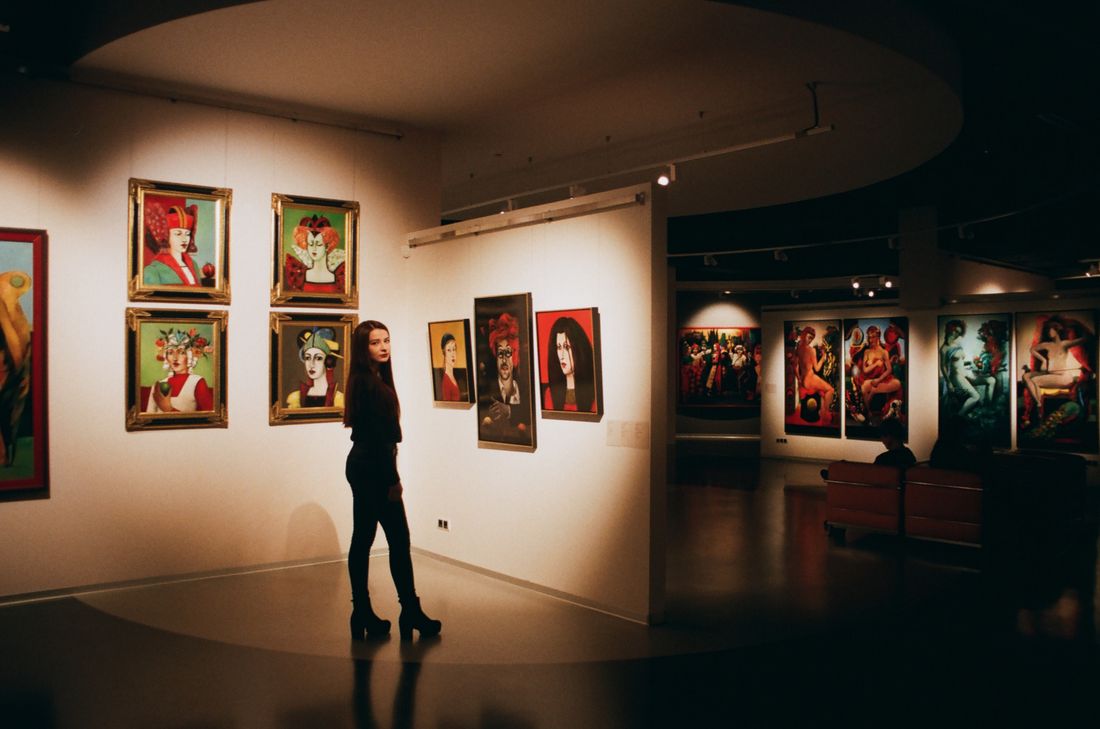
Galleries mix daylight from windows, track lighting aimed at specific works, and ambient room light in a way that shifts character from room to room and sometimes wall to wall within the same room. A piece lit for even, glare-free viewing rarely gives flattering light to the people standing in front of it, which is the actual tension running through most walkthrough coverage.
The practical approach is treating the artwork's lighting as the fixed point and adjusting how close and how wide the photographer shoots the group around it, rather than fighting the gallery's lighting design to get a more even shot of the people instead. Changing that lighting for a tour, even briefly, usually isn't worth disrupting the room over.
Stops that swing between very bright and very dim spaces, such as a skylit room sitting next to an enclosed video room, need the most attention, because that's where a photographer without a moment to adjust settings loses frames entirely. Knowing the route in advance is what turns that swing from a surprise into a manageable, expected transition.
Should a walkthrough be filmed as well as photographed?
Video adds real value when the curator's voice and the pacing of the tour are part of what makes it worth documenting, but it also means solving for audio in a room that wasn't built for it. A short clip of the curator at one strong stop is usually more useful than trying to film the entire route.
A moving tour is a hard audio environment. Room tone picks up footsteps, side conversations, and HVAC noise, and a wireless mic on the curator has to survive them walking, turning, and gesturing without cutting out or rustling against clothing. Video coverage of a walkthrough is really an audio problem wearing a camera's clothes.
Trying to film the whole route usually produces a long, uneven clip that nobody watches start to finish. Choosing two or three stops in advance, ideally the ones with the strongest visual moment and the clearest thing the curator says, gives a far more usable result: short clips that can stand alone in a recap or a social post.
Stills and video pull a photographer's attention in different directions during the same tour, so a walkthrough that genuinely needs both is often better served by two people rather than one person switching between a camera and a video setup mid-room. One person can usually cover stills well, or capture a couple of planned clips well, not both at full quality throughout.
How much should be planned with the curator in advance?
A short conversation with the curator before the walkthrough, covering the order of stops and which two or three pieces they consider the strongest moments, makes a real difference to the coverage without requiring a full rehearsal. The photographer doesn't need a written script, just a rough map of where the tour is heading.
Curators rarely walk a tour the exact same way twice, and that's part of what makes a live walkthrough worth covering instead of a static room shoot. The goal of advance planning isn't locking down every stop, it's knowing the general order and the handful of pieces the curator is most likely to spend real time on that day.
That short conversation also surfaces practical details that are easy to miss otherwise: whether the group will be seated at any point, whether there's a piece the curator specifically wants documented up close, and whether the tour ends somewhere worth a final wide shot, like a group gathered near the exit or a reception starting nearby afterward.
Walking the actual route once beforehand, even a few minutes before the group arrives, does more than any conversation on its own. It shows where the light will be at that hour, where a tight doorway will bottleneck the group, and where the default side-and-ahead position simply won't fit, so the plan can adjust before it actually matters.
What should a gallery get back after the walkthrough, and how is it used?
A gallery should expect a set that reads in order, stop by stop, rather than a folder of unsorted images from the day. That sequence is what makes the coverage genuinely usable afterward, whether it's a recap post, a page in a newsletter, or a record of how the show was presented on that particular day.
The most useful sets separate cleanly into two roles: a handful of strong single images for a feed or a press ask, and the fuller sequence for anyone who wants the whole tour, like an internal archive or a longer recap piece. Delivering everything as one flat, unlabeled folder makes both of those jobs harder than they need to be.
If video clips were part of the coverage, they're most useful cut short and standalone rather than left as one long recording. A fifteen-second clip of the curator's strongest point travels on social in a way a ten-minute file never will, and it's easier for the gallery to reuse later without editing it down themselves first.
The record also has a quieter use: it shows how a specific show was actually presented and discussed at a specific point in time, which matters later when a piece changes hands, a show closes, or someone wants to reference how a work was originally installed and introduced to a room full of people.
Frequently asked questions
How is covering a curator-led walkthrough different from covering a panel discussion or artist talk?
A panel or artist talk has one fixed subject in one fixed spot for the whole event, so the photographer solves the angle once and holds it. A walkthrough moves the curator, the group, and the visual center of the room to a new spot every few minutes, which means the position, the light, and the shot list all reset at each stop instead of staying constant.
How many photos should a gallery expect from a walkthrough shoot?
The right number depends on how many stops the tour makes, not a fixed count set in advance. A useful set usually includes several images per stop: the curator gesturing, the specific work under discussion, a group reaction, and a wider establishing frame of the room, so a dozen stops can reasonably produce several dozen usable images once the weaker frames get cut and the sequence is put together.
Does the photographer follow the curator or stay ahead of the group?
Staying slightly ahead is usually more useful than following. A photographer trailing the group ends up shooting the backs of heads and catches the curator's point only after it's already been made and the group is already dispersing. Moving just ahead to the next stop, or working from the side of the current one, gives time to set the frame before the group arrives and the moment actually happens in front of it.
Can a walkthrough be covered with photography alone, without video?
Yes, and for many galleries that's the more practical choice. Photography alone avoids the audio problems of a moving tour, room noise, footsteps, a mic that has to survive the curator turning and gesturing, and still produces a complete, usable record of the event from start to finish. Video adds value when the curator's voice specifically needs to travel, but it's an addition, not a requirement for good coverage.
How far in advance should a gallery book coverage for a walkthrough?
A week or two ahead gives enough time for a short planning conversation with the curator about the route and the strongest stops, which meaningfully improves the coverage without adding real work for either side. Walkthroughs tied to an opening or a specific event date benefit from locking the date in as soon as it's confirmed, since that same week often has other coverage needs competing for the same booking slot.
One night, two openings, no dropped coverage.
We plan clustered opening nights before they turn into a scramble, whether that means a split schedule, a second shooter, or an early enough booking that the calendar never becomes the problem.
Explore event coverage →