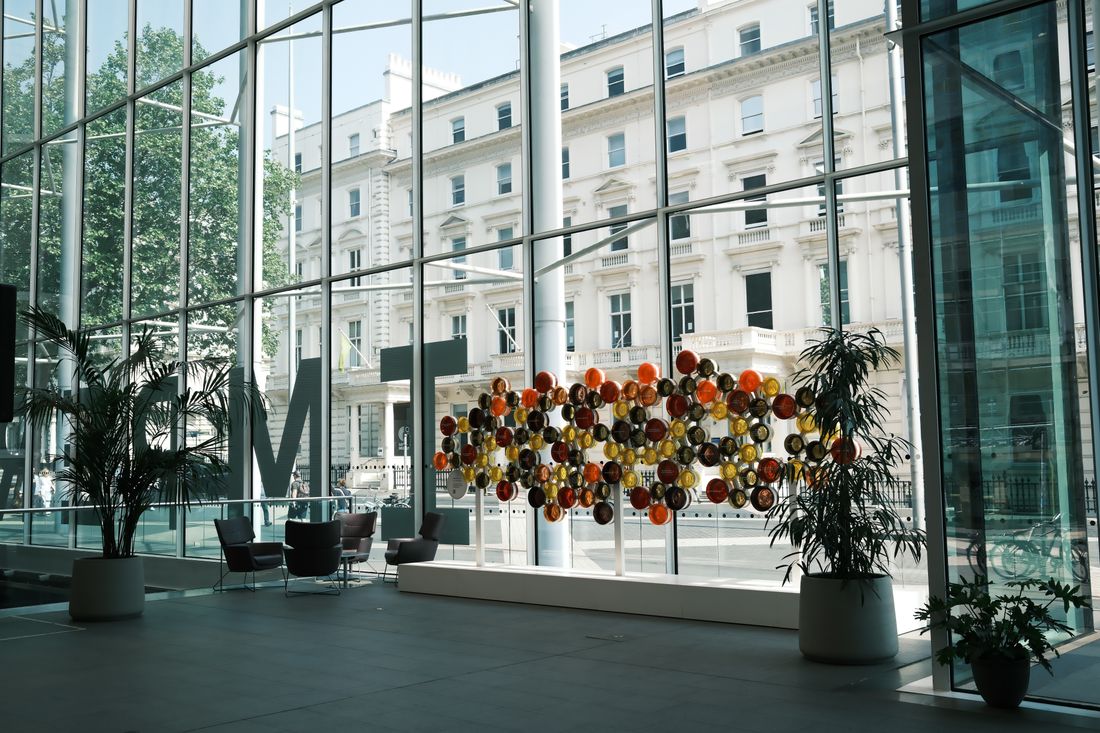
A company unveiling a new art collection in its lobby is not throwing a gallery opening with a security desk attached. It's running a workplace event that happens to include a piece of art, inside a room built for foot traffic and wayfinding rather than for looking closely at anything on the walls. The company wants proof of investment, culture, and a space people want to work in. The artist or gallery behind the work wants it photographed accurately and credited properly. Both are reasonable, and both are answered by planning the coverage around the venue's real constraints instead of borrowing a gallery-opening shot list and hoping the lobby cooperates.
Photographing a corporate lobby art unveiling means treating it as a workplace event with an art documentation task inside it: plan around building security and fixed wayfinding light, protect the one-time remarks moment, keep uninvolved employees out of frame, and deliver two separate sets: event and culture photos for the company, accurate documentation for the artist or gallery.
What Makes an Art Unveiling in a Corporate Lobby Different to Photograph?
An art unveiling in a corporate lobby is covered as a workplace event first and a gallery event second: the room is built for foot traffic, a security desk controls who gets in, the lighting favors function over the art, and part of the audience is employees who never opted into being photographed. Every other decision on the shoot follows from that.
A gallery opening assumes the room exists to show art and the crowd exists to look at it. A lobby unveiling assumes the room exists to move people to elevators, and for one evening it also happens to hold a new piece of art and a small crowd around it. The photographer has to work with a space that was never designed for this purpose, on a schedule set by the building rather than the event, in front of people who work there and are simply trying to get to the parking garage.
None of this makes the coverage worse. It makes it a different job with a different checklist: confirming access before the day, planning around fixed light instead of art-friendly light, and treating the ribbon-cutting or remarks moment as a single unrepeatable take rather than one of many similar moments across the evening. Companies unveiling a collection usually want proof that the investment is real and that the space is a place people want to work. Getting there starts with accepting the venue for what it actually is.
How Does Building Security Change Load-In and Access?
Building security changes load-in by putting every person and every piece of gear through a check the building controls, not the event: a guest list at the front desk, visitor badges, a freight elevator on a schedule, and possibly a certificate of insurance before anyone with a camera bag is allowed past the turnstiles. None of this is optional the way it can be at a gallery.
A gallery opening usually has one door and one set of house rules the gallery itself sets. An office building has a lobby management company, a tenant, and sometimes a building engineer, each with their own sign-in process and their own idea of what counts as reasonable notice. Getting a photographer's name onto the guest list, confirming which elevator bank handles freight versus passengers, and knowing whether a tripod or light stand needs its own approval are all logistics that have to be settled days in advance, not worked out at the door.
In practice, this means the planning conversation starts earlier than it would for a gallery show. Someone on the company side needs to know the building's own event rules, not just the company's internal calendar. A photographer who shows up expecting gallery-style flexibility, a side door propped open and gear rolled in five minutes before doors, will lose real working time standing at a security desk instead of setting up.
Why Is Lobby Lighting a Problem for Photographing the Art?
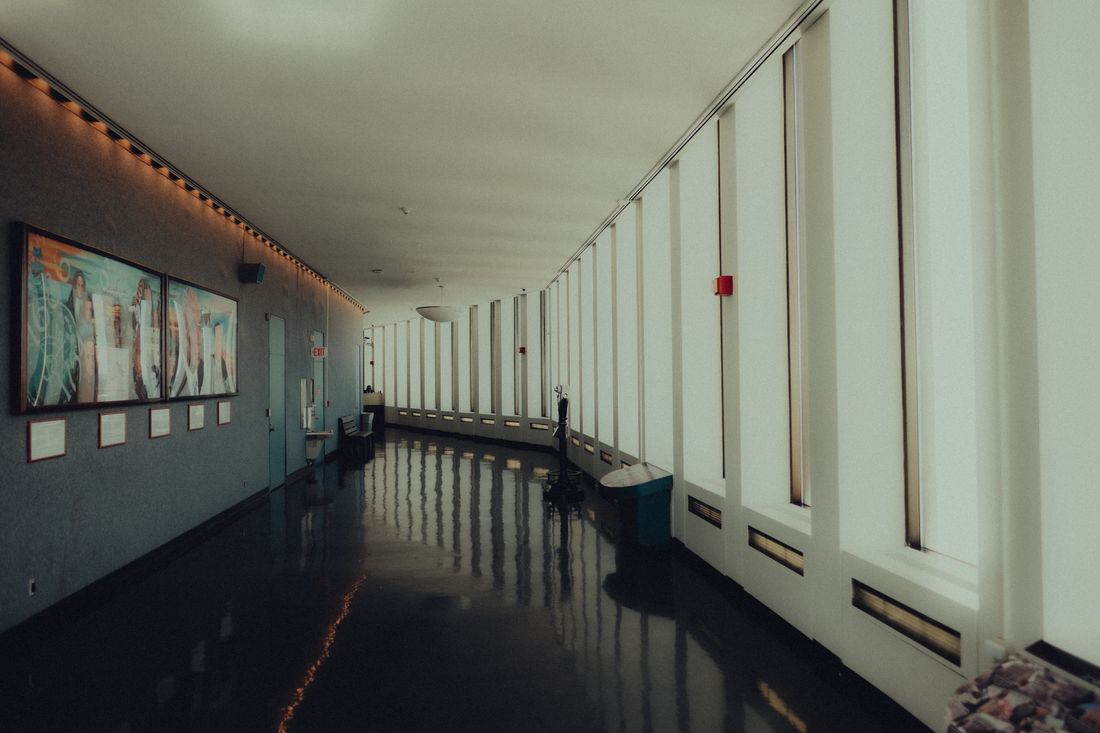
Lobby lighting is built for wayfinding, not for looking at art: even, bright, cool-toned overhead light designed to help people move safely through the space, not raking or accent light designed to show texture, color, or depth in a painting or sculpture. That mismatch is usually the single biggest technical problem on the shoot.
A gallery lights each piece on purpose, usually with adjustable fixtures aimed to control glare and reveal surface detail. A corporate lobby lights the floor, the reception desk, and the path to the elevators, and the new artwork simply sits inside whatever that ambient light happens to be. The color temperature is often flat and slightly cold, the light is uniform rather than directional, and there is rarely a way to dim or redirect it for one evening without involving building engineering.
A photographer working this kind of room usually brings supplemental lighting rather than relying on what is already installed, and treats the art and the event as two separate lighting problems rather than one. The crowd and remarks can be shot in the room's existing light, since that light is doing exactly what it was designed to do for people. The artwork itself, if it needs to be documented accurately rather than just visible in an event photo, usually needs its own light brought in and controlled specifically for that purpose.
How Do Glass Curtain Walls and Polished Stone Complicate the Photos?
Glass curtain walls and polished stone complicate the photos by reflecting everything in the room back into the frame: other people, ceiling fixtures, exit signs, and the photographer's own flash, all bouncing off surfaces that a gallery almost never has to work around. A lobby built to look impressive in daylight can become one continuous mirror once the evening lighting and a crowd are added.
Floor-to-ceiling glass is the most common offender, since it reflects the interior back at itself once it's dark outside, turning a clean shot of the artwork into a shot of the artwork plus a ghost image of the room behind the camera. Polished stone floors and walls do something similar at a lower angle, picking up reflections of shoes, legs, and stray light sources in a way that reads as clutter in a still photo even when it barely registers to someone standing in the room.
Working around this usually means changing position more than changing gear: shooting from angles that put a dark surface or a plain wall behind the lens instead of another reflective one, timing frames between the busiest foot traffic rather than in the middle of it, and checking the back of the camera against a wider view rather than the artwork alone, since a reflection off to the side is easy to miss when the eye is locked onto the art itself.
What Happens During the Ribbon-Cutting or Remarks Moment?
The ribbon-cutting or remarks moment is the one part of the evening that happens exactly once, on the building's and the executives' schedule, with no reset if the photographer is out of position: a short window, usually a few minutes, where an executive, the artist, or both say something and the collection is formally introduced.
Unlike a gallery opening, where the crowd trickles in over a couple of hours and there are usually several similar candid moments to choose from, a lobby unveiling often has exactly one organized moment built around a schedule set by people who are not thinking about photography at all. An executive giving remarks before heading to another meeting, or an artist who has a flight to catch, is not going to repeat a toast because the shot was missed.
This changes how a photographer prepares. Position matters more than usual, since there is rarely time to reposition once the moment starts. Knowing roughly who will stand where, and getting even a rough runtime for remarks, matters more here than the loose, reactive pacing that works fine at a longer gallery reception. Treating this window as the single most protected part of the shoot, ahead of general candids or artwork documentation, is usually the right call, because it is the one part of the night that genuinely cannot be recreated afterward. A second angle from across the lobby is worth having when a second photographer or a fixed camera is available, since one frame from one position leaves no backup if something blocks the primary view.
How Should Employees in the Frame Be Handled?
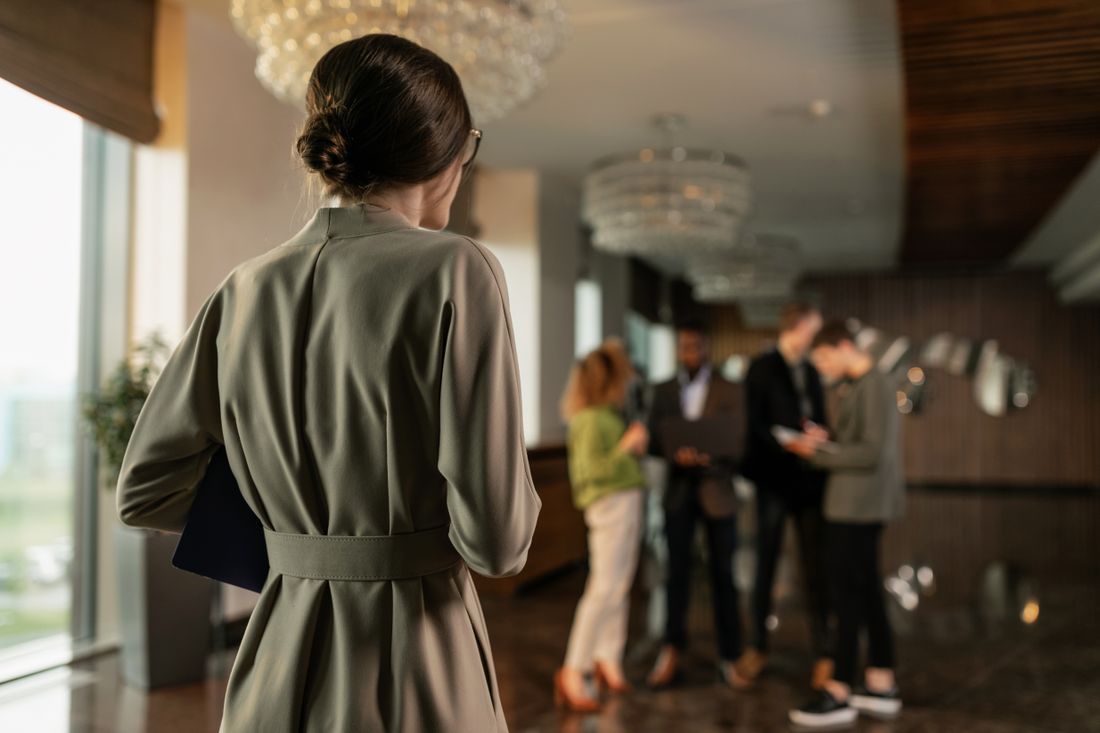
Employees who end up in the frame at a lobby unveiling are handled differently than gallery guests, because they didn't choose to attend an event and don't expect to be photographed on their way through the lobby: the practical approach is to prioritize people who are actually part of the event over people who are simply passing through it.
At a gallery opening, everyone in the room came to be there and generally expects some level of coverage. In a corporate lobby, some of the people in frame are guests at the unveiling, and others are employees leaving for the day who happen to walk through a shot. Treating both groups the same way, as fair game for candid photography, is where this kind of coverage gets uncomfortable fast.
In practice, this usually means keeping the widest candid shots focused on the people clustered around the art and the remarks, rather than sweeping in anyone crossing the lobby in the background. It also means the company side should decide ahead of time whether general employee traffic should be avoided in frame entirely, or whether the event is contained enough, roped off or positioned away from the main walkway, that this mostly resolves itself. Either way, it's a decision worth making before the photographer starts shooting, not one worked out candid by candid. A simple boundary, a few stanchions or a clear line marking where the event sits inside the lobby, does more to protect uninvolved employees than any amount of after-the-fact editing.
Why Does the Artwork Still Need to Be Documented Properly?
The artwork still needs to be documented properly, even though the night is built around an event, because the gallery or artist behind the work generally wants an accurate visual record with correct color, minimal distortion, and clear credit, and that record does not happen automatically just because event photographers are already in the room.
Event photography and documentation photography are answering different questions. Event photography asks what the evening looked like: who was there, what the room felt like, what the remarks moment captured. Documentation asks what the artwork actually looks like: true color, accurate proportions, enough resolution to hold up beyond a social post or a lobby press release. A candid shot of guests standing near a painting, however nice, is not a substitute for a clean, corrected image of the piece itself.
This usually means carving out a short, deliberate window, before the crowd arrives or after most guests have left, to shoot the artwork on its own, lit and framed the way documentation actually requires. It also means the credit line matters: an artist or gallery lending or selling work into a corporate lobby generally wants their name attached correctly wherever the image is used later. Planning for this window ahead of time is far easier than trying to squeeze it in once the room has filled up, when the light has shifted, the crowd is back in front of the piece, and the lobby has gone back to being a lobby instead of a temporary exhibition space.
Whose Deliverable Set Is Whose, and Why Decide Before Doors?
Whose deliverable set is whose comes down to two different clients wanting two different things from the same night: the company generally wants proof of investment, culture, and a lobby that looks like a place people want to work, while the artist or gallery generally wants the work photographed accurately and credited correctly. Settling who gets what, before doors open, avoids a scramble afterward.
Left undiscussed, this tends to surface as a disagreement after the fact: the company wants the crowd and the remarks front and center, the gallery wants clean, accurate images of the piece with nothing distracting in frame, and the photographer is left guessing which set to prioritize during the shoot itself instead of after. A short conversation ahead of time, about who receives which images, in what form, and who has approval on how the artwork is represented, removes almost all of that friction.
In practice, this usually means two clearly separated deliverable sets rather than one blended gallery: an event and culture set built around people, remarks, and the room, handed to the company, and a documentation set built around the artwork itself, handed to the artist or gallery with accurate color and proper credit. Naming both sets and their intended use before the event, rather than sorting it out from one pool of images afterward, is what keeps both clients satisfied with the same single night of coverage.
Frequently asked questions
Do we need a photographer with gallery experience for a corporate lobby unveiling, or is event experience enough?
Event experience matters more than gallery experience here, since the venue behaves like an office building, not a gallery: security desks, fixed lighting, and a one-time remarks moment. Someone comfortable working around building access rules, reflective surfaces, and unpredictable schedules will usually serve the shoot better than someone whose main background is quiet, controlled gallery spaces with flexible hours and art-friendly lighting already in place.
How much advance notice does building security usually need before an unveiling?
This varies by building, which is exactly why it needs confirming early rather than assumed. Many office buildings require a guest list, visitor badges, and sometimes a certificate of insurance before anyone brings in a camera bag or a light stand. Starting that conversation with the building management team days ahead, not the morning of, avoids losing setup time to a front desk instead of the room itself.
Can the same photographer capture both the event and the accurate artwork documentation in one visit?
Yes, but it usually means planning two distinct windows within the same visit rather than treating it as one continuous shoot. A quieter window, before guests arrive or after most have left, is set aside for accurate, corrected images of the artwork itself, while the event coverage happens during the reception and remarks. Naming both windows in advance, and confirming who each set is for, keeps either one from getting shortchanged.
Who typically owns the rights to photos from a corporate art unveiling, the company or the artist?
This is a contract question between the company and the artist or gallery, not something a photographer can determine on site, and it is worth settling as part of the same conversation that separates the two deliverable sets. What a photographer can control is keeping the event images and the documentation images clearly separated and correctly credited, so whatever the agreement says is easy to honor.
What is the best way to keep employees out of candid event photos if they aren't part of the unveiling?
Positioning helps more than instructing a photographer to avoid people entirely. Containing the event to a defined area of the lobby, away from the main walkway to the elevators, usually keeps passing employees out of frame naturally. Where that isn't possible, briefing the photographer to keep candid shots focused on guests clustered around the art and remarks reduces how often uninvolved people end up in a usable image.
Got overlapping openings already on the calendar?
We work out the coverage plan well before the night gets close, whether that's two shooters, a tight schedule, or simply booking early enough to avoid the conflict entirely.
Explore event coverage →