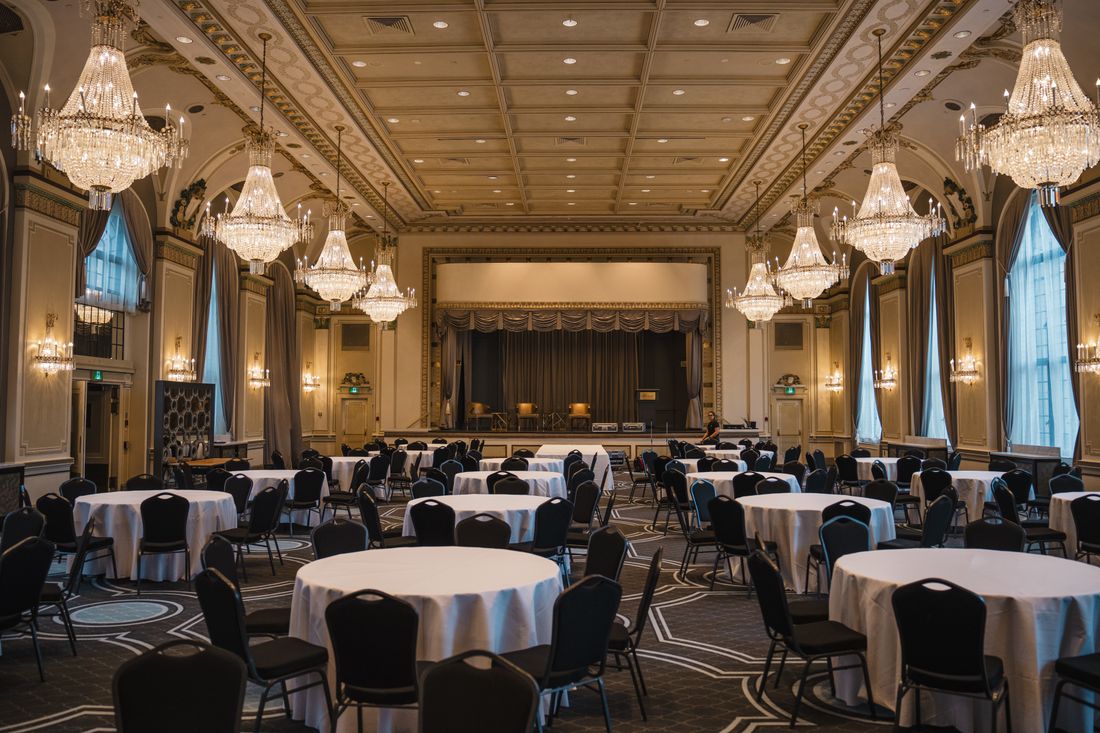
The event ends at nine. The shoot doesn't always agree. A program that runs long, a late arrival, a second wave of guests nobody scheduled, or a request for a few more portraits at the end can all quietly push a shoot past its call time, and none of them look like a problem in the moment. They just look like the evening still happening.
An evening shoot usually extends past its scheduled call time for one of four reasons: the program runs long, guests arrive late and compress everything after them, a second wave of attendance shows up unplanned, or someone asks for a few more portraits once the room starts to clear. Overtime typically gets billed in set increments once the booked window closes, and the studio's job is to flag the clock, not to guess at how long the room wants to keep going.
What Does a Booked Call Time Actually Cover?
A booked call time covers a fixed window, arrival through an agreed end time, built around what the event is expected to need: setup, the program itself, and a reasonable amount of open-room coverage after. It is a planning estimate, not a guarantee that the room will cooperate with the clock.
Most evening events are booked with some cushion already built in, because programs rarely run to the minute. A toast that starts five minutes late, a slightly longer Q&A, a line at the bar before people settle, none of that is unusual, and none of it typically triggers overtime on its own. The booked window is meant to absorb ordinary event drift.
What the call time doesn't absorb is a genuinely different evening than the one that was planned. If the schedule handed over at booking said the program runs until eight and closing remarks land around eight-thirty, the studio plans coverage around that shape. When the actual evening looks meaningfully different from that shape, that's the point where the booked window and the real night start to separate, and it's worth naming early rather than discovering it as the clock runs out.
None of this is meant to make a call time feel rigid. It's meant to make clear what it was built to hold, so that when something pushes past it, everyone understands why, instead of it feeling like a surprise charge for a night that just happened to run long.
Does a Late Start Automatically Mean Overtime?
No. A late start doesn't automatically create overtime, because the booked window is measured against the scheduled end time, not against how punctually the evening began. What matters is whether everything after the late start still fits inside the original call time.
A fifteen-minute late start on a two-hour block usually just compresses the middle, the mingling gets a little shorter, the toast lands a little later, and the shoot still wraps on schedule. The lost minutes come out of the slack most events already carry, not out of extra time the studio has to add on the back end.
Where a late start does start to matter is when it's paired with a program that was already running close to the edge of its window, or when the late start itself keeps growing instead of settling. A fifteen-minute delay that becomes thirty, then forty-five, stops behaving like ordinary drift and starts behaving like a genuinely later evening, which is a different situation than a slow start to an on-time program.
The honest answer is that a late start is a signal worth watching, not an automatic trigger. What actually decides whether it turns into overtime is whether the rest of the evening can still close inside the time that was booked, which is something a photographer on-site is usually watching for anyway. A quick check-in partway through the delay, rather than waiting until the scheduled end time arrives, is usually enough to tell which direction the evening is heading.
What Happens When the Program Itself Runs Long?
When the program runs long, meaning speeches, toasts, or a formal segment stretch well past what was planned, the shoot's end time typically moves with it, because those moments are usually the reason the coverage was booked in the first place. Cutting away mid-program to protect a clock defeats the point of being there.
This is the most common driver of a genuine extension, more common than late arrivals or unplanned crowds, because a program is the part of the evening with the least flexibility once it starts. A speaker who runs fifteen minutes over doesn't stop being worth photographing at minute fourteen. The room is still paying attention, the moment is still happening, and stopping coverage to protect a booked window would mean missing the actual content of the event.
What this means practically is that a studio watching a program run long isn't deciding whether to keep shooting, that part is usually not in question, it's tracking how far past the booked window the evening is likely to end up, and flagging that as early as the trend becomes clear rather than waiting until the window has already closed.
A program that runs long once is common. A program that consistently runs long at a given venue or for a given kind of event is worth knowing in advance, which is part of why the studio asks about the format of the evening at booking, not just the start time.
What About an Unplanned Second Wave of Guests?
An unplanned second wave, a later crowd arriving after the program ends, an after-party crowd folding into the same room, or a guest list that turns out to be larger than expected, extends a shoot because it adds genuinely new content to cover, not because the original guests are staying later.
This is a different situation than a late start or a long program, because those two involve the same evening taking longer. A second wave is closer to a second event landing on top of the first one. New arrivals mean new candid opportunities, a room that fills back up after it started thinning out, and often a different energy worth documenting on its own terms.
It's also one of the harder situations to plan for at booking, since the host may not know in advance whether a second wave is likely, some events genuinely don't have one, and some quietly do every time. What helps most is simply naming the possibility during planning, even as a maybe, since a studio that knows a later crowd is plausible can watch for it and flag the extension as soon as it starts rather than after it's already well underway.
The practical read is that a second wave isn't a scheduling failure on anyone's part. It's additional coverage the original booking didn't anticipate, and it gets handled as an addition, not as a correction to the plan.
What About a Request for Extra Portraits at the End?
A request for a few more portraits once the formal part of the evening winds down is common and usually welcome, but it's still additional coverage outside the booked window, and it typically counts toward an extension the same way a longer program would.
This request tends to come from the same instinct every time: the room has relaxed, people are still there, and it feels like an easy ask to grab a few more frames before everyone leaves. It's a completely reasonable moment to want captured. The scheduling reality is just that those extra minutes happen after the window the shoot was booked and planned around, gear, timing, and crew included.
The easiest version of this request is a quick, direct one, a specific small ask made once the crowd is already visibly wrapping up, rather than an open-ended "let's see how long people stick around." A studio can usually accommodate a short, defined extension far more easily than an undefined one, because a defined ask has a clear edge the schedule can absorb.
None of this means the request is unwelcome. It means naming it as what it is, a small addition past the booked window, keeps it simple instead of turning into a surprise on the invoice for something that felt, in the moment, like it barely took any extra time at all. Asking early, even a rough heads-up before the room fully empties, gives the crew a chance to plan for it instead of scrambling once the last guests are already heading for the door.
How Does Overtime Typically Get Handled Once It Happens?
Overtime is typically handled in set increments once the booked window closes, flagged to the client as it becomes likely rather than announced only after the fact, so nobody is surprised by an invoice line that references time they didn't know was being tracked.
The flag usually comes from whoever is on-site watching the schedule, not from a rigid clock alarm. If a program is clearly running past its planned end, or a second wave is visibly forming, that's the moment worth a quick heads-up, even an informal one, rather than waiting until the booked window has already closed to mention it.
What makes this work is treating overtime as a straightforward extension of the same coverage, not as a separate negotiation happening in the middle of an event. The crew already has their gear out, already understands the room, and is already positioned to keep going. The conversation is usually short: here's roughly how much longer this looks like it's running, here's what that means for the booking, does that work.
The alternative, discovering an extension only on the invoice days later, is where most of the friction around overtime actually comes from. It's rarely the extra time itself that bothers anyone. It's finding out about it after the evening is already over and there's no chance to have made a different call in the moment, which is exactly the gap a short in-the-room flag is meant to close.
How Should Overtime Get Set Up Before the Shoot Day?
Overtime should get set up at booking with a plain answer to one question: what happens if this runs long. Naming the increment, the rough rate structure, and who makes the call on-site removes the guesswork from a night that's already moving fast for everyone involved.
This doesn't need to be complicated. A short conversation during booking, whether the event has a history of running long, whether a second wave is plausible, whether the client wants extra portraits built into the plan from the start, covers most of what actually determines whether overtime becomes an issue later. A host who already knows their own event tends to know these answers, even if nobody's asked directly before.
It also helps to agree in advance on who gives the go-ahead once the booked window is closing. Some clients want the on-site crew to use their judgment; others want a specific person, an event planner, a comms lead, checked with first. Neither approach is wrong, but the shoot day goes more smoothly when that person is already identified rather than being figured out in real time while a speaker is still talking.
The goal isn't to predict the exact minute an evening will end. It's to make sure that if it runs long, the extension is expected rather than discovered, which is the difference between a smooth wrap and an awkward one.
When Does It Make More Sense to Stop on Time Instead of Extending?
Stopping on time makes more sense than extending when the remaining moments are genuinely optional, closing mingling with no new content, rather than something the event was actually booked to capture. Not every minute after the program ends carries the same value, and it's worth being honest about which minutes do.
A program running long or a real second wave of guests is usually worth extending for, because both add coverage the event would otherwise lose entirely. A room slowly emptying out with nothing new happening is a different situation. Extending coverage there mostly captures the absence of the event rather than the event itself, and it's fair for a studio to say so plainly rather than defaulting to "we can always keep shooting."
This is also where a defined stopping point, agreed at booking or flagged early in the evening, earns its keep. Knowing in advance that coverage wraps once the room clears past a certain point, rather than open-endedly, gives everyone a clean way to end the night without it feeling like anyone cut something short.
The honest version of overtime isn't "always say yes." It's recognizing which extensions add real value to the record of the evening and which ones are just more time on the clock, and being straightforward about the difference when the moment actually arrives, even if that means being the one who suggests wrapping first.
Frequently asked questions
Does every evening shoot end up running into overtime?
No. Most evening shoots wrap inside their booked window, since that window is planned with ordinary event drift already built in. Overtime tends to show up around specific triggers, a program running well past its planned end, an unplanned second wave of guests, or a genuine format change, not because an evening happened to feel long or the room stayed lively later than expected. A quiet night that ran a little slower rarely becomes an extension on its own.
How much notice does a studio usually give before flagging overtime?
As early as the trend becomes clear, not after the booked window has already closed. If a program is visibly running long or a later crowd is forming, that's typically flagged in the moment, so the client has a chance to make a call rather than finding an extension explained only on the invoice afterward, once there's no longer any opportunity to make a different decision about how the night should end.
Can overtime be planned into the booking from the start?
Yes, and it's usually the easiest way to avoid surprises. A short conversation at booking, whether the event has a history of running long, whether a second wave is likely, whether closing portraits are wanted, lets both sides agree on the increment and the process in advance instead of improvising mid-event, so the conversation on the night itself is a quick confirmation rather than a negotiation from scratch.
Who decides whether a shoot extends past its call time?
That's worth settling before the event, not during it. Some clients want the on-site crew to use their own judgment; others want a specific point of contact, an event planner or comms lead, checked with first before any extension is agreed to. Either approach works, as long as it's identified in advance rather than being figured out live while the evening is still running and everyone is already occupied.
Is it reasonable to ask for a few extra portraits at the end of the night?
Yes, and it's a common request. It still counts as coverage outside the original booked window, so naming it as a short, specific ask, a few more frames before people leave, rather than an open-ended one, makes it easy for the studio to say yes and keeps the scope clear for everyone, including whoever is tracking the crew's schedule for the rest of that same evening's bookings.
Need a production plan before you can book anything else?
Walk us through what the footage or photos are for and where the shoot is happening, and we'll help you build a plan that protects the day.
Start a project →