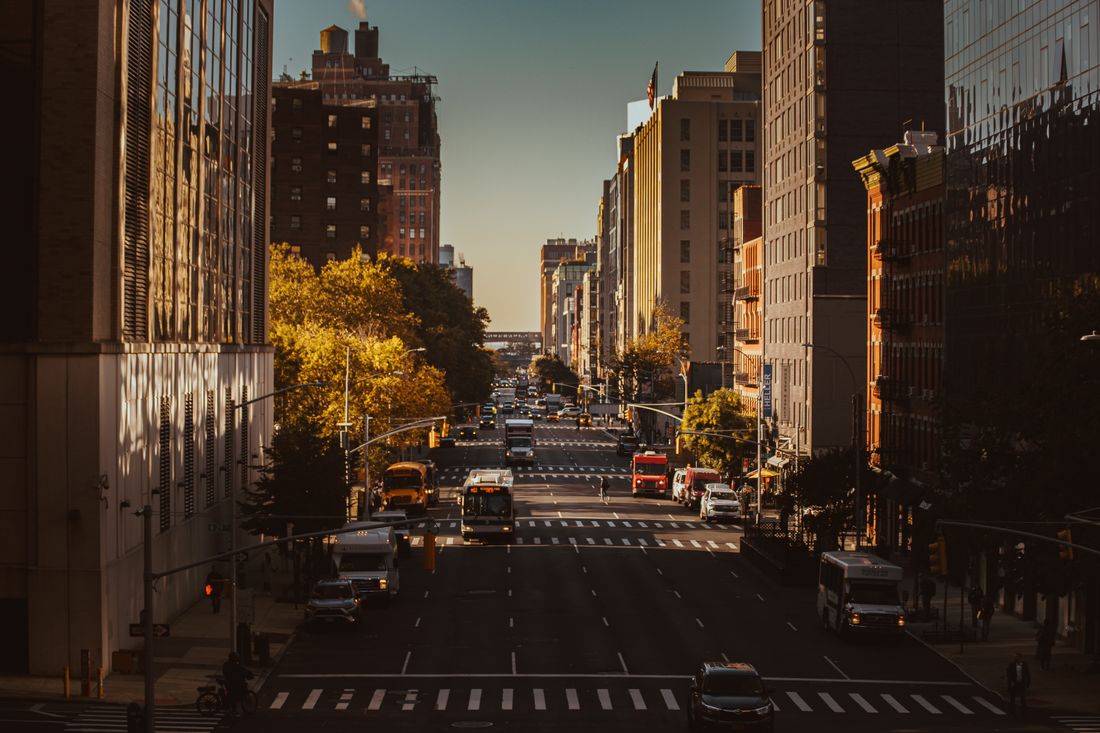
Two smaller bookings landing in the same week almost never arrive already paired. One client mentions a shoot near Union Square, another mentions one in Long Island City, and neither has any reason to think about the other's calendar. Sometimes those two jobs can share a single crew day, cutting travel and cost for both sides. Sometimes the same two addresses, on paper barely different from a hundred other combinations, simply won't work, and the reasons rarely show up until someone actually checks.
Whether two NYC bookings can share a crew day comes down to four checked variables: real travel time between the two locations, how closely their gear and setup needs match, each building's access windows, and how much buffer the combined schedule can protect. When those align, sharing a day is usually straightforward. When they don't, booking separately protects both shoots.
What Does Sharing a Crew Day Between Two Bookings Actually Mean?
Sharing a crew day means one crew, one round of travel time, and one day rate covering two separate bookings instead of two full independent setups. It works when both jobs realistically fit inside a single working day: comparable gear, workable timing on both ends, and locations close enough that travel does not eat into the hours meant for shooting.
Two bookings usually arrive as separate inquiries. One client mentions a shoot in Chelsea, another in Bushwick, and neither knows the other exists until the calendar gets checked. When the logistics genuinely support it, we will sometimes suggest combining two smaller jobs into a single crew day, because it can lower the day rate for both clients. That suggestion only goes out once the specifics have been checked, never assumed.
A shared crew day is not two half-price shoots stapled together. The crew still gives each booking its own full setup and breakdown, the same attention to lighting and framing, and the same care moving between environments. What changes is the travel and idle time between the two jobs, and sometimes the day rate that covers it. If the second booking needs its own rig anyway, sharing the day mostly saves money on travel, not on the time the production itself takes.
Because of that, the decision starts with logistics, not convenience. We look at where each booking sits, what gear it calls for, and how much slack sits between them before we say a shared day makes sense.
How Much Does Distance Between the Two Locations Actually Matter?
Distance decides more of this than almost anything else, because New York travel time is unpredictable in a way flat mileage never captures. Two locations that look close on a map can sit forty minutes apart once parking, elevators, and cross-borough transit are added in, and that gap has to fit inside the same day as two full shoots.
A subway ride across town reads differently than a gear-loaded crew move. Cases, stands, and lighting do not travel like a single person with a backpack. Loading a vehicle, finding parking or a legal loading zone near the second location, and unloading again all take real time that a simple point-to-point distance estimate leaves out entirely. Cross-town traffic on a weekday afternoon can turn what looks like a fifteen-minute trip into something considerably longer.
Borough crossings add their own variable. A shoot in downtown Manhattan followed by one in western Queens is a very different proposition than two bookings a few blocks apart in the same neighborhood, even though both might get described casually as close. Bridge and tunnel timing shifts by hour and by day, which means the same two addresses can be an easy pairing on a Tuesday morning and a tight one on a Friday afternoon.
This is why we ask for both addresses early rather than estimating from neighborhood names alone. A real travel estimate, checked against the actual booking windows both clients need, tells us far more than assuming two jobs in the city are automatically close enough to share.

Why Do the Gear and Setup Requirements of Each Job Decide So Much?
Two bookings that need the same basic gear share a day far more easily than two that need completely different rigs, because swapping equipment mid-day costs real time the schedule has to absorb somewhere. A pair of documentation shoots using a similar lighting setup is a simpler pairing than a documentation shoot followed by coverage with entirely different needs.
Every setup has its own breakdown and rebuild cost. Lighting stands, backdrops, and modifiers used for one job have to come down cleanly before the next one goes up, and that teardown time does not shrink because the day is shared. If both bookings call for a similar lighting approach, a documentation day for two different collections, for instance, the crew can move faster between them because the gear stays largely the same.
Mismatched gear needs push the other direction. A booking that calls for a full lighting kit paired with one needing a lighter, mobile setup means packing and repacking twice in one day, on top of the travel between them. That is not impossible, but it eats into the buffer that would otherwise absorb a late start, and it is one of the first things we check before combining two jobs.
Gear fit is also why we ask what each booking needs before quoting a shared day, rather than assuming two similar-sized shoots need similar equipment. Two portrait sessions can call for very different lighting depending on the space and the look each client wants, and that matters more than the category label on the booking.
How Do Building Access and Timing Windows Affect a Shared Day?
Building access decides whether a shared day is realistic just as much as distance does, because a crew cannot start the second booking until it can actually get into the second location. A gallery with flexible hours and a freight elevator on request is a very different proposition than a building with a narrow loading window or a doorman who needs advance notice.
Many buildings that host galleries, studios, or offices in New York run their own access rules independent of the client's own schedule. A freight elevator might need to be reserved in a specific block. A doorman or building manager might require advance notice before letting a crew bring in cases and stands. None of that is unusual, and it is rarely the fault of either client, but it has to be checked before a shared day gets promised.
Light matters too, particularly for anything shot with available or mixed lighting rather than a fully controlled setup. A booking that depends on a specific window of daylight has less flexibility to shift later in the day than one shot entirely with the crew's own lighting, which means the sequence of two bookings sometimes has to follow the light rather than convenience or geography.
This is why access details, elevator reservations, loading dock hours, building notice requirements, get asked about at the same time as the address itself. A booking that looks easy to combine on paper can turn out to have a narrow access window that makes sharing the day impractical.
Does It Matter If the Two Bookings Are Different Kinds of Shoots?
Two bookings of the same general type usually combine more easily than two very different ones, because similar deliverables tend to call for similar gear, similar pacing, and similar crew roles. Pairing two documentation shoots is generally simpler than pairing a documentation shoot with an event, even if both are short and both are nearby.
Documentation work tends to be methodical and controlled: consistent lighting, a fixed setup, one piece or one space at a time. Event coverage moves at a different pace entirely, following a room and reacting to what happens rather than staging it. A portrait session sits somewhere between the two, controlled but more collaborative with the subject. Asking one crew to shift between these modes twice in the same day is possible, but it is a real transition.
The deliverables themselves also shape how the day gets planned. A documentation shoot usually produces a defined, predictable set of files. An event produces a variable number depending on what actually happens in the room. A brand film or reel adds its own planning layer on top of stills. Mixing these types into one crew day is not automatically a problem, but it does mean the schedule has to account for two different working rhythms.
In practice, the clearest shared days pair similar work: two smaller documentation bookings, two portrait sessions, two short reel shoots. When the types genuinely differ, sharing the day is still sometimes possible, but it depends more heavily on getting the other variables, distance, gear, and access, right.
Where Does the Buffer Time Actually Go, and What Eats It First?
Buffer time is the part of a shared crew day that absorbs everything unpredictable, a late start, a slow elevator, a client who needs a few extra minutes, and it is usually the first thing to disappear when two bookings get combined without enough planning. A day with no buffer is a day where one small delay at the first location becomes a late arrival at the second.
Every shoot runs a little differently than planned, not because anything went wrong, but because real spaces and real schedules rarely match the plan exactly. A subject needs a few extra minutes to settle in. A room needs rearranging that was not visible from photos. A conversation with a client runs a little longer than expected. None of that is unusual on a single booking, which absorbs it easily. Two bookings sharing a day have far less room to absorb the same small delays twice.
Travel time is often where the buffer actually gets spent, even when it was planned for something else. A crew that budgeted fifteen minutes to move between locations and hits twenty five minutes of actual travel has already spent the cushion meant for a slow first setup, before the second booking has even started.
This is why a shared day usually gets built with more buffer than either booking alone would need, not less. Combining two jobs to save time only works if the schedule protects enough slack to absorb the ordinary small delays that come with any real shoot.
What Should You Ask Before Requesting a Shared Crew Day?
The most useful thing a client can do before requesting a shared crew day is bring the actual details early: both addresses, both preferred time windows, and what each booking needs from a gear and access standpoint. A vague request to share a day with another shoot nearby is much harder to answer than one that arrives with specifics already attached.
Flexibility on timing matters more than most clients expect. A booking that can start anywhere within a two-hour window is easier to pair with another than one locked to a single exact hour, because the schedule has room to shift if the first booking runs long or the second location has its own access constraints. Naming that flexibility upfront, rather than leaving it to be asked about later, speeds up the whole planning process.
It also helps to say plainly what the shoot needs to produce, and by when. A booking with a hard deadline the same week behaves differently in the schedule than one with a flexible turnaround, and that difference affects whether combining it with another job is worth the added planning risk. This is a separate question from paying for a faster turnaround.
Asking directly whether a shared day is even possible, rather than assuming it either will or will not work, is usually the fastest path to an honest answer. We would rather check the real logistics against both bookings than guess from a rough sense of the neighborhoods involved, and that check is quick once the actual details are in hand.
What Happens When Two Bookings Genuinely Can't Share a Day?
When two bookings genuinely cannot share a crew day, the honest answer is to book them separately rather than force a combination that puts either shoot at risk. A tight schedule that leaves no room for a late start, a slow elevator, or a client who needs a few extra minutes is not a savings, it is a risk transferred onto both clients at once.
The clearest signal that a shared day will not work is when two or more of the deciding factors line up against it at once: real distance between the locations, mismatched gear needs, and a narrow access window on either end. Any one of those alone is often manageable. Stacked together, they leave no realistic path to a day that respects both bookings equally.
Declining to combine two bookings is not a failure of planning, it is what the planning is for. A crew day that tries to do too much tends to shortchange whichever booking happens to be scheduled second, and that is not a tradeoff either client signed up for. Being upfront about that, early, is more useful than agreeing to a combination and hoping the day works out.
In those cases, the more useful move is usually adjusting dates rather than forcing a shared day. Two bookings that cannot share a day today can sometimes still be scheduled back to back on separate days, close enough in the calendar to feel coordinated even without sharing a single crew call.
Frequently asked questions
Can two unrelated clients share the same crew day?
Yes, when the logistics genuinely support it. Two separate clients can share one crew day if their locations sit close enough, their gear needs are similar, and their timing windows leave enough buffer between the two shoots. Each booking still gets its own full setup, its own attention, and its own deliverables. Sharing the day mainly affects travel time and the day rate, not the quality or scope of either individual shoot.
Does sharing a crew day cost less than booking separately?
Often, yes, because travel and setup overlap gets reduced rather than duplicated twice. The exact savings depend on distance, gear overlap, and how much buffer the combined schedule needs. A shared day is not a flat discount on either booking. It reflects the actual reduction in travel and idle time between the two jobs, which varies depending on how well the two bookings fit together logistically.
How far apart can two locations be and still share a crew day?
There is no fixed mileage limit, because New York travel time depends on traffic, transit, and loading logistics more than raw distance. Two addresses a short walk apart are an easy pairing. Two addresses in different boroughs might still work depending on the time of day and each building's access rules. We check real travel time against both booking windows rather than estimating from distance alone.
What happens if the first booking runs long?
A shared day is planned with buffer specifically to absorb this. If the first booking runs past its planned window, that buffer gets used first, and the second booking's start time may shift slightly within the range already discussed beforehand, not sprung on either client at the last minute. If a delay looks significant, we would rather communicate that early and adjust the schedule than rush either client's shoot to protect an arbitrary start time.
Can a documentation shoot and an event share the same crew day?
Sometimes, though it depends more on the other factors, distance, gear, and access, than the deliverable types alone. Documentation and event coverage move at different paces and often call for different equipment, which makes combining them a bigger planning question than pairing two similar shoots. We would rather check the full logistics honestly than assume any two bookings can combine by default, since a pairing can look fine on paper and still not hold up.
Planning photo or video in NYC?
Tell us what the files need to do, where the work is happening, and what the day has to protect. We will help shape a practical production plan around it.
Start a project →