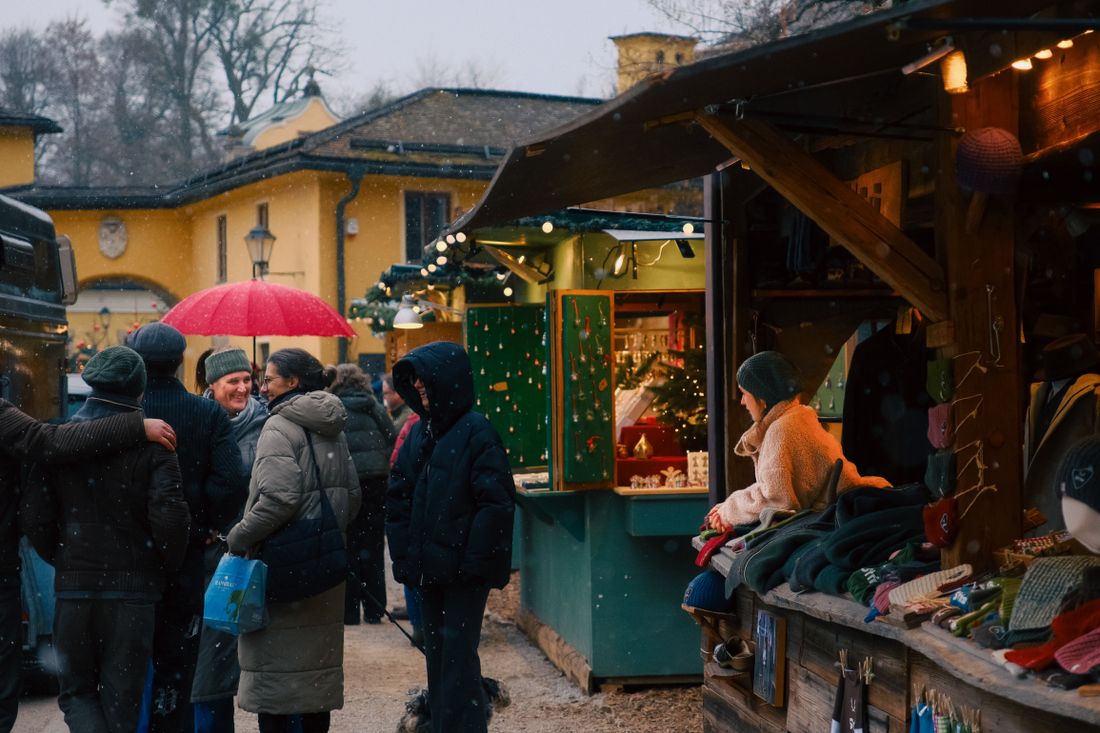
A vendor booth at a holiday market is not a smaller version of an artist's own studio sale. It is one table inside a room somebody else controls, wedged between other vendors, with shoppers moving past dozens of tables in a single pass. That single fact changes the light, the schedule, and almost every framing decision on the day. The coverage that works for a solo studio-as-shop weekend usually falls apart the moment it meets a shared aisle and a market organizer's rules.
A vendor booth inside a multi-vendor holiday market is a shared-space shoot, not a solo studio sale: one table in a room the organizer controls, next to other vendors, with shoppers moving past many tables at once. Coverage has to build the story from the table outward, since the room offers no built-in narrative and neighboring booths compete for the same frame. A clean, raised angle covers the booth as a whole before shoppers arrive, and separate, simply framed shots cover individual pieces on their own. Confirming the market organizer's rules on timing and access ahead of the shoot avoids getting stopped mid-session, and watching the aisle's own rhythm produces the genuine customer moments a staged shot cannot fake.
How Is Photographing a Vendor Booth Different From an Artist's Own Studio Sale?
A vendor booth at a holiday market is a shared-space problem: one table inside a room the organizer controls, wedged between other vendors, with shoppers moving past dozens of tables in a single pass. A studio-as-shop sale is different, one location an artist already owns for a weekend, built entirely around their own work. Coverage that works for one format usually falls flat in the other.
The difference changes almost every decision a photographer makes on the day. In a studio sale, the space itself tells part of the story, the shelves, the worktable, the light through a window the artist chose on purpose. A market booth carries none of that narrative. The walls belong to a rented hall or a tent row, the lighting is whatever the organizer strung up for two hundred vendors at once, and the vendor selling candles is eighteen inches to the left. Nothing about the surroundings was designed for this particular table, so the coverage has to build the story from the display outward instead of borrowing it from the room around it.
The other shift is scale. A studio sale runs on the artist's own clock, in their own footprint, with room to circle a piece for the best angle before a single customer arrives. A booth gets a fixed few feet and an aisle full of people who did not come specifically to see this vendor. Treating a market table like a mini studio sale, waiting for a quiet room that will never arrive, is the first habit worth dropping before the shoot starts.
What Changes When You Can't Control the Room?
In a vendor's own studio, the photographer controls the light, the walls, and the schedule. On someone else's market floor, none of that is available: the light comes from whatever the hall or tent already has, the walls belong to a rented structure nobody can repaint, and the shooting window bends around the organizer's rules and every neighboring vendor's setup.
Light is usually the first surprise. A studio sale can wait for the golden hour a window offers. A market runs on whatever the venue installed, often flat overhead fluorescents in a community hall or string lights in a tent that look festive to a shopper and uneven to a lens. A small reflector or a portable flash that bounces rather than blasts covers most of the gap, but the fix has to travel in a bag, not get planned around a fixed setup the way it would in a studio.
The schedule is the other constraint. A studio sale can start whenever the artist and photographer agree. A market opens and closes on the organizer's clock, and coverage has to happen inside that window, often before doors open for a clean booth shot and again once shoppers arrive for the working scene. Arriving with a plan for both moments, rather than hoping a lull appears, is what makes a fixed, uncontrollable schedule feel manageable instead of chaotic.

How Do Neighboring Booths Create Visual Noise in Your Shots?
Neighboring booths compete for the same frame the moment a wide shot drifts past the table's edge: a competing vendor's bright signage, a stack of storage boxes, a completely different color palette two feet away. The fix is framing tight enough to isolate one vendor's booth while still reading as part of a real market rather than an isolated tabletop.
The easiest tool for this is angle, not distance. Shooting straight into a booth from across the aisle usually pulls in three other tables in the background. Shooting from slightly to the side, along the table's own line, uses the vendor's own display as a natural wall between the lens and everything competing for attention behind it. A wider aperture helps too, letting a busy neighboring booth blur into soft color rather than sharp, distracting detail that pulls the eye away from the actual subject.
Timing matters as much as angle. A booth photographed the moment a market opens, before the aisle fills and other vendors finish arranging their own displays, has far less visual competition than the same booth an hour later. A few frames taken early, before the room reaches full noise, are often the cleanest of the whole session. The goal is never to pretend the booth is completely alone in the room, only to keep everything else from becoming the subject by pure accident.
How Do You Photograph a Booth's Display So It Reads Well on Its Own?
A booth's own display needs one clean, slightly raised angle that shows the full table, the signage, and how the pieces sit together, captured before shoppers crowd the aisle in front of it. That single frame becomes the shot a vendor can actually use to represent the booth on its own, independent of any one customer or product.
Getting that angle usually means standing back and a little above table height, close enough that the booth still reads as the subject but wide enough to include the signage, the table skirt, and the overall arrangement a shopper sees walking up. Straight-on shots taken from directly across the aisle tend to flatten a display and pull in whatever sits behind it. A slight three-quarter angle, taken from just off to one side, keeps depth in the frame and gives the display room and edges without losing the sense of a full table.
The best time for this shot is early, right after setup and before the market opens to shoppers, when the arrangement is at its most intentional and the aisle is still clear. A booth photographed once the crowd arrives usually shows a vendor mid-transaction rather than the display itself, which is a different and equally useful shot, just not this one. Getting the clean version first means the working shots that follow never have to double as the only record of how the booth actually looked.
How Do You Shoot Individual Pieces Without Losing the Booth Context?
Individual pieces need their own close, simply framed shots, isolated against the table surface or a plain backdrop, with nothing from a neighboring booth bleeding into the edges. That detail coverage does a different job than the wide shot: it lets one piece be judged on its own, the way a shopper would hold it up close.
The practical challenge is finding a clean background inside a few square feet of table. A folded piece of neutral fabric, a section of the table skirt, or simply angling the piece against open space rather than the busy aisle behind it usually solves this without any extra gear. Getting low, close to table height, keeps the shot from looking like a documentation photo taken from standing height and instead makes it feel like an object a person is actually considering buying.
Consistency across pieces matters more than any single clever shot. A set of detail images taken at the same angle, distance, and light reads as a coherent product set a vendor can use across a shop update or a social post, where five pieces each shot differently reads as scattered even if every individual frame is fine. Working through a small, repeatable setup for each item, rather than improvising fresh framing for every piece, is what turns a handful of scattered detail shots into something genuinely usable together.
What Do Market Organizers Typically Expect From a Photographer?
Market organizers usually set rules on when a photographer can be on the floor, how close a camera can get to the aisle, and whether coverage needs its own credential. Confirming those rules with the organizer directly, not only the vendor who booked the shoot, avoids getting stopped mid-session over a permission nobody checked.
The most common restriction is timing. Many markets set aside a short window before doors open for vendors to finish setup, and expect anyone with a camera to be clear of the aisles once shoppers are let in, unless coverage was arranged with the organizer ahead of time. Some markets are relaxed about a photographer working the floor during open hours; others treat the aisle as customer space only and want a photographer shooting from the booth's own footprint, not stepping into the walkway to get an angle.
Other rules worth checking before arrival include flash use in a crowded hall, whether other vendors need to be asked before appearing in a frame, and where a photographer can stand without blocking foot traffic the organizer is responsible for keeping clear. None of this is unusual to ask about, and most organizers answer quickly and clearly when a vendor requests it on a photographer's behalf well ahead of the market date. The version of this that goes wrong is always the one where nobody asked first, and a rule everyone assumed was fine turns out not to be.
How Does Foot Traffic Change the Way You Time Your Shots?
Foot traffic at a market moves in waves, not a steady trickle, so usable candid shots come from watching the aisle rather than the booth, waiting for a genuine pause where a shopper stops, picks something up, or talks with the vendor, then shooting quickly before the moment passes.
Between waves, an aisle can go from empty to crowded in under a minute, and a photographer who is only watching the table misses the shopper walking into frame from the side. Positioning slightly off the booth's own footprint, angled so both the display and a stretch of aisle are visible, gives enough warning to be ready when someone actually stops. Chasing a shopper who has already passed the booth rarely produces anything worth keeping; the better move is anticipating who is about to arrive.
Quiet stretches are just as useful, but for a different kind of shot. When the aisle empties for a minute, that is the window for the clean booth-wide frame from earlier or for a detail shot that needs a still table rather than a moving hand. Working both rhythms across a session, the crowded bursts for genuine customer moments and the lulls for the cleaner reference shots, produces a more complete set than shooting continuously through the whole session and hoping something genuinely useful happens to land in frame entirely on its own.
What Should a Vendor Walk Away With From a Market Coverage Session?
A vendor should leave a market coverage session with three distinct kinds of images: a clean wide shot of the booth on its own, a set of individual product details, and a handful of genuine customer moments, each doing a job the others cannot cover on their own.
The booth-wide shot is what represents the vendor as a business, useful for an application to next year's market, a social post announcing where to find the table, or a simple record of how the display actually looked when it worked. The product details are what sell individual pieces after the market ends, on a shop update or in a message to a customer who asks if something is still available. The customer moments are proof of life, evidence that real people stopped, picked things up, and bought, which a static product photo alone never quite communicates.
None of these three replace a studio sale's coverage or a fine-art fair booth's, because those formats are answering different questions with different stakes. What they do is give a vendor a usable record of one specific, shared-space format: a table among many, working inside someone else's room, that most coverage plans do not account for on their own. Booking with that distinction in mind, rather than assuming any event photography covers it, is what actually gets a vendor images they can use.
Frequently asked questions
Do you need the market organizer's permission before photographing a vendor's booth?
Yes, in most cases. A vendor can invite a photographer, but the market itself usually sets its own rules on access, timing, and whether photography needs a separate credential beyond a vendor's booth pass. Confirming directly with the organizer, not only the vendor, before the shoot avoids being stopped mid-session over a rule nobody checked. Most organizers respond quickly to a straightforward request, which lets a photographer plan around the shooting window that is actually allowed.
How is photographing a vendor booth different from covering a full pop-up exhibition?
A pop-up exhibition is a standalone show built around one body of work in a space rented for that purpose, so coverage documents the whole exhibition experience. A vendor booth is one table among many inside a market somebody else runs, competing for space and attention with neighboring vendors on every side. The booth session is narrower by design, a clean shot of the table, individual product details, and real customer moments, not a full walkthrough of a dedicated show.
Should a photographer ask neighboring vendors before including them in a shot?
A wide crowd shot of the aisle at a public market generally does not need individual sign-off from every nearby vendor. A frame where a neighboring booth's own product or signage becomes clearly identifiable is a different situation and worth a quick, friendly check before it gets used publicly. The safest habit is framing tight enough that the booth being covered stays the clear subject, so a neighboring table rarely becomes the point of a shot at all.
How many images should a vendor expect from a market booth session?
A useful session usually produces three distinct kinds of images: one clean, booth-wide shot taken before the crowd arrives, a small set of individual product details shot consistently, and several genuine customer moments captured once shoppers move through the aisle. The exact count depends on how long the market runs and how busy it gets, but a vendor should walk away with enough variety across those three categories for a shop update, a future application, and a social post.
Does a vendor booth at a holiday market need the same coverage as a fine-art fair booth?
No. A fine-art fair booth sits inside a professional exhibitor context with its own conventions around presentation and buyer expectations, a different register from a holiday or craft market table. A vendor booth session focuses on a simpler set: the display, the individual pieces, and the market's foot traffic. Both formats share the same shared-space problem, shooting inside someone else's room, but the audience and purpose of the images differ enough that one shot list rarely serves both.
One night, two openings, no dropped coverage.
We plan clustered opening nights before they turn into a scramble, whether that means a split schedule, a second shooter, or an early enough booking that the calendar never becomes the problem.
Explore event coverage →