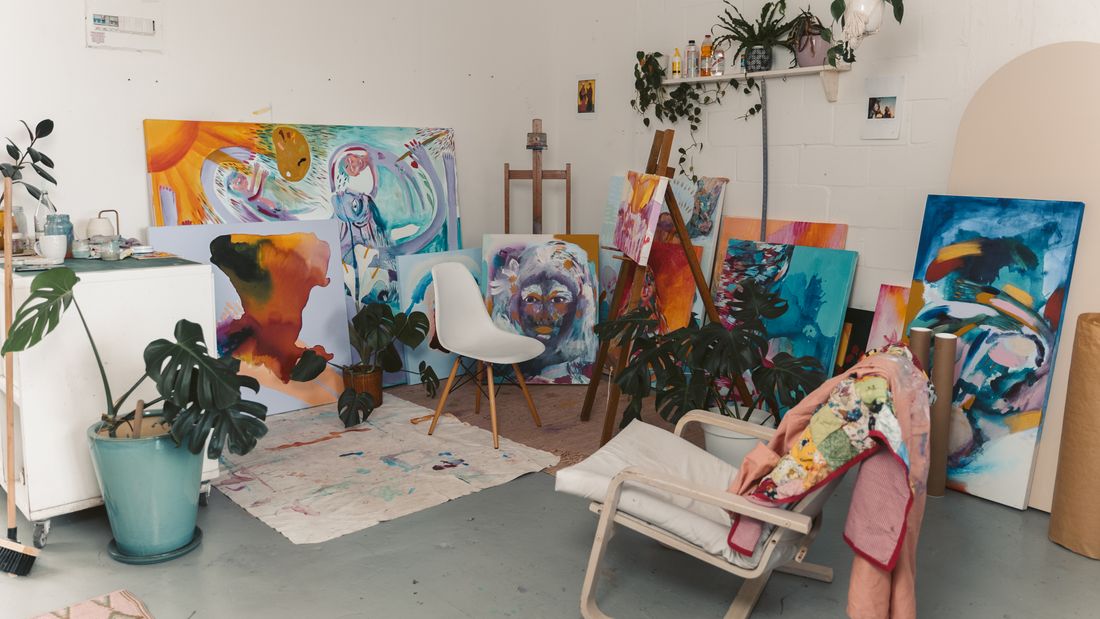
A long project rarely gets easier to document the further it goes. Materials pile up, the piece changes shape under its own hands, and the version that mattered in March is long gone by the time the work ships. Once a surface gets covered, that earlier state exists only if someone photographed it before it disappeared. A single closing shoot can show how the work finished. It can't show how it got there. What that takes instead is a plan: a handful of real turning points across the timeline, one repeatable setup, and a naming system that keeps the sequence legible long after the project itself is done.
Documenting a long project in stages means photographing it at planned points across its timeline, not only at the end. A repeatable setup, three to six intervals tied to real turning points, consistent lighting, and a clear naming system are what let the stages compare honestly and hold up later for grant applications, catalogue essays, or condition questions.
What Does It Mean to Document a Long Project in Stages?
Documenting a long project in stages means photographing the work at several planned points across its timeline, not only once it's finished. Instead of one closing shoot, the project gets three to six sessions tied to real turning points, each shot with enough consistency that an early state and a late state can sit side by side and compare.
Most documentation gets planned as a single event. The piece is finished, someone gets called in, the shoot happens, the folder gets filled. That works fine for a piece that took an afternoon. It stops working around the second or third month of a project that keeps changing shape under its own hands. By the time the work ships, the studio has cycled through states nobody wrote down anywhere.
A staged plan treats the timeline itself as part of the subject. Instead of asking whether the work is ready to shoot, the useful question becomes which points are worth locking in before they're gone. That might be the first layer going down, a structural change partway through, and the near-final state before the last pass. The number of stages depends on the project, but the habit stays the same: decide the checkpoints in advance, instead of deciding after the fact that a moment mattered.
The result is not a highlight reel of pretty moments picked after the fact. It is closer to a set of checkpoints that, together, describe how the work moved from where it started to where it landed, in a way a single closing shot never can.
Why Can't One Final Shoot Show How the Project Got There?
A single end-of-project shoot can only show the state the work is in the day the camera arrives, not any decision made along the way. Once a surface gets covered, a material layered over, or a structure closed up, that earlier state exists only if someone photographed it before it disappeared for good.
This is the part that catches people off guard. A painting can go through a dozen real decisions before it settles into its final composition, and a single closing photograph preserves exactly one of them. The rest stop existing in any visible form the moment the next layer goes on top. There is no way to recover a covered brushstroke or a structural choice built over later. If nobody photographed it, it is gone the same way an unrecorded conversation is gone.
That gap matters more than it looks like it should, because the finished piece answers a different question than the process does. A closing shot proves what the work became. It says nothing about what the work tried first, what got abandoned, or what problem a change was solving. A grant reviewer or a curator writing an essay is often more interested in that second question.
Staged documentation exists to close that gap while it's still open. Each session catches a state that would otherwise only survive as memory, a poor archive for a project that ran for months. The camera does not need to catch everything. It only needs enough real points that the shape of the process stays visible after the work itself has moved on.
Which Intervals Are Actually Worth Documenting?
The intervals worth documenting are the real turning points in the work, not evenly spaced calendar dates. A useful starting set is the early state, one or two structural shifts partway through, and the near-final state before the last pass, chosen because the piece actually changed at each point, not because a month had passed.
Calendar-based schedules feel easier to plan, but they miss the moments that matter. A monthly shoot might land in a slow stretch where nothing has moved, and skip the week a whole section got reworked. Tying stages to the project's own milestones solves that. A useful trigger list: the point before the first major material goes down, any point the composition or structure genuinely shifts, the point a technique changes, and the point the piece is close to done but not yet finished.
Three to six stages covers most long projects well. Fewer than three collapses back into a before-and-after comparison, losing the middle of the story. More than six competes with the actual working time, and a project interrupted too often starts to feel managed for its record instead of its own sake.
The plan does not need to be rigid. Deciding the rough shape of the stages first gives the project a spine, but the actual dates should follow the work, not the other way around. A stage due in week six that the real shift didn't reach until week eight should wait. Documenting nothing there is more honest than documenting a state that hadn't actually changed yet.
How Do You Keep Lighting and Setup Repeatable Across a Year?
Keeping a setup repeatable across a year means fixing the camera position, the light source, and the framing once, then returning to that configuration for every stage. A marked tripod spot, a consistent light source at the same time of day, and a written note of settings used let an early stage and a late stage compare honestly, instead of just looking different.
The biggest threat to a staged sequence is not a bad shoot. It's a shoot that quietly drifts from the last one. A different window, a different hour, a slightly different distance, and a change in the work becomes impossible to separate from a change in how it was lit. That's a real problem for a comparison meant to show what happened to the piece, not the light.
A few habits keep the drift out. Marking the camera position on the floor with tape means the next session starts from the same distance and angle without guessing. Using the same light source, whether a fixed window at a set time or a repeatable artificial setup, removes the biggest variable in how color reads. A gray card in the first frame, kept out of the final crop, gives a fixed point to check color against later, even months apart.
None of this needs to be elaborate. A phone note with the camera distance, the light setup, and the time of day is often enough to rebuild the same conditions next time. The goal is a setup specific enough that the only thing changing between stages is the work itself.
How Should Staged Files Be Named So the Sequence Stays Legible?
Staged files should carry the project name, a stage number, and a date, in that order, so the sequence reads correctly the moment a folder opens, without opening each file to figure out where it falls. A consistent pattern turns a pile of similar images into a timeline that sorts itself.
A simple convention does most of the work: project identifier, then stage number, then the shoot date in a sortable format, such as year, month, day. A folder named this way lists itself in the right order in any file browser, with no manual sorting required. The stage number matters as much as the date, because it tells a viewer this is the third checkpoint in a planned sequence, not just a photo taken on some Tuesday.
A short index alongside the files earns its keep here. One line per stage, noting the date and a plain description of what changed since the last session, turns the folder from a set of images into a readable record. That index answers what happened between stage two and stage three, and why the piece looked different by then.
Keep every stage. It's tempting to clean out earlier states once the piece is finished, especially if an early stage looks unfinished next to the final result. That instinct works against the whole point of documenting in stages. The rough early state is what makes the sequence useful later, and a folder with gaps in it goes back to a single closing shot with some extra clutter attached.
Who Ends Up Using a Staged Documentation Record, and For What?
A staged documentation record gets used by grant and residency panels reviewing an applicant's process, by writers building a catalogue essay around how a body of work developed, by anyone later asking a condition or provenance question about a piece, and by the artist's own future reference when a talk or interview asks about the work.
Grant and residency applications increasingly ask for process material rather than only finished images, because a panel reviewing dozens of applicants is often trying to understand how someone works, not just what they end up with. A staged sequence answers that directly. It shows a decision being made rather than only the result of one.
Catalogue essays lean on the same material differently. A writer describing how a body of work moved from an early idea to its final form works from whatever record exists. A staged sequence gives them something concrete to point to instead of the artist's memory, which tends to smooth itself out with retelling.
Condition and provenance questions are the quieter use, and tend to arrive later than anyone expects. A conservator or appraiser trying to understand whether a change happened during a piece's making or after it left the studio benefits from a dated record of its development. Without one, that question has little to answer it beyond a guess.
The artist gets the most ordinary use out of it: a working memory that doesn't fade, useful the next time a talk or a simple curiosity about an earlier idea calls for looking back at exactly how a piece got where it ended up.
What Happens If a Stage Gets Skipped or the Project Runs Long?
A skipped stage leaves a gap in the sequence, not a ruined one. The record moves from whatever the last documented state was to whatever comes next, and that gap is worth noting in the index rather than hidden or filled in later with a photo pretending to be from the missed date.
Long projects run long for real reasons. A piece gets set aside for a month, a material takes longer to cure than expected, or a structural shift needs three attempts instead of one. None of that is a failure of the plan. It's what happens when a plan meets a project with its own timeline. The fix is not forcing a stage on schedule regardless of whether anything has changed. It's letting the trigger, not the calendar, decide when the next session happens.
What does need attention is the temptation to backfill a missed stage after the fact. A photograph taken after a change has already happened cannot stand in for one that should have been taken before it, no matter how the dates get labeled. A missing stage is more honest left as a gap than dressed up as something it isn't. A quietly misdated file is much harder to catch later.
If a project runs well past its planned length, the better response is usually to add a stage rather than stretch the existing intervals thinner. A project meant to run four months that runs nine has simply had more happen to it, and the record should reflect that rather than pretend the original plan still fits.
What Does a Workable Staged Documentation Plan Actually Look Like?
A workable plan names three to six real turning points before the project starts, fixes a repeatable camera and lighting setup once, sets a naming convention with a short running index, and treats the schedule as something the work adjusts rather than a calendar to obey. That's the whole plan. Nothing about it requires special equipment.
The order matters more than the detail. Deciding the rough checkpoints first, even loosely, gives the project a spine before it starts changing shape. Fixing the setup second means every session after the first takes minutes, not a fresh decision about angle and light. The naming convention and index can be built in five minutes and pay for themselves the first time anyone needs to explain what happened between two stages.
What this plan is not is a burden layered on top of the actual work. Each session is short once the setup is fixed, usually shorter than people expect the first time, because most decisions were already made when the plan was written. The discipline is returning to the same setup and updating the index, not spending a full afternoon on documentation every time something changes.
The payoff shows up later, when someone asks a question a single closing photo can't answer. What did this look like before the change. When did the structure shift. A staged record has an answer sitting in a folder, dated and in order, instead of a shrug about what the process must have looked like. That's the case for documenting a long project in stages, not just at the end.
Frequently asked questions
How many stages should a long project be documented in?
Three to six is a workable range for most long projects. Fewer than three tends to collapse back into a simple before-and-after comparison and loses the middle of the process. More than six starts competing with the actual working time and can turn documentation into its own distraction. The right number depends on how many real turning points the project has, not on a fixed schedule, a set number of months, or a round number picked in advance.
Does staged documentation need the exact same lighting every session?
It needs to be consistent enough that a change in the work can be told apart from a change in the light, not identical down to the pixel. A fixed camera position, a repeatable light source at the same time of day, and a color reference in the first frame of each session usually get close enough that an early stage and a late stage can be compared honestly, even when the sessions are months apart.
Is staged documentation the same thing as a time-lapse of the work?
No. A time-lapse is a motion format built for sharing, usually compressed from many frames into a short clip meant to be watched start to finish. Staged documentation is a set of discrete, full-quality photographs taken at planned intervals and kept as an archival record rather than a video. The two can come from the same working sessions, but they serve different purposes and get organized and stored in different ways.
What's the shortest gap that's still worth documenting between stages?
There's no fixed minimum. What matters is whether something real has changed since the last stage, whether that took two weeks or four months to happen. Documenting two sessions close together only makes sense if the work genuinely moved between them in a way worth catching on camera. If nothing has changed, waiting for the next real turning point is more useful than shooting on a fixed schedule regardless of progress.
Who typically asks to see a staged documentation record?
Grant and residency panels reviewing process material as part of an application, writers building a catalogue essay around how a body of work developed over time, conservators or appraisers working through a condition or provenance question, and often the artist themselves, referring back to it for a talk, an interview, or their own memory of how a piece actually came together across months of work.
Make sure your archive means something when someone asks for proof.
We photograph the work the way an insurer or gallery registrar wants it documented, straight views, correct color, and condition callouts you can actually point to later.
Explore artwork documentation →