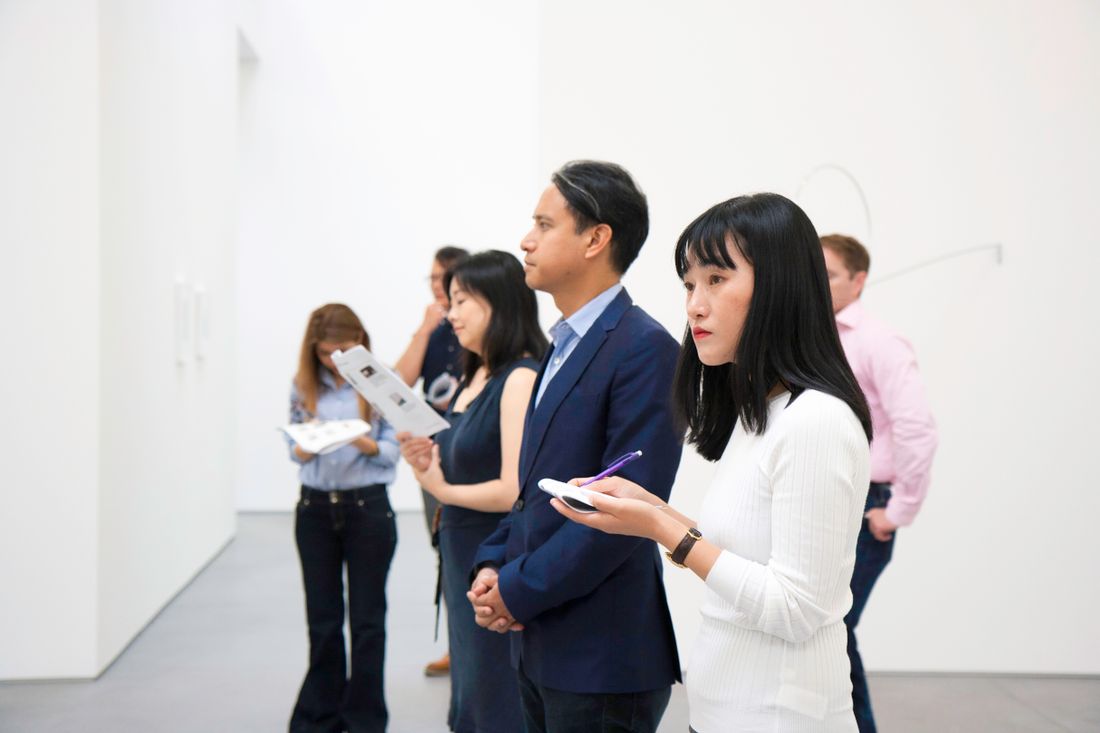
A booth is built to be looked at from a small distance, with room to step back and let the work breathe. A scheduled talk erases that distance in seconds. A crowd forms where the walking space used to be, someone starts speaking a few feet from the nearest piece, and the coverage plan built for the rest of the fair, the one calibrated for quiet browsing and the occasional passing collector, stops matching the room. The talk lasts twenty minutes. What gets captured in that window, and what gets protected around it, decides whether the booth still reads as itself once the crowd clears.
A booth talk turns a display into a temporary stage for roughly twenty minutes: a crowd fills the walking room, hall noise competes with whoever is talking, and the plan built for the rest of the fair has to shift toward the speaker, a few clean shots of the work, and backup audio before the crowd disperses.
What Happens to a Booth When a Talk Is Scheduled Inside It?
When a talk is scheduled inside a booth, the space stops functioning as a display and starts functioning as a small stage for roughly twenty minutes. The walking room built for people to step back and view the work fills with standing bodies, and the lighting and sightlines meant for art now have to serve a speaker instead.
Most booths are staffed for browsing traffic: someone stops, looks, asks a question, and moves on. A scheduled talk changes that pattern completely. People arrive ahead of time and wait, so the crowd is already dense before the speaker says a word, and it tends to stay dense for the whole run time rather than thinning the way ordinary booth traffic does over the course of a day.
The booth's own layout was never built with a standing audience in mind. There is rarely a natural place for twenty or thirty people to gather without blocking a sightline to at least some of the work, and the walls or partitions holding the art are often the same surfaces the crowd ends up leaning against or standing in front of once the room fills.
None of this is a flaw in the booth. A booth is designed to let a handful of people move through it at a time, and a talk asks it to hold a stationary crowd instead, at least for the length of the talk. Coverage has to account for that shift rather than treat the talk as just another moment happening inside an otherwise ordinary booth day.
What Is the Physical Problem of Covering a Talk Inside a Booth?
The physical problem is simple to state and hard to work around: the crowd stands exactly where the work used to be visible from, there is no room to back up for a wider shot, and the hall's ambient noise sits underneath whatever the speaker is saying. All three problems show up at once, not one at a time.
A booth's normal shooting positions assume open floor space in front of the art. During a talk, that floor space is the first thing the audience takes. Anyone trying to photograph or film from the position that would normally work is now standing behind, beside, or inside the crowd instead of in front of clear sightlines, which means the usual angles are gone before the talk even starts.
Backing up rarely solves it, because most booths do not have the depth to spare. A step back that would open the frame in a larger room instead puts the camera into the aisle behind the booth, competing with foot traffic from neighboring booths and the general noise of the hall. The booth's own walls become a hard limit on how far the frame can widen.
Hall noise is the third layer. Convention centers are loud by default: HVAC systems, neighboring booths running their own conversations, occasional announcements over a house PA. A speaker without amplification competes with all of it, and a crowd standing close together absorbs sound in a way that makes a soft-spoken talk even harder to hear a few rows back, let alone capture cleanly.
What Has to Be Captured in That Twenty-Minute Window?
In the twenty-minute window itself, three things matter most: the speaker actually talking, the audience's visible reaction, and a few clean frames that connect the speaker back to the specific work they are discussing. Everything else in the booth can wait until the crowd clears, because this window will not repeat itself.
The speaker comes first, not because the audience is unimportant, but because a talk without usable footage or photos of the person speaking is not a record of the talk at all. That means securing a clear, well-lit angle on the speaker's face early, before the crowd finishes filling in and blocks the position that was scouted in advance.
The audience's reaction is the second priority, and it is easy to under-shoot because it feels secondary in the moment. A few frames of people listening, leaning in, or reacting to a specific point give the gallery something to use that a straight recording of the speaker alone cannot provide: proof that people showed up and paid attention.
The third priority, connecting speaker to artwork, is the one most specific to a booth talk rather than a talk in a dedicated space. If the piece being discussed is visible at all, even partially, in the same frame as the speaker, that single image usually becomes the most useful asset from the whole twenty minutes, because it tells the story a stand-alone portrait of the speaker cannot.
What Can Wait Until After the Talk Ends?
Detail shots of individual pieces, wide establishing shots of the full booth, and casual crowd candids can all wait until after the talk ends. None of those depend on the twenty-minute window the way the speaker and the audience reaction do, and trying to grab them mid-talk usually costs more than it earns.
Detail shots need close, steady access to the work, which the talk's own crowd makes difficult or impossible without stepping in front of someone or interrupting a sightline. Once the talk ends and the crowd starts to disperse, that access returns on its own, usually within a few minutes, without anyone having to ask the audience to move.
A wide establishing shot of the booth has the same problem in reverse: during the talk, the wide shot is mostly a shot of people's backs and shoulders, not the booth itself. It reads better once the room empties out and the layout, the walls, and the work are visible again the way they were designed to be seen.
Casual crowd candids, the kind that show general foot traffic and browsing energy, belong to the booth's normal coverage rhythm rather than the talk's window. Chasing them during the talk pulls attention away from the speaker at the exact moment attention matters most. The disciplined move is to let the talk have its twenty minutes fully, then return to normal booth coverage once it wraps.
How Do You Keep the Booth's Own Work Visible Behind a Speaker?
Keeping the booth's own work visible behind a speaker usually comes down to positioning: choosing an angle where at least one piece stays in frame past the crowd, and treating the speaker's spot as fixed once the talk begins. A few degrees of angle can be the difference between a clean background and a wall of shoulders.
Before the talk starts, it helps to identify which piece is most likely to end up behind the speaker once the audience settles, and to favor a shooting position that keeps that piece in the background rather than fighting for a different angle mid-talk. Once the crowd is in place, repositioning is difficult without stepping into someone's sightline, so the early decision tends to be the one that sticks for the whole window.
Height matters more than it seems. A slightly raised position, even a small step stool or a platform edge if the booth has one, clears the frame over the heads of a standing crowd in a way that a shot taken from the floor usually cannot. Convention hall lighting is typically flat and even, which helps here, since there is rarely a harsh shadow problem to solve on top of everything else.
The goal is not a perfect gallery-style installation shot during the talk. It is a frame that still reads as this booth, with this work, rather than a generic photo of a person talking to a crowd that could have happened anywhere in the building.
How Do You Handle Audio for a Talk in a Convention Hall?
Audio in a convention hall almost always needs backup beyond whatever the booth's own setup provides, because house sound is unpredictable and a booth rarely has dedicated audio infrastructure the way a formal lecture space does. A close secondary recorder, positioned near the speaker rather than relying on ambient room pickup, is the difference between usable and unusable sound.
Most booth talks happen without a proper PA system. Sometimes there is a handheld mic borrowed from fair organizers, sometimes there is nothing at all and the speaker simply projects. Either way, the hall's background noise, other booths, HVAC, foot traffic, does not pause for the talk, so any recording that relies only on ambient sound tends to come back muddy even when the video looks fine.
A small handheld recorder or a clip-on mic placed close to the speaker solves most of this without adding visible equipment to the frame. It does not need to be broadcast quality. It needs to be close enough to the source that the speaker's voice sits clearly above the room instead of blending into it, which a camera's built-in mic from several feet away almost never manages in a loud hall.
Room tone, a short stretch of the ambient hall sound with nobody talking, is worth grabbing separately if there is a quiet moment before or after the talk. It gives an editor something clean to smooth over rough cuts later, rather than trying to fix a gap in the recording with silence that never quite matches the rest of the room.
What Should You Hand the Gallery Before the Fair Ends?
Before the fair closes for the day, the gallery benefits most from a short, sorted set: the strongest handful of speaker photos, one or two frames that connect the speaker to the work, and a quick audience reaction shot or two, delivered while the fair is still running rather than held for a full edit later.
The instinct to wait until everything is perfectly culled usually works against the gallery here. A fair runs for a limited number of days, and a booth team posting or sharing a same-day photo from the talk while the fair is still open gets more use out of it than the same photo delivered a week later, once the moment has passed and the fair itself is over.
A same-day set does not need to be the final delivery. It can be a small batch, five to ten images picked quickly for immediate use, with the fuller edit and any video following on the normal turnaround afterward. What matters in the moment is speed on a small, well-chosen set rather than completeness.
This is also a good moment to flag anything that came up during the talk worth knowing about before the rest of the fair continues: a piece that got specific attention from the audience, a question that came up more than once, or a detail about the room that will matter if another talk happens later in the run.
How Is Covering a Booth Talk Different From Covering the Booth Itself?
Covering a booth talk is a short, high-density exception inside a longer, steadier job. The rest of the fair rewards patience, waiting for a quiet moment, a natural conversation, good light between visitors, while the talk rewards speed and a plan set before the first word is spoken, because there is no waiting for a better moment once it starts.
Normal booth coverage over the course of a fair day has room to be selective. A slow stretch with few visitors is not wasted time; it is a chance to get clean detail shots, tidy the booth, or catch a candid conversation without anyone feeling rushed. A talk removes that slack entirely. Once it starts, every minute is either used well or lost.
The two modes also ask for different instincts. Day-long booth coverage rewards noticing: catching the visitor who lingers a beat longer than everyone else, the collector who takes a photo of a price list, the quiet moments that add up over hours. A talk rewards preparation: knowing where to stand before the crowd forms, having a backup audio plan ready, and treating the twenty minutes as a single continuous take rather than a series of moments to react to individually.
Neither mode replaces the other. A fair day full of good ambient coverage with no plan for the scheduled talk misses the one moment most likely to get shared and remembered, and a talk covered well in isolation does not make up for a booth that otherwise went undocumented for the rest of the day.
Frequently asked questions
Do you need a second photographer just for a scheduled booth talk?
A second person helps more than it does for ordinary booth coverage, because the talk asks one person to cover the speaker, the audience, and the work at once inside a crowded space with no room to reposition quickly. One photographer can still cover a talk well by planning a single strong position in advance, but a second set of hands makes it far easier to catch audience reaction without losing the speaker.
How much advance notice do you need before a booth talk starts?
Even a short window helps, since most of the useful preparation, choosing a shooting position, checking sightlines to the work, deciding where a backup recorder should sit, takes only a few minutes once the plan is clear. Ten or fifteen minutes of notice is usually enough to scout the booth's layout and pick a position before the audience starts gathering and the space fills in.
What if the talk isn't on the fair's official schedule?
Unscheduled or informal talks still deserve the same coverage priorities, just compressed into less warning. The moment a booth starts to gather a crowd around someone speaking, treating it as a scheduled talk rather than ordinary browsing traffic, prioritizing the speaker and a clean audio source first, tends to produce better results than continuing normal booth coverage and hoping to catch it after the fact.
Should video be prioritized over photos during a booth talk?
Video usually captures more of what makes a talk worth documenting, since tone of voice and audience energy do not translate well into stills alone. That said, stills remain useful for same-day sharing and print use in a way raw video clips are not, so the strongest approach usually runs both at once rather than choosing one over the other for the full twenty minutes.
How is covering a talk inside a booth different from a talk in a dedicated space?
A dedicated space is usually built for the audience: seating, a fixed sightline to the speaker, and often its own sound system. A booth was built to display work, not host a crowd, so the same twenty-minute talk has to compete with a room never designed to accommodate it, which changes positioning, audio planning, and how much of the surrounding art actually stays visible once people gather.
Got overlapping openings already on the calendar?
We work out the coverage plan well before the night gets close, whether that's two shooters, a tight schedule, or simply booking early enough to avoid the conflict entirely.
Explore event coverage →