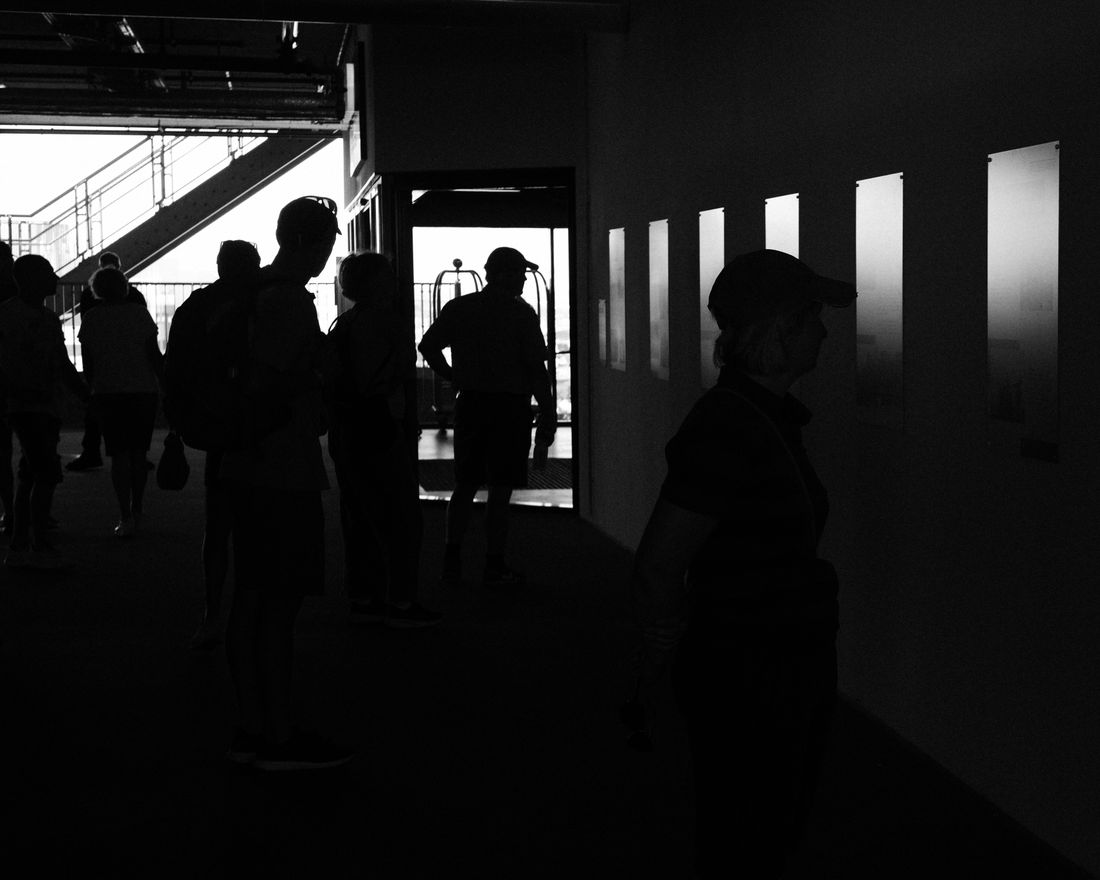
A university or academic gallery's opening night can look, in a photograph, exactly like a commercial gallery's: a room, a crowd, wine in plastic cups, work on the walls. What each room has to prove with that photograph is not the same thing at all. A commercial opening has to prove the work is sellable and the space is credible to the people who might buy it. A university opening has to prove something closer to a mission statement, and it has to prove it to a longer, stranger list of people than any collector-facing room ever answers to.
A university gallery opening has to prove its academic and civic mission is working, using one room and one night, to deans, alumni relations, and admissions marketing at once. A commercial gallery only has to prove the work is sellable to the collectors in the room. Same crowd shape, entirely different stakeholder list, and that list is what actually changes the coverage.
What Does a University Gallery Opening Have to Prove That a Commercial One Doesn't?
A university or academic gallery's opening night has to prove that the institution's mission is alive, that a department, a curriculum, and a community of students and faculty produced something worth a room full of people. A commercial gallery's opening only has to prove the work is sellable and the space is credible to the buyers standing in it. The two rooms can look nearly identical in a photo. The verdict each photo has to carry is not.
A commercial opening answers to one audience: collectors, plus the occasional critic. A university opening answers to several audiences, each there for a different reason, and none of those reasons is primarily "I might buy this." A parent is there because their kid has three pieces in the show. A donor is there because the building has their name on a plaque. A prospective student is there because a tour guide walked them past the door.
That difference does not show up in the crowd shot itself. It shows up in what happens to the photo afterward. A commercial gallery's photo goes to a mailing list and maybe a press page. A university gallery's photo goes to a dean's report, an alumni newsletter, and an admissions slide deck, often the same week, pulled from the same folder by offices that rarely compare notes.
That's the actual brief for a university opening: not "cover the show," but cover the show in a way that survives being split three ways. The next question is who those three ways actually are.
Who Is Actually in the Room at a University Gallery Opening?
A university gallery opening has at least four audiences in the same room, and they rarely overlap: the department itself (faculty, the gallery director, the students who made the work), the institution's leadership (a dean, sometimes a provost), alumni relations and development, and admissions or enrollment marketing. A commercial gallery has one audience, the collector, with a critic and the artist's own circle standing near the edges of it.
The department wants the work itself to read well: the pieces in focus, the installation legible, the students who made it visibly present and credited. That's the closest thing to a commercial gallery's own priority, and it's usually the smallest slice of what the night actually needs to produce.
Leadership wants something different: evidence that the room was full, that the audience was broad, that a curriculum translated into a public event people showed up for. A packed room reads as institutional health in a way a well-lit painting doesn't, and that's a genuinely different photographic target.
Alumni relations wants recognizable faces from a specific era of the program, a former student now a working artist, a retired faculty member who still comes back. Admissions wants something else again: a current student, mid-conversation, looking like someone a prospective student could picture becoming. None of these four groups is being served by the same eight frames, and a shot list built for only one of them quietly fails the other three.
What Does a Dean or Provost Need From the Photos?
A dean or provost needs photographs that argue the institution's investment in the arts is paying off in public, visible terms: a full room, a diverse audience, the physical space of the gallery looking like an asset worth the line item it occupies in a budget. That argument runs on scale and turnout more than on any single striking image.
In practice, that means wide shots matter more here than almost anywhere else in gallery coverage. A dean's report or annual review wants a frame that reads as "the building was busy" at a glance, not a tightly cropped portrait of one collector examining one piece. The room itself, doorway to back wall, with people filling the middle distance, does more work in that context than a technically superior close-up.
It also means the photos need range across the evening, not just the first twenty minutes when the room is at its fullest and the light is best. A dean's report spans a semester or a year, and a gallery director pulling images for that report needs a night that reads as sustained energy, not a single peak moment stretched to cover an entire program's activity.
A commercial gallery never needs this kind of evidence. Nobody is arguing to a budget committee that the gallery deserves to keep existing. The university gallery's opening night photos are doing quiet advocacy work that a commercial opening's photos never have to do, and a shot list that ignores it leaves a dean's office with nothing to work with later.
What Does Alumni Relations Need That a Dean's Office Doesn't?
Alumni relations needs recognizable individuals from the program's own history: former students, especially ones now working professionally, and long-tenured faculty who represent continuity across decades rather than a single semester. A dean's office wants scale. Alumni relations wants specific, identifiable people whose presence proves the program's reach outlasts any one class.
That changes what the photographer needs going in. A dean's report can run on anonymous crowd energy. An alumni newsletter cannot; it needs names attached to faces, which means the gallery director or a department liaison has to flag who's in the room before the shutter starts, not after. A photographer walking in cold, with no sense of which guest is a graduate from fifteen years ago, will miss exactly the frames that office needs most.
The style of the photo matters too. Alumni communications tend to favor warm, candid, conversational images over formal posed ones, because the goal is to feel like a homecoming rather than a press event. A stiff handshake photo reads wrong in a newsletter built around belonging and return.
None of this shows up in a commercial gallery's brief at all, because a commercial gallery has no alumni to speak of, only a client list it is not trying to make anyone feel nostalgic about. It's one more audience with its own photographic requirements, layered onto the same single evening, that a purely collector-facing opening never has to satisfy.
What Does Admissions Marketing Need From the Same Night?
Admissions marketing needs something almost opposite to alumni relations: not the program's history, but a prospective student's future, rendered as a scene someone could picture stepping into. That usually means current students, mid-conversation, engaged with the work or with each other, photographed in a way that reads as an ordinary Tuesday of belonging rather than a special one-night event.
This is the audience most likely to get overlooked, because admissions rarely sends anyone to the opening itself to ask for what it needs. The gallery director is usually the one who has to remember, on behalf of an office that isn't even in the room, that a viewbook or a landing page will eventually need a current student looking genuinely present in the gallery, not performing for a camera.
The photographic target here is closer to editorial than event coverage: natural expressions, a sense of a real conversation mid-sentence, students who look like they belong in the space rather than students posed in front of it. An opening night full of stiff, camera-aware smiles serves the dean's turnout argument fine and gives admissions almost nothing usable.
A commercial gallery's opening has no equivalent stakeholder at all; there is no future customer being recruited by the photo, only a present one being persuaded to buy. Naming this fourth audience before the shutter starts is what keeps a university opening from accidentally shooting for three groups and forgetting the one actually planning next year's incoming class.

What Does a Commercial Gallery's Opening Have to Prove Instead?
A commercial gallery's opening has to prove exactly one thing: that the work belongs in a collection, and that the room around it is credible enough to support that claim. Every photographic decision serves that single argument, which is why commercial gallery coverage can stay narrower and more consistent, frame after frame, than a university opening ever gets to be.
That single audience wants the work itself rendered with real fidelity: accurate color, clean framing, installation shots that could stand in for a viewing appointment for someone who couldn't attend. It wants the room to read as active and serious, collectors in genuine conversation near the work, without needing to prove the institution's broader value the way a dean's report does.
It's a genuinely simpler brief in one specific sense: there's no alumni office to satisfy, no admissions deck waiting for a usable frame, no dean's annual report pulling from the same folder for an unrelated purpose next quarter. The stakeholder list is short, everyone on it is there for the same reason, and the coverage can be built around one clear priority instead of four competing ones.
That simplicity is exactly why treating a university opening like a commercial one goes wrong so quietly. The instinct to shoot for the room and the work, which is the entire job at a commercial opening, only covers one of the four audiences a university gallery actually has to answer to on the same night. The other three offices find that out weeks later, when the folder doesn't have what they need.
How Should the Shot List Change Once These Stakeholders Are Named?
The shot list changes by adding categories, not by working harder inside the same one. A commercial gallery's list runs on work detail, installation views, and collectors near the art. A university gallery's list needs those same frames for the department, plus a wide, sustained crowd sequence for the dean's office, plus tagged portraits of specific alumni and faculty, plus natural, editorial-style frames of current students for admissions.
The practical fix is naming the four audiences out loud before the night starts, ideally with the gallery director pulling a short list of who from alumni relations or admissions actually plans to attend, so specific people can be found in a crowded room instead of hoped for. A photographer told in advance that a retired chair of the department will be there can go find that person; a photographer who only hears about it afterward cannot.
It also means budgeting shooting time differently across the evening instead of concentrating effort in the first half hour. The dean's office needs the room at its fullest. Admissions needs a quieter, more natural moment that rarely happens in the first twenty minutes when everyone is still arriving and posing.
None of this requires more equipment or a longer night, only a plan that treats the opening as four briefs running at once instead of one. That plan is the actual deliverable a university gallery needs and a commercial one never has to build.
What Happens When a University Opening Gets Shot Like a Commercial One?
When a university opening gets shot with a commercial gallery's brief, that is, work detail, installation views, and general crowd energy, the department usually ends up satisfied and the other three offices end up scrambling. The gallery director has strong images of the show itself. The dean's office has no wide, sustained sense of turnout to pull from. Alumni relations has no tagged faces from the right era. Admissions has nothing that looks like a prospective student's future.
The scramble that follows is familiar to anyone who has worked in a communications office: someone requests different photos weeks later, the photographer is long gone, and the folder that exists has to be stretched to cover a need it was never built for. A single strong frame occasionally rescues one office. It rarely rescues three.
The fix isn't more photography. It's the same night, planned around four audiences instead of one, with the offices that actually need something from the evening naming that need before the first guest arrives. A gallery director who treats the dean's report, the alumni newsletter, and the admissions deck as three separate briefs due on the same night gets a folder that survives being split three ways.
That's the real difference between a university gallery's opening and a commercial one: not the architecture, not the wine, but a stakeholder list that never fits inside a collector-facing shot list, no matter how good that shot list is.
Frequently asked questions
Why does a university gallery opening need a different shot list than a commercial gallery's?
A commercial gallery's opening answers to one audience, collectors, so its photos only need to prove the work is sellable and the room is credible. A university gallery's opening answers to several offices at once, a dean, alumni relations, and admissions marketing among them, and each needs something different from the same evening. The shot list has to cover all of them, not just the work on the walls.
What kind of photos does a dean or provost's office actually use from an opening?
Dean and provost offices tend to use wide, sustained crowd shots that argue the space is active and well attended, since that reads as institutional health for a report or review far more clearly than a single frame ever could. A tight close-up of one collector examining one piece does little for that purpose. A gallery director planning coverage should prioritize turnout and range across the evening, not just the strongest individual frame.
How is coverage for alumni relations different from coverage for admissions marketing?
Alumni relations wants recognizable, identifiable people from the program's own history, a graduate now working professionally, a longtime faculty member, photographed warmly and candidly, so the images feel like a homecoming. Admissions wants the opposite: current students in natural, editorial-style moments that read as an ordinary day of belonging rather than a staged event. One audience is looking backward at continuity, the other forward at a prospective student's future.
Does a university gallery need to tell the photographer who from each office will attend?
Naming specific attendees in advance, a retired department chair, a development officer's target donor, a prospective student's tour group, makes those people findable in a crowded room instead of hoped for after the fact once the night is already over. A gallery director coordinating with alumni relations and admissions before the night starts turns a general crowd shot into images those offices can actually use later.
What goes wrong when a university opening is photographed like a commercial gallery opening?
The department usually ends up satisfied, since the work itself is well covered, while the dean's office, alumni relations, and admissions are left without what they actually need: sustained turnout shots, tagged alumni portraits, or natural student moments. Those offices then have to stretch an unrelated folder to cover a need the shoot was never planned around, and the result rarely holds up as well as coverage planned for the purpose.
Got overlapping openings already on the calendar?
We work out the coverage plan well before the night gets close, whether that's two shooters, a tight schedule, or simply booking early enough to avoid the conflict entirely.
Explore event coverage →