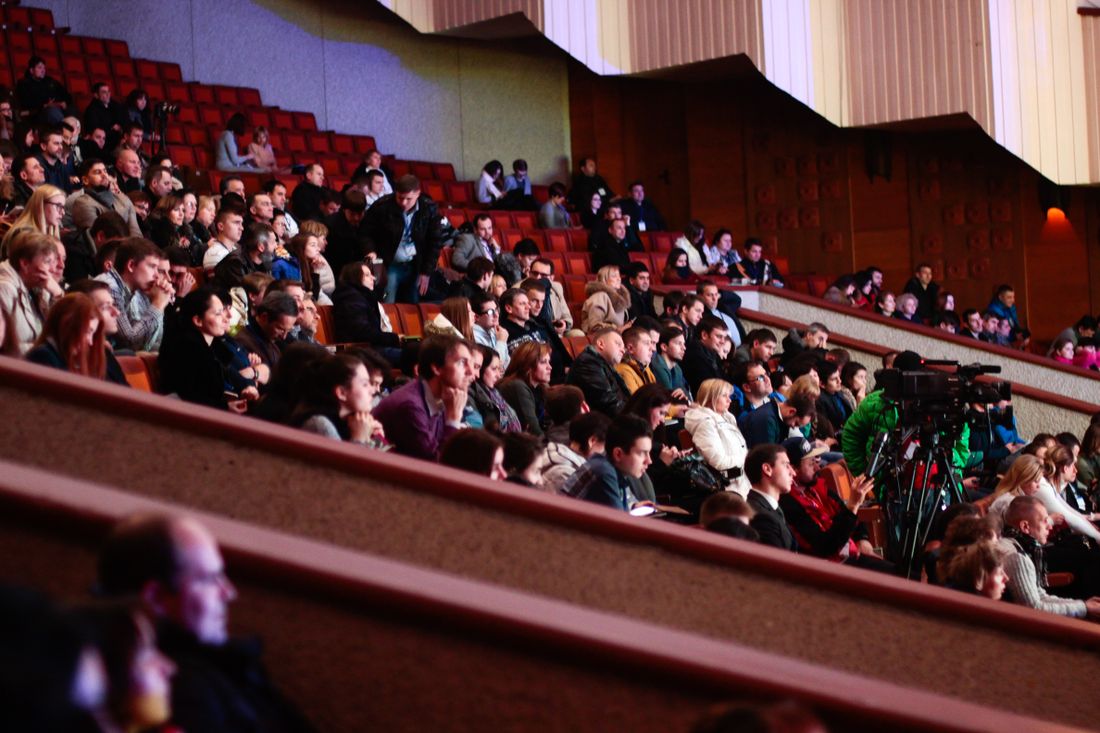
A grant-funded public program answers to a foundation, not a box office. The funder already paid for the program to happen, so the photos coming out of it aren't there to prove the event sold, they're there to prove it actually reached the people the grant was written for. That's a different burden of proof than a ticketed series carries, and it changes what the coverage is built to show from the first frame. Confusing the two usually means arriving at report time with a beautiful set of photos that answers the wrong question.
Coverage of a grant-funded public program needs to prove reach and impact for a funder's report: real attendees engaging with the program, a fair sense of who actually showed up, and enough context to back up the numbers in the narrative. It isn't proving ticket sales or revenue, and it isn't a documentation record of the artwork itself.
What Does a Funder's Report Actually Need This Coverage to Prove?
A funder's report generally needs the coverage to prove that a real audience showed up and engaged with the program as it was described in the grant application, not that the event was profitable or well attended in a commercial sense. Reach and engagement are the currency here, since the funder already committed the money before the first attendee walked in the door.
A ticketed event answers to a box office. Whoever produced it needs proof that people paid to be there, since revenue is the metric that decides whether the series continues. A grant-funded program answers to a program officer reviewing whether the money did what the proposal promised. That officer usually cares more about who came, how many, and what they actually did while they were there than whether anyone paid a cent for the privilege of showing up.
In practice, this usually means the coverage needs to visibly connect back to the specific outcomes named in the grant proposal: if the proposal promised community engagement, the photos need to show people engaging, not just a well-lit empty room before doors opened. Reviewing what the proposal actually committed to before the shoot happens is what keeps the coverage aimed at proving the right thing months later, rather than discovering the mismatch only once the report is already due and there's no time left to go back and shoot what was actually needed.
How Is This Different From Covering a Ticketed Lecture or Talk Series?
Covering a grant-funded program differs from a ticketed lecture series mainly in what success has to look like on camera: a ticketed series wants proof of a paying crowd and a producer-worthy atmosphere, while a grant-funded program wants proof of genuine public reach, which sometimes means a smaller, quieter room reads as more honest than a packed one staged to look impressive.
A talk series producer generally wants images that make future tickets easier to sell: a full house, an engaged crowd, a polished stage. A grant-funded program's photos serve a completely different reader. A program officer isn't deciding whether to buy a ticket. They're deciding whether the reported numbers and the visual record line up, and an overly polished, sparse-feeling room can actually undercut a report claiming strong community turnout.
In practice, this usually means resisting the instinct to shoot a grant-funded program the way a ticketed event gets shot, chasing the fullest, most photogenic angle of the room. A wider, more honest set that shows the actual mix of attendees and the actual size of the crowd usually serves the funder relationship better than a tightly cropped set built to look bigger than the room really was that day, especially since program officers often visit in person or compare notes across grantees over time, and a photo set that quietly overstates the crowd is easy to notice once someone has actually seen the space themselves.

How Is Event Coverage Different From Documenting the Program's Artwork Itself?
Event coverage for a funder's report is a separate task from documenting the artwork or output the program produced, since the funder's report usually needs proof that people showed up and participated, while artwork documentation exists to create an accurate visual record of the work on its own. Treating these as one shoot often shortchanges both jobs.
A mural, a performance, or a finished community project usually still needs its own clean, corrected documentation set, separate from any event photos, because a future grant application, a website, or a press request will eventually want an accurate image of the work without the crowd in the frame. That documentation answers a different question than a funder's impact report does.
In practice, this usually means planning for two distinct outcomes from the same visit rather than expecting one photo set to serve both purposes well: a reach-and-engagement set built around people, and a shorter, cleaner set built around the work itself if the program produced something worth documenting on its own. Confirming which one (or both) the funder actually needs before the shoot avoids handing over a set that proves attendance but leaves nobody with a usable image of what was actually made, which becomes a real problem the moment someone later wants to feature the work itself in a newsletter, a website update, or a follow-up proposal to the same funder.
What Does Evidence of Reach Actually Look Like in Photos?
Evidence of reach in photos generally means a wide, honest view of the room or space showing the actual scale of the crowd, paired with closer frames of people genuinely engaged in the program's specific activity, rather than a handful of flattering close-ups that could have been taken at any small gathering. Scale and specificity both need to read clearly.
A single great portrait of one engaged attendee proves that one person was interested. It doesn't prove the program reached the number of people the grant reported. A wide establishing shot does that work, showing the room filled to whatever degree it actually was, without cropping tight enough to hide how many chairs were empty or how many people actually attended the session that day.
In practice, this usually means shooting a deliberate combination on-site: a few wide, honest frames of the full space at its most attended moment, several mid-range shots of small groups actually participating in whatever the program does, whether that's a workshop, a talk, or a hands-on activity, and only a few closer individual frames, chosen to represent the range of people who came rather than the single most photogenic face in the room, since the report's reviewer is looking for a believable picture of the whole audience across the space, not one standout moment that happens to photograph unusually well and gets stretched to represent everyone else in the room.
What Does Fairly Representing Who Attended Actually Require?
Fairly representing who attended generally requires shooting a genuinely representative spread of the actual crowd rather than curating toward whichever handful of frames photograph the most conventionally appealing, since a funder's report usually wants the visual record to match the real makeup of the audience the program reached, not a flattering edit of it.
It's easy to end up, without any bad intent, with a final set that leans heavily toward a few particularly photogenic or particularly animated attendees, simply because those are the easiest frames to get excited about while shooting or editing. A funder reading the report alongside the photos is looking for an honest sense of who the program actually served, and a curated-looking set can read as more polished marketing than a genuine record.
In practice, this usually means reviewing the final selects specifically for range, not just for technical quality: does the set include a spread of ages, groups, and moments, or does it repeat the same few faces and angles because they happened to look best. A quick second pass through the contact sheet with that specific question in mind catches most of the drift before it ends up in a funder's hands, and it's a far cheaper fix to make at the edit stage than after the report has already gone out into the world with a skewed set of images attached to it.

Should the Coverage Capture Participant Reactions or Quotes, Not Just Attendance?
Coverage that captures genuine participant reactions generally strengthens a funder's report more than attendance photos alone, since a program officer reading the narrative wants some sense of what the experience actually felt like for the people who came, and a few honest candid moments of engagement, laughter, focus, conversation, usually communicate that better than a room full of straight-ahead crowd shots.
Attendance photos answer how many. Reaction-driven photos answer what it was like, which is often the part of a grant narrative that's hardest to write convincingly from numbers alone. A photo of someone genuinely absorbed in a hands-on activity, or a small group laughing together after a session, tends to do more work in a report's narrative section than another wide shot of chairs filled with people looking at a stage.
In practice, this usually means briefing the crew to watch for these moments specifically, rather than only working through a standard event shot list: someone trying something for the first time, a visible moment of connection between attendees, a facilitator working directly with a small group. These moments don't happen on command, so having someone dedicated to watching for them, rather than splitting attention across a dozen other tasks, usually produces a noticeably stronger handful of usable frames, and those are often the exact images a program officer remembers after reading dozens of similar reports in the same funding cycle.
What Deliverable Format Actually Works for a Grant Report Packet?
A grant report packet generally works best with a modest, clearly captioned set rather than a large unsorted folder: a handful of wide reach shots, a handful of engagement shots, and a short written caption on each noting the date, the activity, and roughly how many people were present, since a program officer reviewing dozens of reports rarely has time to guess at context from an image alone.
Handed a folder of fifty uncaptioned photos, whoever writes the actual report usually has to reconstruct the context from memory or from separate sign-in sheets, matching faces to numbers well after the event has faded. A short caption written at the time of the shoot, while the details are still fresh, saves that reconstruction work later and keeps the photo evidence lined up cleanly with whatever attendance figures the report is citing elsewhere.
In practice, this usually means agreeing in advance on roughly how many final images the report actually needs, since a funder's report rarely uses more than a handful of photos regardless of how many were taken, and building the caption habit into the shoot itself rather than trying to reconstruct it from memory during the edit. A dozen well-captioned images usually serves a report better than a hundred unlabeled ones nobody has time to sort, and it also gives whoever writes the narrative something concrete to reference instead of paraphrasing the event from memory weeks later.
What's a Realistic Scope and Budget for This Kind of Documentation?
A realistic scope for grant-funded program coverage generally stays modest and matched to what the report actually needs, since most nonprofit program budgets weren't written with an elaborate production line item in mind, and a shorter, focused visit built around a clear shot list usually serves the funder relationship as well as, or better than, a longer, more expensive shoot chasing every possible angle.
A ticketed series can sometimes justify a larger production budget because the photos themselves help sell future tickets. A grant-funded program's coverage exists mainly to support one report, maybe a handful of them if the program runs across several sessions, which usually means the scope should track the reporting calendar rather than trying to capture everything that happens at every single session.
In practice, this usually means scoping the visit around the program's actual reporting milestones: a shoot at the best-attended or most representative session rather than every session, a modest number of final images rather than an exhaustive set, and a budget conversation early enough that the nonprofit isn't choosing between documenting the program and running it. Many nonprofits find that a single well-planned visit, timed to the program's strongest session, covers most of what a funder's report actually needs, leaving room in the budget for the parts of the program the grant money was actually meant to fund in the first place.
Frequently asked questions
How is grant-funded program coverage different from covering a ticketed lecture series?
A ticketed series is generally shot to help sell future tickets, so it wants a full, polished-looking room and a producer-worthy atmosphere. A grant-funded program is shot to prove reach and engagement for a funder's report, where an honest, representative view of the actual crowd usually matters more than making the room look as full or as glamorous as possible. The two goals can call for genuinely different shot lists from the same kind of event.
Does this coverage need to show participant faces, or can it stay anonymous?
It depends on the program and any consent requirements already in place, but most funder reports benefit from at least some recognizable engagement, not strictly anonymous crowd shots, since faceless photos can read as generic stock imagery rather than genuine proof of participation. Programs serving populations with privacy concerns often plan a mix, some identifiable engagement shots alongside wider, less identifiable crowd frames, agreed on before the shoot.
What if the grant-funded program runs across multiple sessions or locations?
Most reports don't need every session documented. A more realistic approach usually covers the best-attended or most representative session or two, rather than shooting the full run, since the report typically only uses a handful of images regardless of how many sessions actually happened. Confirming which session best represents the program's typical attendance, rather than defaulting to the first one, usually produces more useful photos.
How soon does the funder generally need the photos after the event?
It depends on the funder's own reporting deadline, which is usually set well before the event itself and worth confirming early rather than assuming there's flexibility. Some funders want images within days to support an interim update, while others only need them when the full report is due, which could be weeks or months later. Either way, agreeing on turnaround before the event avoids a scramble right before a filing deadline.
Who typically owns the images from a grant-funded program's event coverage?
This is usually settled in the arrangement between the nonprofit and whoever documents the program, and the nonprofit commissioning the coverage generally owns the images for its own reporting and marketing use going forward. Some funders request a copy for their own archives or future publications, which is worth confirming as part of the reporting requirements rather than assuming it's automatically included in whatever gets delivered after the event.
One night, two openings, no dropped coverage.
We plan clustered opening nights before they turn into a scramble, whether that means a split schedule, a second shooter, or an early enough booking that the calendar never becomes the problem.
Explore event coverage →