A creative agency's own holiday party rarely looks like a corporate office's, and the coverage shouldn't either. We've written before about what generally separates creative event coverage from corporate event coverage, but a design studio's internal party is a specific, recurring case worth its own answer: what actually makes the room read as creative register, and what the resulting photos get used for once the party is over.
A creative agency's holiday party reads as creative register through styling, energy, and informality, an office or loft space rather than a rented ballroom, mingling rather than a formal program. Coverage should prioritize candid culture and team moments over posed group shots, because the resulting images usually end up as recruiting and culture content, not an internal newsletter.
What Makes an Agency's Holiday Party Read as Creative Register
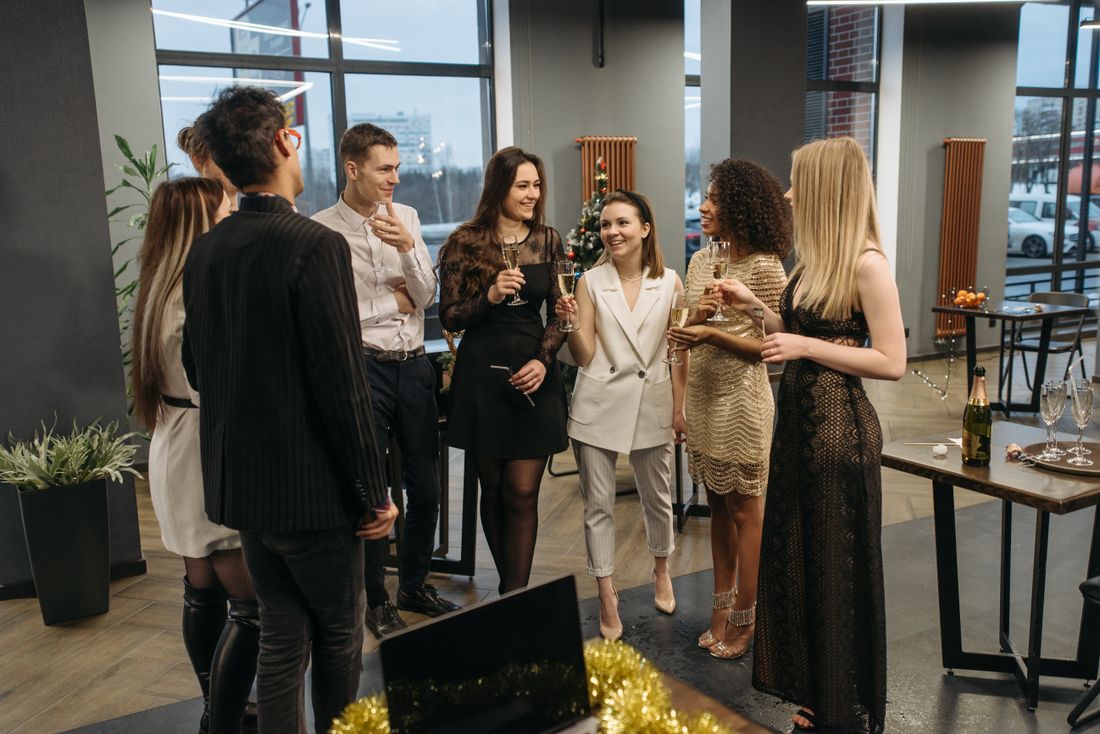
A creative agency's holiday party reads as creative register through three things happening in the room itself: styling, energy, and informality. The space is usually the agency's own office or a loft, not a rented ballroom, and the night runs on mingling rather than a formal program with a stage or a podium.
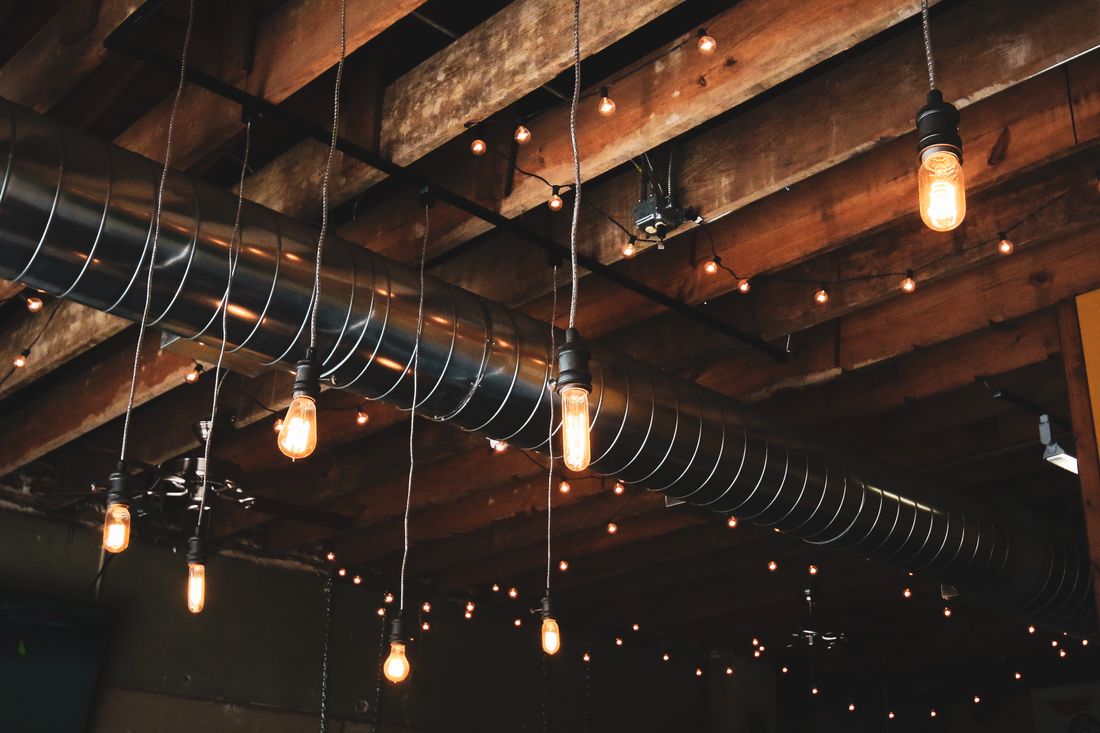
Styling shows up in small, deliberate choices rather than a themed event package: string lights instead of uplighting, a DJ or a playlist instead of a live band with a set list, food set up as a table people graze from rather than a seated dinner. None of these choices are dramatic on their own, but together they signal that the party was thrown by the people who work there, not by an events team following a corporate template.
Energy is the harder thing to name but the easiest thing to feel walking in. There's no receiving line, no assigned seating, no moment where the room stops to watch a speech. People move freely, form and reform small groups, and the party has no single center of gravity the way a formal program creates one around a stage.
Informality ties all of this together. It isn't the absence of planning, an agency holiday party is usually organized carefully, it's the absence of the structure that makes a party read as corporate: no stage, no branded backdrop, no formal seating chart deciding who sits with whom.
The General Distinction This Post Builds On
We've written a general explainer on what separates creative event coverage from corporate event coverage: crew size, editing pace, what each register asks a photographer to prioritize in the room. That post covers the framework broadly. This one applies it to a single, recurring case: an agency's own internal holiday party.
The short version worth repeating here is that the two registers aren't about better or worse coverage, they're about what the room is actually proving. A corporate event usually needs to prove scale, professionalism, and leadership presence. A creative agency's own party needs to prove something closer to culture and belonging, since the audience for the resulting photos is largely the agency itself and the people it might eventually hire.
That difference in what's being proven is what determines everything downstream: what the photographer prioritizes, how tightly the shot list gets planned in advance, and what happens to the images afterward. An agency holiday party sits firmly on the creative-register side of that framework, and the rest of this post works through exactly what that means in practice.
Readers who want the fuller general framework, crew size, editing turnaround, how to brief a photographer for either register, should start with that post. This one assumes the general distinction and goes straight into the specific case.
Treating the two as the same booking is the most common way an agency ends up with photos that don't match the night. A photographer defaulting to corporate habits at a creative party produces a gallery that feels slightly off even when nothing about the shoot went wrong.
What the Coverage Should Prioritize at an Agency's Own Party
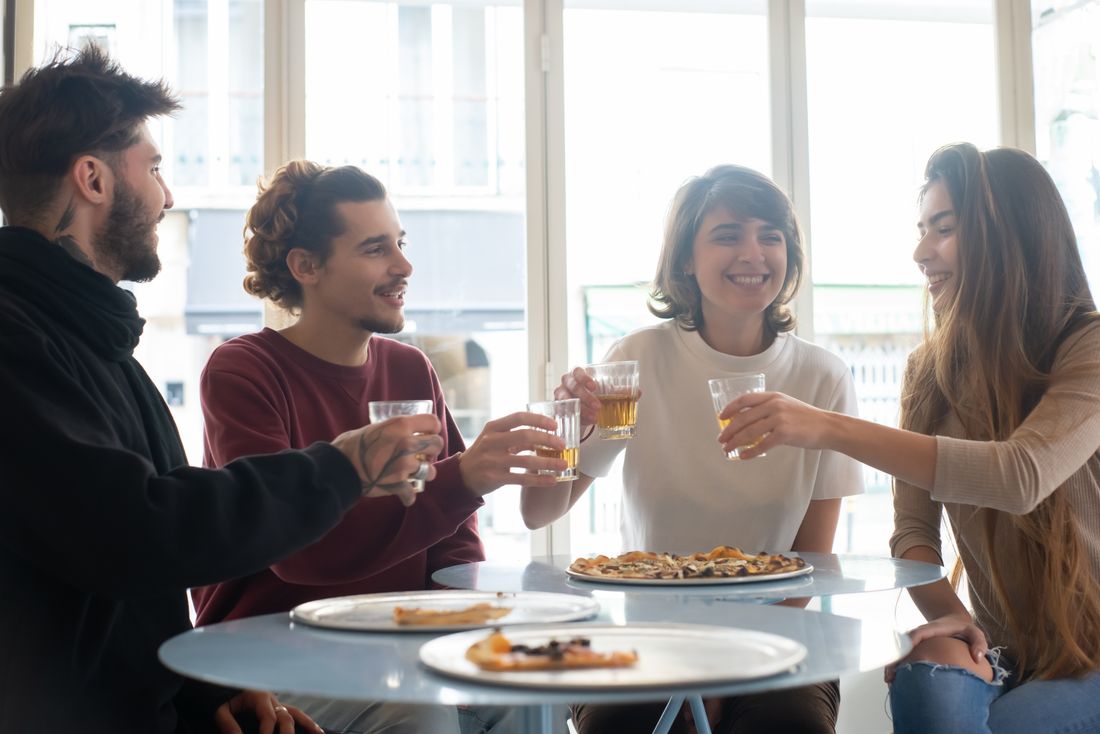
Coverage of an agency's internal holiday party should prioritize candid culture and team moments over posed group shots. The value of the photos comes from how genuinely they capture the room, not from how many people are visibly present and accounted for in a lineup.
In practice, that means a photographer spends most of the night moving through the space rather than organizing people into frames. Two colleagues mid-laugh at a snack table, a small group gathered around someone showing something on their phone, the room from a wide angle with people scattered through it naturally, these carry more of what the party actually felt like than a formal group photo ever will.
That doesn't mean group shots have no place. A handful of loose, quick group frames, taken without stopping the party to arrange them, are useful and worth capturing. What changes is the priority: candid moments come first, and any posed frames get slotted in briefly rather than anchoring the whole shoot.
This priority follows directly from what the photos end up being used for. A gallery of genuine, unposed moments reads as an accurate record of the culture; a set dominated by posed group shots reads as evidence that an event happened, which is a different, less useful thing for an agency to have on hand afterward.
It also changes how a photographer moves through the room. Rather than stationing at one spot and waiting for people to arrange themselves, the more useful approach is walking the space continuously, following where the energy actually is.
How This Differs From a Corporate Office Holiday Party
A corporate office holiday party tends to want more formal all-staff group shots and leadership-forward framing, the opposite emphasis from an agency's own internal party. That difference isn't about which coverage is more difficult, it's about what each organization actually needs the photos to demonstrate afterward.
A larger corporate office often uses its holiday party photos in places where scale and inclusion matter: an internal newsletter, a slide in a year-end presentation, proof that leadership showed up and mingled with staff across departments. That use case genuinely calls for organized group shots, and for the photographer to make sure department heads and executives are visibly present in at least a few frames.
An agency's own party rarely has that same audience or use case. There's no year-end all-staff presentation the photos need to anchor, and no reason to make sure every department is visibly represented in a formal lineup. The party is smaller, the culture more informal, and the photos are meant to feel like a night out with people who work together, not a record of institutional participation.
Neither approach is more correct in the abstract. The difference is entirely about matching the coverage to what each organization actually plans to do with the resulting photos once the party is over.
It's worth noting that a design team sitting inside a larger corporate parent can genuinely need both registers at once, which is a real, common overlap and not a contradiction. In that case, the honest answer is naming both needs upfront rather than defaulting entirely to one.
What These Deliverables Actually Get Used For
Photos from a creative agency's own holiday party usually end up as recruiting and culture content, not material for an internal newsletter. They show up on a careers page, in a social post about what it's like to work somewhere, or in a deck a founder pulls from when talking about the agency's culture to a prospective hire.
That use case is a large part of why candid moments matter more here than posed ones. A photo of genuine laughter at a snack table does real work on a careers page in a way a formal group photo never will, because it shows rather than tells a prospective hire what the team actually feels like in a room together.
It's worth naming this use case before the shoot, not after, because it changes what's worth capturing. A photographer briefed on recruiting and culture content will spend more time on faces, interactions, and the texture of the space itself than one briefed simply to document that a party happened.
This is also why the space itself, the decorated corner, the string lights, the general feel of the office dressed for the season, is worth a few frames on its own. Those images often end up doing just as much work in a culture-focused gallery as the people photos do.
None of this needs to be treated as a formal production with a shot list to plan. It's closer to keeping a running mental note of the use case while moving through the party.
How Briefing This Shoot Differs From Briefing a Formal Office Party
Briefing a photographer for an agency's own holiday party means naming the informal register upfront, rather than assuming it's obvious from the setting. Without that framing, a photographer's default instincts can drift toward the more structured coverage a formal event usually calls for.
The useful things to name in the brief are simple: there's no formal program to anchor around, group shots are a small part of the coverage rather than the main goal, and candid interaction matters more than making sure every attendee appears in a frame. None of this requires a detailed shot list, since the whole point is that the night isn't built around one.
It also helps to name where the photos are headed afterward, a careers page, a social post, an internal culture deck, since that use case shapes what's worth prioritizing in the room far more usefully than a generic instruction to get good photos of the party.
This is a shorter, looser briefing conversation than a formal event usually needs, which is itself consistent with the register of the party. A long, detailed shot list would work against the informality the coverage is trying to capture in the first place.
It also gives the photographer permission to make judgment calls throughout the night rather than checking against a rigid plan. A short brief, trusted, tends to produce more natural coverage than a long one that forces a photographer to keep pausing to confirm what's next.
What Still Needs a Little Structure, Even at an Informal Party
Even a deliberately informal agency party benefits from a small amount of light structure, mainly around timing rather than posing. Knowing roughly when the room will be fullest, when people tend to arrive versus when they start leaving, helps a photographer be in the right place without needing a formal schedule to follow.
A few quick, unforced group frames are worth planning for loosely, not as a stopped, organized moment, but as something a photographer can gather in under a minute while people are already standing together. Naming this as a light expectation beforehand, rather than leaving it entirely improvised, tends to produce a better result than either extreme.
It also helps to flag, briefly, whether there's any leadership presence worth capturing naturally, a founder giving a short toast, a team lead cutting a cake, since these moments happen quickly and are easy to miss without at least knowing they're coming. This is a much lighter version of the leadership-forward framing a corporate party wants, present but not the organizing principle of the shoot.
None of this structure should be visible in the final photos. The goal is coverage that reads as effortless and unplanned, even though a small amount of quiet planning usually sits behind it.
Sharing a rough timeline beforehand, when the party starts, roughly when any toast or short remarks might happen, when things tend to wind down, gives a photographer enough to work with without requiring the party itself to run on a schedule.
How to Know Whether Your Holiday Party Is Creative or Corporate Register
The clearest test is simple: does the party have a stage, a formal program, or a seating chart deciding who sits with whom. If yes, it's closer to corporate register regardless of how casually the company otherwise operates. If the night runs on mingling with no single center of gravity, it's closer to creative register.
A useful second question is who the resulting photos are actually for. If they're headed toward an internal newsletter, a slide about company-wide participation, or a record that leadership was present, that points toward the more structured, leadership-forward coverage a corporate office typically wants. If they're headed toward a careers page or a social post about culture, that points toward candid, informal coverage instead.
Some parties genuinely sit in between, a design team inside a larger corporate parent company, for instance, and in those cases it's worth naming both needs explicitly in the brief rather than assuming one register covers everything. A short list of a few required formal frames alongside a mostly candid approach usually resolves that overlap cleanly.
Naming the register honestly before booking, rather than assuming it from the venue alone, is what actually determines whether the coverage ends up matching what the party, and the people in it, felt like.
Venue alone is a weak signal either way. An agency renting an unusual loft for the night is still a creative-register party if it runs on mingling with no formal program, and a company holding its party in its own casual-feeling office can still want the structured, leadership-forward coverage a corporate party calls for.
Frequently asked questions
How is coverage of a creative agency's holiday party different from a corporate office party?
Agency coverage prioritizes candid culture and team moments over posed group shots, matching an informal, mingling-based party with no formal program. A corporate office holiday party tends to want more structured, leadership-forward group shots, since the photos usually need to demonstrate scale and participation for an internal audience. Both are valid coverage styles, just built around different rooms and different uses for the photos afterward.
What should an agency actually brief a photographer on before its own holiday party?
Name the informal register directly: there's no formal program to build around, group shots are a small part of the coverage, and candid interaction matters more than documenting every attendee. It also helps to say where the photos are headed afterward, a careers page or social post, since that shapes what's worth prioritizing more usefully than a generic instruction to just get good photos of the night.
What do the photos from an agency's internal holiday party typically get used for?
Most often, recruiting and culture content: a careers page, a social post about what it's like to work there, or a deck a founder references when describing the team's culture to a prospective hire. That's different from a corporate office party, where photos more often end up in an internal newsletter or a year-end presentation, which is part of why the two registers get covered differently.
Does an informal creative agency party need any group photos at all?
A handful of loose, quick group frames are still worth capturing, gathered informally while people are already standing together rather than as a stopped, organized moment. The priority stays on candid coverage, but a few unforced group shots are useful additions, not something to skip entirely just because the party itself is informal. They tend to work best pulled from a natural cluster already forming near the food or drinks.
How can an agency tell if its holiday party is creative register or corporate register?
Check whether there's a stage, a formal program, or a seating chart deciding who sits with whom, any of those point toward corporate register regardless of how casual the company feels day to day. Also consider who the photos are actually for: a careers page or social post points toward creative register, while an internal newsletter or leadership-facing recap points toward corporate register instead, and some teams genuinely need a mix of both.
Two openings on the same night doesn't have to mean a scramble.
We plan around clustered opening nights ahead of time, a split schedule, a second shooter, or booking early enough that the calendar stops being the risk.
Explore event coverage →