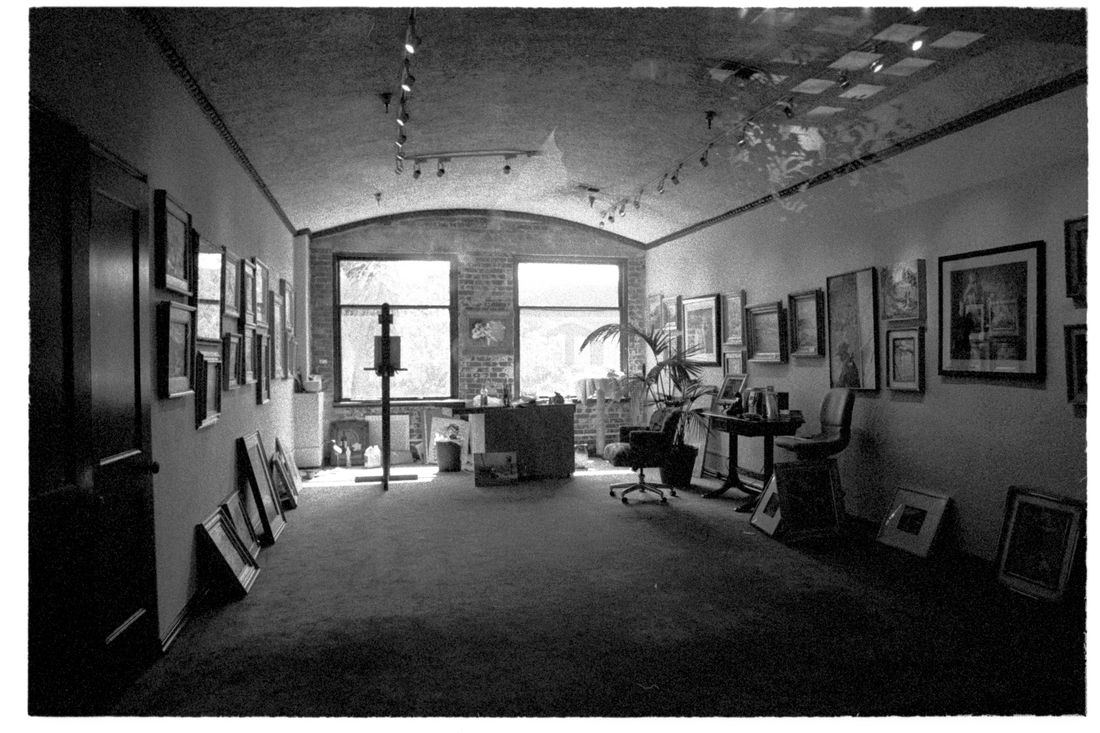
Every artist on a gallery's roster hands over files, and none of them match. The real question is not whether to fix that everywhere. It is whether the mismatch is actually costing the gallery a sale, a press placement, or a clean page in a fair's booth PDF.
A gallery should commission its own documentation for whatever it is actively selling, showing, or submitting to a fair or press outlet, and rely on artist-supplied files for the rest of the archive. The two rarely need to be the same decision applied across an entire roster.
What files does a gallery already have from its roster?
Every artist on a gallery's roster hands over something: JPEGs from a friend's camera, a phone shot of a canvas on the studio floor, or a properly lit file from a photographer the artist hired years ago. All of it is free. Almost none of it matches the next file in the folder.
Open any gallery's shared drive and the pattern repeats. One artist shoots their own work on a tripod in natural light and color corrects by eye. Another asks a friend with a decent camera to snap a few frames after a studio visit. A third sends whatever a previous gallery left behind, sometimes years old, sometimes cropped for a different purpose entirely. File names range from something legible to a string of numbers a phone assigned automatically. Resolution swings from print-ready to barely enough for a web thumbnail.
None of this is a failure on the artist's part. Documentation is rarely their job, their budget, or their skill set, and asking them to solve it themselves usually means solving it inconsistently, because every artist solves it differently. The gallery inherits the sum of everyone's individual approach, which amounts to no shared approach at all.
This is the starting condition, not a problem yet on its own. A folder of mismatched files sits quietly until someone needs to use several of them together, side by side, for one purpose. That is usually the moment the inconsistency becomes visible, and it is worth naming clearly before deciding whether it is worth paying to fix.
When does inconsistent documentation actually cost the gallery something?
Inconsistent files cost a gallery when several works have to appear together and read as equally serious: a stalled sale where a buyer compares two pieces side by side, a press request on a tight deadline, a fair application, or a booth PDF where six works look like they belong to six different galleries. Anywhere a set has to look like a set, mismatched files show.
Picture a collector deciding between two paintings by different artists on the roster. One file is crisp, evenly lit, and color true. The other is a warm, slightly soft phone photo. The paintings might be equally strong in person, but on screen the second one reads as the lesser work, and the sale can quietly tilt toward the piece with the better photograph rather than the better painting.
A press outlet asking for high-resolution images on a same-day deadline is another version of the same problem. If the only file on hand is a small JPEG pulled from an old website, there is no time to fix it, and the gallery either sends something below the outlet's standard or misses the placement entirely.
Art fair applications and booth PDFs compress the issue further. A jury or a visitor scans a single page of thumbnails in seconds. When five images share a consistent look and a sixth is visibly different in color, crop, or lighting, that one work reads as an afterthought regardless of its actual quality. The inconsistency becomes the gallery's problem in that moment, not the artist's.

When are the artist's own files genuinely fine to use?
Artist-supplied files are genuinely fine for internal reference, studio inventory tracking, casual social posts, and any use where one image stands alone rather than next to another artist's work. If a file is sharp enough to see the piece clearly and nothing else is competing against it in the same frame or feed, there is rarely a reason to pay for a reshoot.
A lot of a gallery's daily use of images never puts two artists' files next to each other. Checking inventory, confirming a piece's condition before a studio visit, posting a single work to social media with its own caption and its own moment, these all work fine with a serviceable file, even an imperfect one. The bar for good enough is not the same bar a side-by-side comparison demands.
Early-career artists in particular often already have decent files, because a friend with a good camera or a prior program shot them properly, and there is no reason to redo work that already meets the standard. Spending on a reshoot here does not improve anything a client will actually notice.
The honest test is not whether the file is perfect. It is whether the file's flaws are visible in the context the gallery actually uses it in. A slightly warm phone photo used once, on its own, rarely costs a sale. The same file used inside a six-artist fair booth PDF is a different situation, and that distinction is what the next section is built around.
What does a gallery-commissioned shoot actually buy, beyond consistency?
A gallery-commissioned shoot buys one photographer's eye, one lighting setup, and one color standard applied to every piece in the batch, so a fair PDF, a press kit, or a comparison page reads as a single coherent set rather than a folder of donations. It also buys a file the gallery controls from the start, rather than one it is handed after the fact.
Consistency is the visible part, but the less visible part is control over timing and scope. A commissioned shoot happens when the gallery needs it, in the order the gallery needs it, covering exactly the works going into a specific fair, show, or press push. Waiting on individual artists to supply files on a gallery's deadline, especially when several artists are involved, means waiting on the slowest one.
There is also a quieter benefit around the work itself. A photographer shooting for the gallery, not for the artist's own record, tends to frame decisions around how the piece needs to read for a sale or a press placement: what crop serves a listing page, what detail shot answers a collector's question before it is asked, what a size reference actually needs to show.
None of this makes artist-supplied files obsolete. It means the gallery is paying for a specific kind of reliability: files that arrive on schedule, match each other, and are built for the gallery's own use rather than inherited from someone else's process.
Which parts of a roster justify the gallery paying for documentation?
The works actively being sold, submitted to fairs, or pitched to press justify a commissioned shoot. A deep archive of older or unavailable work usually does not, because nobody is comparing those pieces side by side or racing a deadline with them. The decision follows where the gallery's attention and money are actually moving, not the roster as a whole.
A useful way to sort a roster is by what each piece is doing right now. Work on the gallery's current or upcoming show, work going into a fair booth, and work a collector or press contact is actively considering are all places where a mismatched file has a real chance to cost something. These are the pieces worth documenting on the gallery's own terms.
Work sitting in storage with no active sale conversation, older pieces already fully documented once, or an artist's early work that rarely leaves the archive folder, these carry much less urgency. Paying to reshoot a piece nobody is actively selling spends money solving a problem that has not shown up yet.
Roster size matters here too. A gallery with six artists can reasonably commission documentation across most of what is actively for sale. A gallery with sixty cannot, and has to be more deliberate about which artists, which bodies of work, and which upcoming deadlines earn the shoot first. The rule stays the same either way: pay where the file is about to be used, not everywhere at once.
What does a hybrid approach between the two actually look like?
A hybrid approach has the gallery commission documentation for whatever it is actively selling, showing, or submitting, and lets the artist's own files cover the rest of the archive. Most galleries land here rather than at either extreme, because it matches spending to actual use instead of documenting everything or nothing.
In practice, this means the gallery keeps a short, moving list: work going into the next show, work headed to a fair, work a press contact or collector has asked about. That list gets a commissioned shoot, on the gallery's schedule, matched in lighting and color. Everything else in the artist's inventory stays as the artist supplied it, updated only when a piece moves onto the active list.
The archive side does not need to sit still forever. As older work resurfaces, for a retrospective, a resale, or a renewed collector interest, it can move from the artist-supplied pile into the commissioned batch at that point, rather than being redone preemptively. This keeps the gallery from paying twice: once for everything up front, and again later for whatever actually mattered.
The hybrid model also gives the gallery a clean answer when an artist asks why some of their work was reshot and some was not. The answer is honest and simple: this piece is in active use, and the gallery wanted a file it could rely on for that use. It is a scope decision, not a judgment on the work itself.
Who owns and can use each set of files?
Files a gallery commissions and pays for are typically licensed for the gallery's own use under whatever terms the shoot was booked on, while files an artist supplies remain governed by whatever the artist agreed to with whoever made them, which the gallery often has not seen. The two sets can carry different rules even sitting in the same folder.
This distinction matters more than it looks on the surface. A gallery that commissions its own shoot can settle usage terms up front: what the files are for, how long they can be used, whether the gallery can hand them to press or a fair organizer without asking again. That clarity does not exist automatically with a file an artist supplied from a previous relationship or a favor from a friend.
It is worth asking, plainly, whether an artist-supplied file came with any usage limits attached. Some photographers license images only to the artist, not to whoever the artist later works with, and a gallery using that file in a fair PDF or a press kit could be stepping outside what was actually agreed to, even with good intentions on every side.
None of this requires legal language in a gallery's day-to-day process. It requires asking one direct question before a file goes into wide use: do we know what we are allowed to do with this, and who actually granted that permission in the first place.
What should a gallery ask an artist before deciding?
Before deciding whether to commission a shoot, a gallery should ask what files exist, who took them, what usage rights came with them, and how recently the work was photographed. Those four answers usually make the decision obvious without needing a formal audit of the whole roster.
What exists and who took it tells the gallery whether the file is likely to hold up: a considered shoot by someone with lighting experience reads differently than a phone photo taken in passing. Usage rights tell the gallery whether the file can actually go into a fair PDF or a press kit without a second conversation. Recency tells the gallery whether the file still matches the piece, since color and condition can shift as work ages or gets reframed over time.
It also helps to ask the artist directly what they think of their own files. Many artists already know which images are weak and are relieved someone finally asked, rather than assuming the gallery is happy with what is on file. This conversation tends to surface which pieces are quietly overdue for a proper shoot before the gallery even opens the folder.
None of this needs to happen all at once, roster wide. Asking these four questions about whatever is moving toward a show, a fair, or a press push is enough to decide, piece by piece, whether the file already on hand can do the job or whether it is worth commissioning something better.
Frequently asked questions
Does a gallery need to commission documentation for its entire roster at once?
No. Most galleries commission documentation for whatever is actively selling, showing, or heading to a fair, and let artist-supplied files cover the rest of the archive. This keeps spending tied to actual use instead of treating the whole roster the same way. As older work moves back into active use, for a retrospective or a renewed sale conversation, it can move into the commissioned batch at that point.
How can a gallery tell if its artist-supplied files are actually a problem?
Check whether the files get used side by side with other artists' work: in a fair PDF, a comparison page, or a press kit. A mismatched file rarely costs anything when it is used on its own. The same file placed next to five consistent ones, in a context a buyer or a jury scans quickly, is where the inconsistency actually shows and starts to matter.
Can a gallery reuse artist-supplied files in a fair application or press kit?
Sometimes, but usage rights are worth confirming first. Files an artist supplies may carry limits set by whoever originally photographed them, terms the gallery does not always know about and has no way to guess by looking at the file itself. Before putting a supplied file into wide use, ask what it is actually licensed for and who granted that license. A gallery-commissioned shoot avoids this question entirely by settling usage terms at the time the shoot is booked.
Does a gallery-commissioned shoot replace the files an artist already has?
No, it supplements them. Artist-supplied files still work for internal reference, inventory tracking, and casual use where one image is not being compared against another artist's file. A commissioned shoot exists for the moments where consistency actually matters: fairs, press, and side-by-side sales in front of a buyer. Most galleries end up keeping both sets on file and using each one where it actually fits, rather than treating the choice as all or nothing.
Who typically decides which works get a gallery-commissioned shoot?
The gallery does, based on what is actively moving: upcoming shows, fair submissions, and press or collector interest. This is a scope decision about current use, not a ranking of one artist's work over another's, and it can change as a piece moves through its own timeline. A piece with no active sale conversation rarely needs a commissioned shoot yet, even if it eventually will once it re-enters that pipeline.
Make sure your archive means something when someone asks for proof.
We photograph the work the way an insurer or gallery registrar wants it documented, straight views, correct color, and condition callouts you can actually point to later.
Explore artwork documentation →